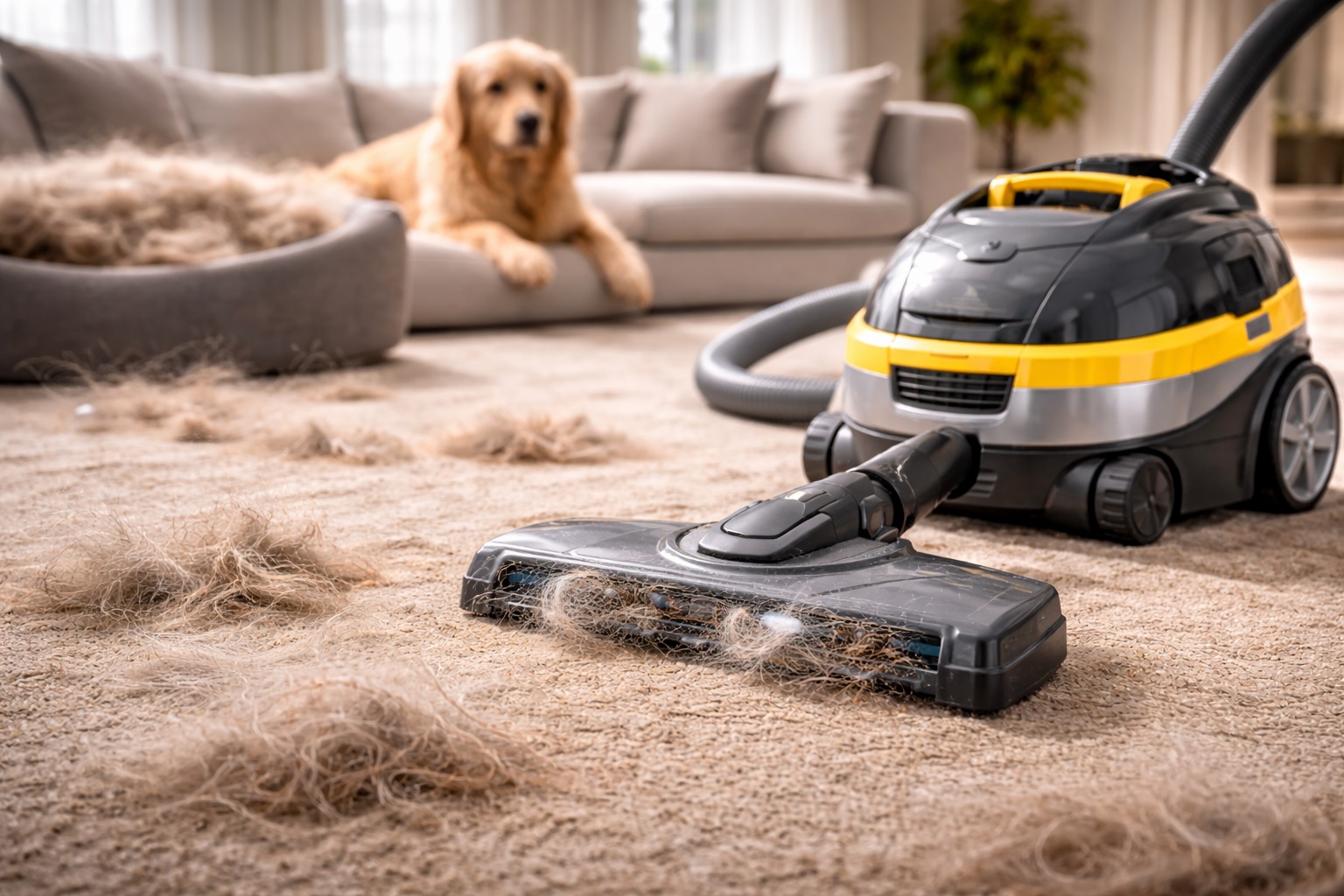
When Cleaning Becomes a Routine—but the Problem Stays
For pet owners, vacuuming often becomes a daily ritual. Floors are cleaned every day, sofas are brushed repeatedly, and yet pet hair keeps returning—on carpets, furniture, and even in the air.
This leads to a common frustration:
“If I vacuum every day, why does the hair never disappear?”
The answer is not effort. It lies in how pet hair behaves, how airflow interacts with fibers, and why many vacuum systems are not designed for high-frequency biological debris.
This article explains why daily vacuuming often fails in pet households and what system-level solutions actually work.
🧠 Pet Hair Is Not Dust—It Behaves Differently
Most vacuum systems are optimized for fine dust or loose debris. Pet hair introduces a different challenge.
Static Charge and Fiber Entanglement
Pet hair:
Carries static electricity
Wraps around carpet and fabric fibers
Clings to upholstery and corners
Instead of lifting cleanly, hair resists airflow and reattaches easily.
Continuous Shedding Cycle
Unlike dust, pet hair is constantly generated. Daily vacuuming removes surface hair, but without proper containment and airflow control, hair quickly redistributes.
Key Insight:
If removal speed is slower than shedding speed, daily cleaning still falls behind.
🧹 Why Standard Vacuums Fail in Pet Households
Failure is usually systemic, not mechanical.
Suction Without Separation
Many vacuums lift pet hair but fail to separate it efficiently from airflow. Hair accumulates at the intake, clogs pathways, or wraps around internal components.
This reduces performance rapidly—sometimes within minutes of use.
Inadequate Filtration
Without proper sealing and filtration, fine dander and hair fragments re-enter the room. This makes surfaces look clean while air quality worsens.
🧹 Multi-Functional Durable Vacuum Cleaner: Built for Repetition
Pet households require machines designed for frequent use.
A multi-functional durable vacuum cleaner supports:
Daily operation without performance drop
Mixed surfaces (floors, carpets, furniture)
Higher resistance to hair-induced wear
Durability matters because pet hair accelerates internal stress in lightweight consumer machines.
⚡ Energy-Saving Efficient Powerful Vacuum Cleaner: Consistency Beats Peaks
Pet hair removal benefits from stable performance, not short bursts of power.
An energy-saving efficient powerful vacuum cleaner provides:
This enables frequent cleaning without performance degradation.
🔄 Portable Self-Cleaning Vacuum Cleaner: Solving the Hair Wrap Problem
One of the biggest pain points in pet households is manual hair removal from brushes and filters.
A portable self-cleaning vacuum cleaner reduces:
Brush roll hair wrapping
Filter clogging
Maintenance downtime
Self-cleaning mechanisms are not conveniences—they are performance stabilizers in high-hair environments.
🧪 HEPA Filter Vacuum Cleaner: Hair Is Visible, Dander Is Not
Pet hair is only part of the problem.
A HEPA filter vacuum cleaner captures:
Without HEPA-level containment, daily vacuuming can spread allergens even as hair is removed.
💧 Wet and Dry Vacuum Cleaner: When Hair Meets Spills
Pet environments are rarely dry-only.
A wet and dry vacuum cleaner handles:
This eliminates the need for multiple tools and prevents hair from binding with moisture on surfaces.
🧪 Case Snapshot: Daily Cleaning, Different Results
In a multi-pet household, daily vacuuming with a standard vacuum reduced visible hair but required frequent brush cleaning and filter maintenance. Airborne allergens remained noticeable.
After switching to a multi-functional wet and dry vacuum cleaner with self-cleaning features and HEPA filtration, cleaning frequency stayed the same—but results improved. Hair buildup decreased, maintenance time dropped, and indoor air quality complaints disappeared.
The difference was not effort, but system suitability for pet environments.
⚙️ What Actually Works for Pet Hair Control
Effective pet hair management systems share five traits:
Multi-functional durable vacuum cleaner design
Energy-saving efficient powerful motor for daily use
Self-cleaning mechanisms to prevent clogging
HEPA filtration for dander containment
Wet and dry vacuum cleaner capability for mixed messes
This approach removes hair and reduces recurrence.
📌 A Strategic Message for Buyers and Product Teams
Pet owners are not lazy—they are underserved.
For distributors, OEM partners, and product managers, the opportunity lies in designing systems that match high-frequency, high-resistance cleaning environments, not occasional use cases.
Daily vacuuming fails when systems are not built for daily reality.
Hashtags
Pet Hair Cleaning Solutions, Daily Vacuuming Problems, Multi-Functional Durable Vacuum Cleaner, Energy-Saving Efficient Powerful Vacuum Cleaner, Portable Self-Cleaning Vacuum Cleaner, HEPA Filter Vacuum Cleaner, Wet and Dry Vacuum Cleaner, Pet Household Cleaning, Pet Hair Removal Technology, High Frequency Cleaning Environments, Self-Cleaning Vacuum Systems, Hair Wrap Prevention, Pet Dander Control, Indoor Air Quality for Pet Homes, Allergy Friendly Cleaning, Residential Cleaning Technology, Carpet and Upholstery Cleaning, Mixed Surface Pet Cleaning, Durable Cleaning Equipment, Vacuum Filtration Systems, Fine Particle Containment, Vacuum Airflow Design, Home Cleaning Performance, User Experience Driven Cleaning, B2B Cleaning Equipment, Vacuum Cleaner R&D, OEM Vacuum Solutions, Cleaning Equipment Innovation, Sustainable Cleaning Equipment, Energy Efficient Home Cleaning, Daily Use Vacuum Systems, Pet Friendly Home Care, Cleaning Workflow Optimization, Hair and Allergen Management, Modern Home Cleaning Systems, Residential Cleaning Trends, Cleaning Industry Insights, Practical Cleaning System Design, Global Pet Care Market, Home Hygiene Solutions, Engineering Driven Cleaning, Lanxstar