Hi, message us with any questions.
We're happy to help!





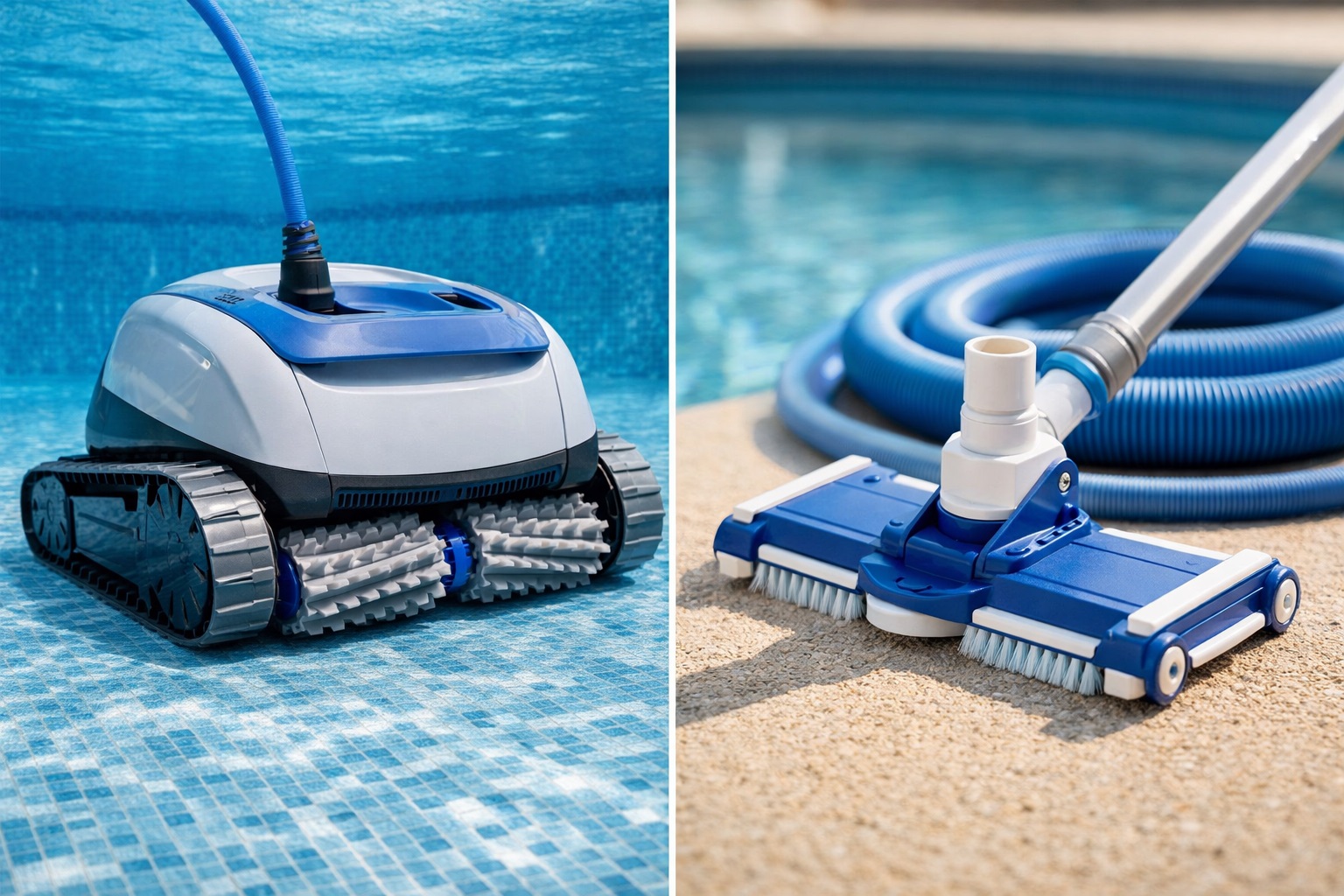
A Strategic Perspective for B2B Vacuum Cleaner Buyers
For many European and Middle Eastern B2B vacuum cleaner buyers, the debate between automatic and manual pool vacuums is often simplified into one question: Which option costs less upfront?
However, experienced distributors, procurement managers, and cleaning industry entrepreneurs understand that purchase price rarely reflects the real cost. Long-term operational efficiency, labor dependency, maintenance complexity, and regulatory compliance often outweigh the initial investment.
This article provides a long-term cost comparison based on real procurement logic, supported by industry-based decision scenarios, and explains why an increasing number of B2B buyers are shifting toward wet and dry vacuum cleaner solutions as a more sustainable alternative.
🔍 1. Redefining “Cost” in B2B Cleaning Equipment Procurement
In B2B purchasing, cost is not a number—it is a system.
A realistic long-term cost evaluation must include:
Initial equipment investment
Labor hours per cleaning cycle
Energy consumption over years
Maintenance frequency and spare parts
Downtime and operational disruption
Regulatory and air-quality compliance
Cross-scenario usability
Ignoring these variables is the fastest way to underestimate total cost by 30–50%.
⚙️ 2. Manual Pool Vacuums: Low Entry Cost, High Long-Term Exposure
Manual pool vacuums remain common due to their simplicity and low purchase price. For small private pools, this may be sufficient.
But in commercial environments, manual systems introduce structural inefficiencies.
Long-Term Cost Drivers:
Heavy dependence on skilled labor
Inconsistent cleaning outcomes
Single-use functionality
Physical fatigue leading to higher staff turnover
📍 Procurement Scenario: Southern Europe Facility Operator
A facility management company in Southern Europe, responsible for multiple residential and hotel pools, initially relied on manual pool vacuums to minimize capital expenditure.
Key challenges emerged within two seasons:
Labor hours increased significantly during peak months
Cleaning quality varied across sites
Equipment could not be redeployed for surrounding facility cleaning
The company realized that manual equipment was not cheaper—it was simply shifting cost into labor and inefficiency.
🤖 3. Automatic Pool Vacuums: Efficiency with Structural Trade-Offs
Automatic pool vacuums reduce manual effort and provide consistent cleaning cycles. For many operators, this seems like a logical upgrade.
Advantages:
Reduced labor involvement
Predictable performance
Lower daily operational supervision
However, automatic systems often introduce new cost variables:
Complex electronic components in humid environments
Proprietary spare parts
Limited use outside pool cleaning
In many commercial settings, these systems remain single-purpose assets, which restricts return on investment.
🔄 4. The Strategic Shift: Wet and Dry Vacuum Cleaner as a Multi-Scenario Asset
Instead of choosing between manual or automatic pool vacuums, advanced buyers are reframing the decision:
How many cleaning problems can one machine solve over its lifetime?
A wet and dry vacuum cleaner designed for commercial use can handle:
Poolside debris and water extraction
Changing rooms and shower areas
Technical rooms and basements
Emergency water removal
This transforms cleaning equipment from a task-specific expense into a multi-functional operational asset.
🚀 5. Why High Suction Performance Changes the Cost Equation
Automation alone does not guarantee efficiency.
In real-world environments, cleaning speed and effectiveness depend on suction performance, not marketing labels.
A High Suction Vacuum Cleaner allows:
Faster debris removal
Fewer repeated cleaning passes
Stable performance under wet conditions
When combined with an Energy-Saving Efficient Powerful Vacuum Cleaner motor design, high suction does not translate into higher energy costs—an essential factor for large facilities and long-term operations.
🌱 6. Energy Efficiency as Distributor-Level Risk Control
Energy efficiency is no longer only an end-user concern—it directly impacts distributors and importers.
An Energy-Saving Efficient Powerful Vacuum Cleaner helps reduce:
Energy-related customer complaints
Regulatory friction in EU markets
Long-term warranty exposure
📍 Distributor Scenario: Middle East Market
A Middle Eastern distributor previously offered separate SKUs for:
Pool vacuums
Facility cleaners
Emergency water extraction units
This resulted in:
Higher inventory pressure
Complex after-sales service
Slower product rotation
By consolidating into Multi-Functional Durable Vacuum Cleaner platforms, the distributor reduced SKU complexity and improved repeat purchase behavior—without increasing capital risk.
🧪 7. HEPA Filtration: A Quiet but Critical Compliance Factor
In Europe and parts of the Middle East, air quality standards increasingly affect procurement decisions.
A Wet and Dry Vacuum Cleaner with HEPA Filter provides:
Improved indoor air quality
Compliance with public facility regulations
Safer operation in hotels, hospitals, and commercial pools
📍 Engineering Insight Scenario
From a product engineering perspective, combining wet/dry architecture with HEPA filtration reduces internal contamination and motor stress—extending operational lifespan compared to traditional pool-only machines.
This technical advantage is rarely highlighted in marketing materials but strongly influences long-term maintenance cost.
📊 8. Simplified 5-Year Cost Comparison Model
| Cost Factor | Manual Pool Vacuum | Automatic Pool Vacuum | Wet & Dry Vacuum Cleaner |
|---|---|---|---|
| Initial Cost | Low | High | Medium |
| Labor Cost | High | Low | Medium–Low |
| Energy Consumption | Medium | Medium–High | Low |
| Maintenance | Low | High | Medium |
| Use Scenarios | Single | Single | Multiple |
| Asset Utilization | Low | Medium | High |
Key Insight:
Over a 5-year period, multi-functional systems consistently deliver the lowest cost per cleaning task.
🧩 9. The Strategic Insight Most Buyers Overlook
Top-performing procurement teams do not optimize for:
One product
One task
One department
They optimize for:
Asset utilization rate
Cross-scenario flexibility
Predictable maintenance
Reduced operational risk
This is why many experienced buyers eventually replace both manual and automatic pool vacuums with commercial-grade wet and dry vacuum cleaner systems.
🎯 10. Final Recommendation for B2B Buyers
If you are:
A distributor building a scalable product portfolio
A facility manager operating across multiple sites
A procurement team under long-term cost pressure
Then the real decision is not automatic vs manual.
The real question is:
How much value can one machine generate over its entire lifecycle?
📌 Suitable Audience
European & Middle Eastern B2B vacuum cleaner buyers
Commercial cleaning equipment distributors
Facility management procurement teams
Cleaning industry entrepreneurs
📌 Hashtags
wet and dry vacuum cleaner, High Suction Vacuum Cleaner, Energy-Saving Efficient Powerful Vacuum Cleaner, Multi-Functional Durable Vacuum Cleaner, HEPA Filter Vacuum Cleaner, commercial vacuum cleaner, industrial cleaning equipment, B2B vacuum cleaner, professional cleaning solutions, pool cleaning equipment, facility management tools, hotel cleaning systems, energy efficient vacuum, heavy duty vacuum cleaner, wet dry industrial vacuum, European cleaning market, Middle East cleaning industry, commercial suction equipment, large area cleaning, professional facility cleaning, vacuum cleaner distributor, vacuum cleaner importer, OEM vacuum cleaner, private label vacuum cleaner, cleaning equipment wholesale, commercial janitorial equipment, industrial hygiene solutions, smart cleaning systems, long lifespan vacuum cleaner, low maintenance vacuum, cost effective cleaning equipment, total cost of ownership cleaning, sustainable cleaning solutions, green cleaning equipment, regulatory compliant vacuum, HEPA industrial cleaning, air quality compliant vacuum, commercial debris removal, water extraction vacuum, multi scenario cleaning, durable cleaning machines, professional vacuum systems, industrial vacuum technology, cleaning equipment ROI, B2B procurement cleaning, facility cleaning optimization, Lanxstar