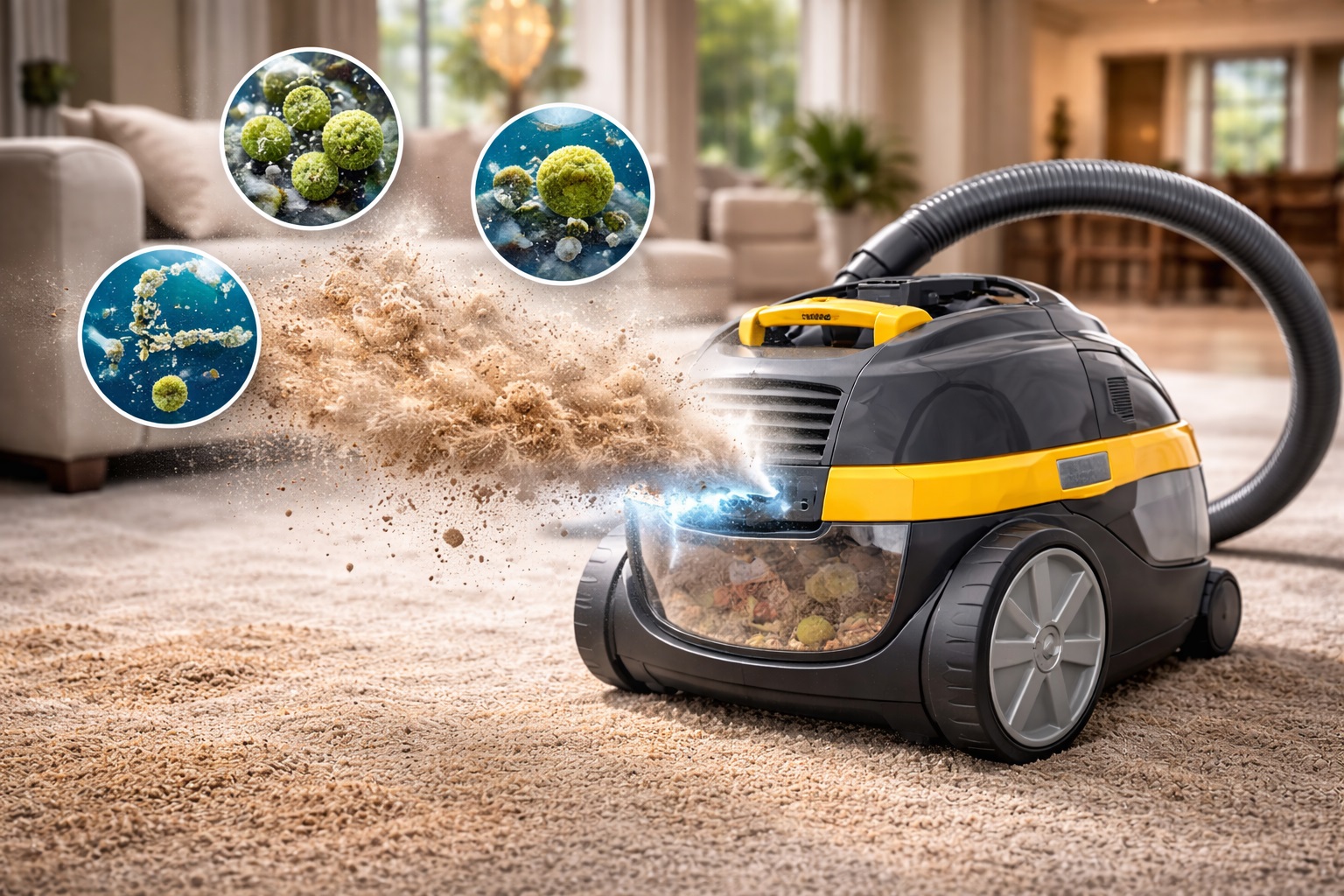
When Cleaning Power Creates a New Problem
Many buyers judge a vacuum cleaner by one metric alone: suction power. In showrooms and product sheets, stronger suction is often presented as a guarantee of better cleaning. Yet in real-world use—especially in apartments, large homes, and mixed environments—this assumption frequently backfires.
Users report a familiar contradiction:
floors look clean, but indoor air feels worse.
This article explains why strong suction does not always equal clean air, the most common mistakes made with canister vacuum systems, and how to design cleaning setups that remove debris without reintroducing contamination.
🧠 Mistake #1: Treating High Suction as the Only Performance Metric
A high suction vacuum cleaner is only as effective as the system supporting it.
The Turbulence Problem
When suction increases without airflow control:
Fine dust becomes airborne
Exhaust carries particles back into the room
Cleaning appears effective but air quality declines
This is why some users experience dust smell, irritation, or visible haze after cleaning.
Key Insight:
Uncontrolled suction removes dirt from surfaces—but redistributes it into the air.
🧹 Mistake #2: Ignoring Exhaust Air and Filtration Quality
Many canister vacuums focus engineering effort on intake performance, while treating exhaust as an afterthought.
Without proper sealing and filtration:
Microscopic dust bypasses filters
Airflow leaks around filter housings
Fine particles re-enter living spaces
This issue becomes critical in apartment vacuum cleaner scenarios, where air volume is limited and contamination accumulates quickly.
🏢 Why Apartments Expose These Mistakes Faster
Apartments amplify vacuum design flaws.
Compared to large homes, apartments have:
As a result, dirty exhaust air becomes noticeable much faster, even when surfaces look clean.
🔌 Mistake #3: Misusing Cordless Handheld Vacuum Cleaner Units
A cordless handheld vacuum cleaner is designed for convenience, not containment.
Common misuse includes:
Full-room cleaning instead of spot work
Extended operation beyond design limits
Expecting HEPA-level filtration from compact systems
Handheld units often lack sufficient sealing and filtration depth, allowing fine dust to escape during use.
⚡ Fast Lightweight Vacuum Cleaner: Speed Without Control
A fast lightweight vacuum cleaner improves maneuverability, but speed creates risk when airflow is poorly managed.
At high speed:
Lightweight systems must balance speed with airflow stability, or they trade surface cleanliness for airborne contamination.
💧 Wet Dry Vacuum Cleaners: Power Must Be Contained
Wet dry vacuum cleaners are often chosen for their versatility, but mistakes still occur.
Common issues include:
Using dry filters in wet environments
Overfilling tanks and disrupting airflow
Skipping maintenance that ensures sealing integrity
When properly configured, wet dry systems offer superior containment. When misused, they amplify air quality problems.
🧪 Case Snapshot: Clean Floors, Worse Air
In a compact apartment using a high suction canister vacuum, occupants reported increased dust smell after cleaning despite visibly clean floors.
Inspection revealed inadequate exhaust filtration and minor air leaks around the filter housing. After switching to a properly sealed wet dry vacuum cleaner configuration and adjusting suction to stable airflow levels, airborne dust complaints disappeared—even though suction power was reduced.
The improvement came from air management, not higher power.
⚙️ What a Clean-Air Canister Vacuum System Looks Like
Effective canister vacuum systems share five characteristics:
High suction vacuum cleaner paired with controlled airflow
Fully sealed filtration path from intake to exhaust
Proper filter selection and maintenance
Lightweight or cordless units used only for spot tasks
Wet dry vacuum cleaners configured correctly for environment
This approach cleans surfaces and protects indoor air quality.
📌 A Strategic Message for Buyers and Distributors
Dirty air after cleaning is not a user error—it is a system design and usage problem.
For distributors, OEM partners, and decision-makers, the opportunity lies in educating buyers beyond suction numbers and delivering systems that balance power, containment, and real-world usage.
Clean floors mean little if the air becomes the next problem.
Hashtags
High Suction Vacuum Cleaner, Canister Vacuum Mistakes, Indoor Air Quality Cleaning, Cordless Handheld Vacuum Cleaner, Fast Lightweight Vacuum Cleaner, Apartment Vacuum Cleaner, Wet Dry Vacuum Cleaners, Vacuum Filtration Systems, Airflow Control Design, Dust Redistribution Issues, Exhaust Air Containment, Sealed Filtration Path, Fine Dust Control, Apartment Cleaning Solutions, Compact Space Cleaning, Residential Cleaning Technology, Quiet Cleaning Systems, High Frequency Cleaning Environments, Vacuum System Engineering, Product Design Engineering, B2B Cleaning Equipment, Professional Cleaning Systems, Cleaning Equipment Optimization, Vacuum Performance Optimization, Sustainable Cleaning Equipment, Energy Efficient Cleaning Systems, User Experience Driven Cleaning, Cleaning Industry Insights, OEM Vacuum Solutions, Vacuum Cleaner R&D, Indoor Environment Health, Dust and Allergen Management, Filtration Technology Innovation, Cleaning Equipment Innovation, Global Cleaning Market, Practical Vacuum Usage, Home Cleaning Best Practices, Apartment Living Solutions, Engineering Driven Cleaning, Vacuum Buyer Education, Healthy Indoor Spaces, Lanxstar











