Hi, message us with any questions.
We're happy to help!





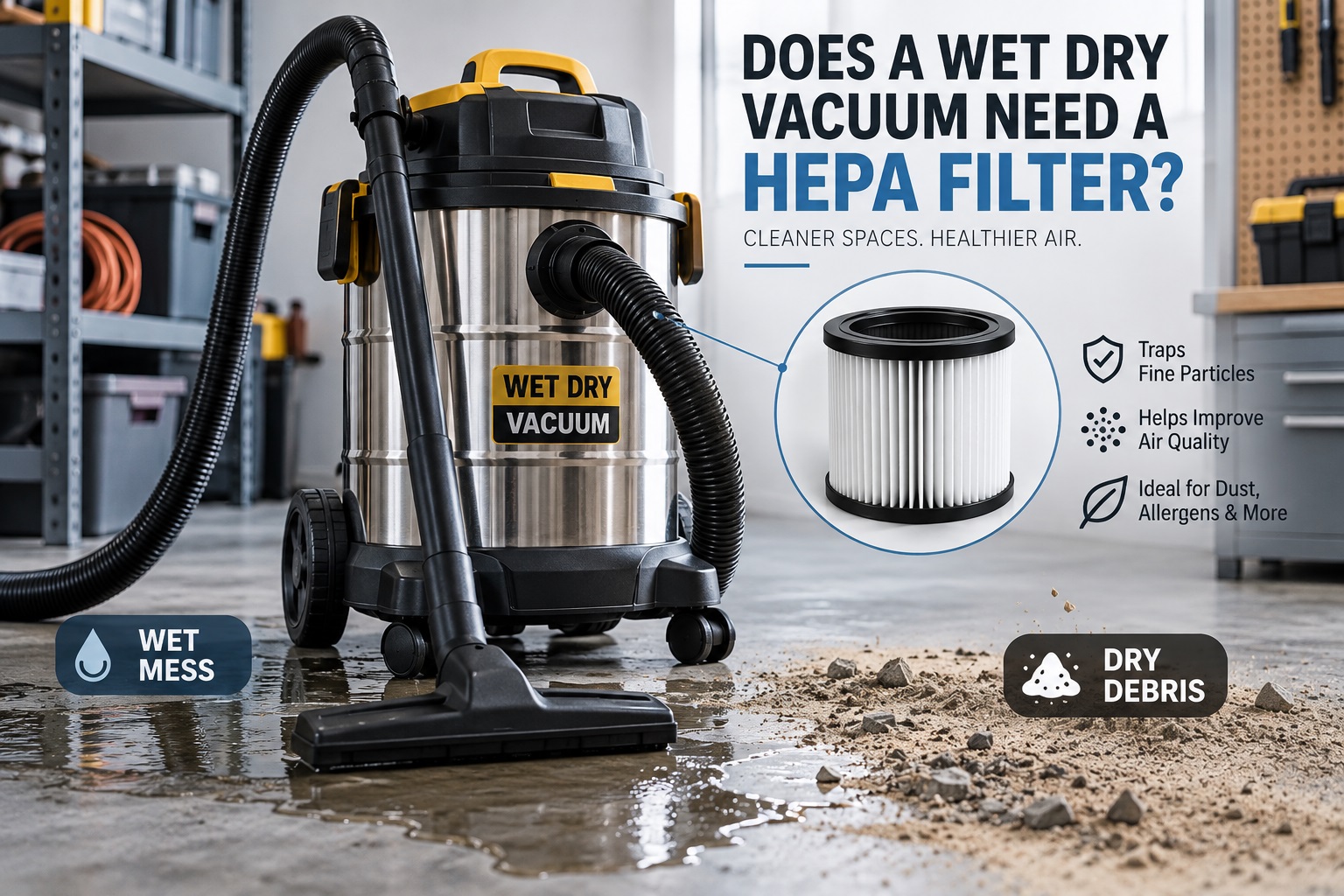
Does a Wet Dry Vacuum Really Need a HEPA Filter?
A wet dry vacuum cleaner is designed for versatility. Depending on its configuration, it can handle dry dirt, dust, debris, and liquid spills, making it useful in warehouses, workshops, hotels, construction environments, vehicle-detailing businesses, factories, and many other commercial locations.
But one question frequently arises when professional buyers compare machines:
Does a wet dry vacuum need a HEPA filter?
The short answer is: not always.
A HEPA filter can be highly useful when fine-particle filtration is important, but it is not automatically necessary for every wet and dry cleaning task. A vacuum collecting coarse workshop debris has very different requirements from equipment used around fine airborne dust.
For importers, wholesalers, facility managers, and product engineers, the better question is therefore:
What will the vacuum collect, where will it operate, and what filtration performance does that application require?
Answering those questions helps determine whether a HEPA filter vacuum cleaner is appropriate or whether another filtration configuration can provide a more practical balance of airflow, maintenance, cost, and durability. 🔍
1. Understanding How a Wet Dry Vacuum Works
A wet and dry vacuum cleaner is engineered to collect both dry material and liquids when operated according to its intended configuration.
Compared with an ordinary household vacuum, commercial wet dry machines often feature larger tanks, more robust housings, powerful motors, specialized hoses, casters, drainage systems, and accessories designed for demanding cleaning environments.
A Large-Capacity Wet Dry Vacuum Cleaner, for example, may be used to remove floor debris in a logistics center and later handle an appropriate liquid spill.
The filtration requirements can change between these tasks.
During dry pickup, incoming air can contain dust and fine particles. The filtration system separates those particles from the exhaust airflow.
During wet pickup, however, the vacuum must manage liquid safely according to the machine's design. Many machines use different filter arrangements or operating procedures for wet and dry collection.
💡 Important: Operators should always follow the manufacturer's instructions regarding filter installation or removal during wet pickup. A filter designed for dry dust should not automatically be assumed suitable for liquid collection.
This distinction is particularly important for commercial fleets, where different employees may use the same equipment.
2. What Does a HEPA Filter Actually Do?
HEPA stands for High-Efficiency Particulate Air.
HEPA filtration is intended to capture very small particles from an air stream at a defined filtration performance. However, professional buyers should distinguish a genuine HEPA specification from broad marketing expressions such as “HEPA-type,” “HEPA-style,” or simply “high-efficiency.”
If HEPA performance is important to a project, ask the vacuum cleaner manufacturer or supplier for the actual filter specification and relevant supporting documentation.
It is also important to distinguish the filter from the complete vacuum system.
A high-efficiency filter provides limited benefit if significant amounts of air can bypass it through poorly sealed joints or housing gaps. Effective filtration therefore depends on the filter, seals, airflow path, filter mounting structure, and overall machine design.
For an OEM or engineering project, filtration should be treated as a system-level design requirement rather than simply adding a different filter element to an existing machine. ⚙️
3. When Does a Wet Dry Vacuum Benefit From HEPA Filtration?
There are several situations in which HEPA filtration can be valuable.
Fine Dust Collection
If the vacuum is regularly used for fine dry particulate matter, higher-efficiency filtration may reduce the amount of captured material returning through the exhaust airflow.
This can be relevant in workshops, certain renovation environments, commercial facilities, and other locations where fine dust is a significant concern.
However, some fine or hazardous dust applications require purpose-designed industrial dust extractor equipment rather than a general-purpose wet dry vacuum.
HEPA should never be treated as a substitute for determining the nature of the material being collected.
Indoor Commercial Cleaning
A commercial vacuum cleaner operating in occupied indoor environments may benefit from finer filtration.
Hotels, offices, retail stores, meeting facilities, and similar spaces often require equipment that balances cleaning performance with noise control and indoor operating comfort.
In these applications, buyers might combine HEPA filtration with a Portable Quiet Vacuum Cleaner or low noise vacuum cleaner design.
Facility Management
Facility management companies often clean multiple environments with different dust loads.
A versatile commercial grade vacuum cleaner with suitable filtration can provide more flexibility across office areas, storage rooms, entrances, maintenance areas, and other spaces.
Sensitive Applications
Certain projects may specify particular filtration requirements because of internal facility procedures, customer contracts, or applicable standards.
In those cases, buyers should define the required performance before purchasing rather than assuming any product carrying a HEPA label will meet the project's needs.
4. When Might a Standard Filter Be Enough?
A HEPA filter is not always the most practical configuration.
Imagine a warehouse where a vacuum primarily collects pieces of packaging, dirt tracked in from loading areas, small fragments, and occasional liquid spills.
The purchasing priorities may be:
Strong suction
Large tank capacity
Durable wheels
Long power cable
Convenient drainage
Easy filter maintenance
Robust hose and accessories
Reliable motor life
For this application, a standard cartridge or other appropriate filtration system may be sufficient if specialized fine-particle filtration is not required.
The same principle can apply to certain workshop, garage, vehicle-cleaning, and general maintenance applications.
A High Suction Vacuum Cleaner or heavy duty vacuum cleaner with a suitable conventional filter may deliver excellent practical performance without the additional cost associated with HEPA filtration.
The correct decision depends on the actual debris—not on which specification sounds more advanced.
5. What Happens to HEPA Filters During Wet Pickup?
This is one of the most important questions for wet dry vacuum users.
A HEPA filter intended for dry filtration generally should not be assumed to operate normally when exposed to water.
Depending on filter construction, moisture may restrict airflow, damage filter media, reduce filtration performance, or create maintenance problems.
Different wet and dry suction system designs manage liquid pickup in different ways. Some machines require a dry filter to be removed before wet operation. Others may use a dedicated foam filter, separate wet filter, protective arrangement, or another manufacturer-specified configuration.
For commercial buyers, this creates a practical training issue.
If workers frequently switch between wet and dry tasks, the machine should have a filter-changing process that is easy to understand and perform correctly.
Clear labels, straightforward filter access, and simple operating instructions can be particularly valuable for large cleaning teams. 💧
6. HEPA Filtration and Suction Power
A common concern is whether HEPA filtration reduces suction.
Any filter creates some airflow resistance, and finer filtration can potentially create more resistance than a more open filter structure.
However, the final performance depends on the entire vacuum design.
A properly engineered high suction power vacuum cleaner can maintain strong cleaning performance while using fine filtration when the motor, impeller, filter area, air channels, seals, and exhaust system are designed together.
Filter loading also matters.
As dust accumulates, airflow can decline. This means a vacuum that performs strongly with a clean filter may behave differently after prolonged use.
Professional buyers should therefore evaluate more than nominal wattage.
For commercial applications, consider:
Airflow: How effectively does air move through the complete machine?
Vacuum pressure: Is suction suitable for the intended debris?
Filter area: Is there sufficient filtration surface for the expected dust load?
Maintenance: How easily can operators clean or replace the filter?
Filter availability: Can replacement elements be purchased consistently throughout the machine's service life?
These factors often provide more useful information than a single motor-power number.
7. Case Study: Construction Site Cleaning
Consider a hypothetical building contractor purchasing several machines for renovation projects.
The equipment must collect sawdust, floor dirt, packaging debris, small construction fragments, and occasional water from suitable cleanup tasks.
The contractor initially considers purchasing the same HEPA-equipped model for every job because HEPA appears to be the premium option.
After analyzing the actual cleaning tasks, the procurement team divides the requirements.
For coarse debris and general wet pickup, it chooses a durable wet dry vacuum cleaner for construction site applications with a large tank and easy-maintenance filtration.
For areas where substantial fine dust must be controlled, the company evaluates dedicated equipment with an appropriate fine-dust filtration system.
This prevents the contractor from paying for unnecessary features on every unit while still providing more suitable equipment for dust-intensive work.
It also reduces the risk of operators using a dry HEPA element incorrectly during wet collection.
🏗️ Procurement lesson: Different cleaning hazards and materials may require different vacuum configurations even on the same construction project.
8. Case Study: Warehouse and Logistics Cleaning
Now consider a large logistics company.
Its warehouse operates around the clock and generates packaging dust, cardboard fibers, pallet debris, dirt from loading docks, and occasional liquid spills.
The company needs a reliable industrial wet and dry vacuum cleaner for warehouse cleaning supplier capable of supporting daily operations.
For the main warehouse floor, the purchasing team prioritizes:
large tank capacity, durable construction, strong suction, mobility, convenient drainage, and simple maintenance.
A stainless steel vacuum tank may be attractive where durability and easy cleaning are important.
In administrative offices connected to the warehouse, however, the requirements are different. Smaller debris, indoor dust, operator comfort, and noise become more important.
The company therefore uses a compact HEPA-equipped commercial model for offices and a larger industrial wet dry machine for warehouse areas.
This mixed-equipment strategy provides a better match between filtration and actual cleaning conditions. 📦
9. HEPA Considerations for Hotels and Commercial Facilities
Hotels present another useful example because a single property may require several different vacuum types.
Guest rooms and corridors can benefit from compact, maneuverable equipment with lower operating noise and effective fine-particle filtration.
A commercial vacuum cleaner for hotel use may therefore be configured differently from a machine used by the hotel's engineering department.
Maintenance teams may need wet dry equipment for entrances, utility areas, renovation work, basement spaces, or appropriate spill collection.
Instead of asking whether every hotel vacuum “needs HEPA,” procurement managers can divide cleaning tasks by environment.
This approach can improve both performance and equipment utilization.
For hotel distributors, it also creates opportunities to offer several models instead of attempting to cover every cleaning scenario with one machine.
10. How HEPA Affects Wholesale Purchasing Costs
For wholesalers and importers, filter selection has commercial consequences beyond the original machine price.
Suppose a distributor is planning a bulk vacuum cleaner purchase of several hundred units.
Adding a HEPA configuration may affect:
Unit cost
Replacement filter cost
Packaging
Spare-parts inventory
Product positioning
End-user maintenance requirements
Target customer segment
This is why buyers comparing vacuum cleaner price wholesale quotations should ask what is actually included.
A lower machine price does not necessarily mean lower lifetime operating cost. Similarly, a higher-priced HEPA configuration does not automatically offer better value if the target customer's application does not require it.
For a distributor, the ideal product portfolio might include both standard-filter and HEPA-filter versions.
Customers can then choose based on their applications and budgets.
11. OEM and ODM Filter Configuration
Filter selection is particularly important for OEM vacuum cleaner, ODM vacuum cleaner, and private label vacuum cleaner projects.
A professional buyer should give the factory detailed application information before finalizing the specification.
For example:
Market: Europe, North America, Asia, Middle East, or another region.
Customer: Warehouse operator, hotel, cleaning contractor, retailer, workshop, or industrial user.
Material: General dirt, fine dry dust, liquids, vehicle debris, packaging waste, or other substances.
Operating time: Occasional use or several hours per day.
Tank requirement: Compact, medium-capacity, or large-capacity.
Noise target: Standard commercial operation or low-noise environment.
Filtration: Conventional filter, HEPA configuration, or application-specific filtration.
Branding: Lanxstar configuration, OEM branding, or private-label packaging.
An experienced OEM industrial vacuum cleaner manufacturer can then assess the relationship between filtration, airflow, motor configuration, tank size, accessories, and production cost.
This is much more effective than requesting a generic machine and changing the filter at the end of development.
12. Should Buyers Always Choose HEPA for Better Quality?
Not necessarily.
“Better quality” should mean better suited to the intended task—not simply more features.
A rugged industrial vacuum cleaner designed for heavy debris collection may be an excellent professional machine without requiring HEPA filtration for its intended use.
Likewise, a compact HEPA-equipped machine can be an excellent choice for a commercial indoor environment but unsuitable for collecting large volumes of workshop debris.
Buyers searching for the best industrial vacuum cleaner should therefore define what “best” means for their application.
Is the priority suction?
Filtration?
Tank capacity?
Noise?
Mobility?
Energy consumption?
Wet pickup?
Maintenance?
Price?
Durability?
Once those priorities are defined, filter selection becomes much easier.
13. What Should Vacuum Cleaner Engineers Consider?
For product R&D teams, filtration affects multiple parts of machine design.
A filter with higher resistance may require airflow optimization. A larger filtration area may require changes to tank or motor-head geometry. Filter replacement access can affect housing construction, while improved sealing may influence tooling and assembly processes.
Engineers may also need to consider how operators transition between wet and dry operation.
A Multi-Functional Durable Vacuum Cleaner should not only offer multiple functions—it should make those functions practical for real users.
Filter installation errors should be minimized wherever possible through clear design.
Other considerations can include motor cooling, float mechanisms, tank design, accessory storage, noise management, drainage, and the availability of replacement consumables.
For manufacturers, the best filtration solution is therefore a combination of engineering performance, manufacturability, cost, maintenance, and end-user behavior. 🧰
14. Questions to Ask an Industrial Vacuum Cleaner Supplier
Before ordering from an industrial vacuum cleaner supplier, buyers should clarify the filtration system in detail.
Ask what type of filter is supplied as standard and whether a genuine HEPA configuration is available.
Ask whether the dry filter must be removed during wet pickup.
Confirm replacement-filter pricing and expected availability.
Request relevant test information when specific filtration performance is required.
Ask how filtration affects airflow and suction performance.
For a dual motor vacuum cleaner, clarify how airflow and filtration have been designed for extended commercial use.
If you are working with a vacuum cleaner manufacturer in China, also discuss destination-market requirements, OEM branding, packaging, accessories, spare parts, production capacity, MOQ, and quality-control procedures before placing a large order.
These details can be particularly important for a vacuum cleaner distributor Europe or another importer managing long supply chains.
15. Standard Filter vs HEPA: Making the Purchasing Decision
For most buyers, the decision can be simplified into a few questions.
🔹 Are you mainly collecting coarse debris and liquids?
A suitable standard filtration configuration may be sufficient.
🔹 Are you collecting significant fine dry particles?
Consider higher-efficiency filtration and determine whether the application requires specialized dust-extraction equipment.
🔹 Will the vacuum operate in occupied indoor environments?
HEPA filtration may be a useful feature when fine-particle control is a priority.
🔹 Will users frequently switch between wet and dry pickup?
Evaluate how easily the filtration configuration can be changed and maintained.
🔹 Are there specific regulations or customer requirements?
Follow the applicable requirements rather than relying on general product labels.
🔹 Are you purchasing hundreds or thousands of units?
Calculate replacement-filter costs, spare-parts logistics, maintenance requirements, and target-market demand before finalizing the specification.
16. Choosing a Wet Dry Vacuum for Your Market
For global importers and distributors, there is no single configuration that fits every market.
A Fast Lightweight Vacuum Cleaner may suit mobile cleaning teams. A Large-Capacity Wet Dry Vacuum Cleaner can be more appropriate for warehouses and workshops. A Portable Quiet Vacuum Cleaner can address hospitality or occupied commercial spaces, while a heavy duty vacuum cleaner may be preferred for demanding industrial tasks.
Energy consumption can also influence procurement decisions. An energy efficient vacuum cleaner should balance power consumption with usable airflow, suction, and cleaning productivity rather than relying only on a wattage claim.
For buyers sourcing a factory direct vacuum cleaner, the objective should be to build the specification around the end customer's cleaning problem.
That principle applies equally to filtration.
Conclusion: Does Your Wet Dry Vacuum Need HEPA?
A wet dry vacuum does not automatically need a HEPA filter.
HEPA filtration can be valuable when fine dry particulate control is an important requirement, especially in suitable indoor commercial applications. Standard filtration may be a more practical and economical choice for many general-purpose wet and dry cleaning tasks involving coarse dirt, debris, and liquids.
The correct choice depends on the material being collected, operating environment, applicable requirements, airflow design, maintenance process, and total cost of ownership.
For importers, distributors, wholesalers, commercial cleaning companies, and R&D engineers, the most effective approach is to define the application first and choose filtration second.
Lanxstar works with commercial and industrial vacuum cleaner applications where filtration, suction, capacity, noise, accessories, and OEM/ODM configurations can be evaluated according to specific market requirements.
For commercial, wholesale, OEM, ODM, and industrial vacuum cleaner information, visit www.lxvacuum.com.
If you are interested, please feel free to contact us.
50 Related SEO Keywords:
High Suction Vacuum Cleaner, Portable Quiet Vacuum Cleaner, Multi-Functional Durable Vacuum Cleaner, Fast Lightweight Vacuum Cleaner, Energy-Saving Efficient Powerful Vacuum Cleaner, Large-Capacity Wet Dry Vacuum Cleaner, wet and dry vacuum cleaner, wet dry vacuum cleaner, industrial vacuum cleaner, commercial vacuum cleaner, industrial vacuum cleaner supplier, vacuum cleaner manufacturer, industrial cleaning equipment, commercial cleaning equipment, vacuum cleaner supplier, vacuum cleaner manufacturer in China, industrial vacuum cleaner factory, wholesale vacuum cleaner, bulk vacuum cleaner purchase, OEM vacuum cleaner, ODM vacuum cleaner, private label vacuum cleaner, cleaning equipment supplier, warehouse cleaning solution, construction site cleaning equipment, hotel cleaning equipment, hospital cleaning equipment, factory floor cleaning, logistics warehouse cleaning, car detailing vacuum cleaner, commercial cleaning service equipment, facility management cleaning equipment, HEPA filter vacuum cleaner, high suction power vacuum cleaner, heavy duty vacuum cleaner, dual motor vacuum cleaner, stainless steel vacuum tank, low noise vacuum cleaner, energy efficient vacuum cleaner, wet and dry suction system, industrial dust extractor, commercial grade vacuum cleaner, buy industrial vacuum cleaner, commercial vacuum cleaner for sale, factory direct vacuum cleaner, industrial wet and dry vacuum cleaner for warehouse cleaning supplier, wet dry vacuum cleaner for construction site, OEM industrial vacuum cleaner manufacturer, Lanxstar, vacuum cleaner maker



