Hi, message us with any questions.
We're happy to help!





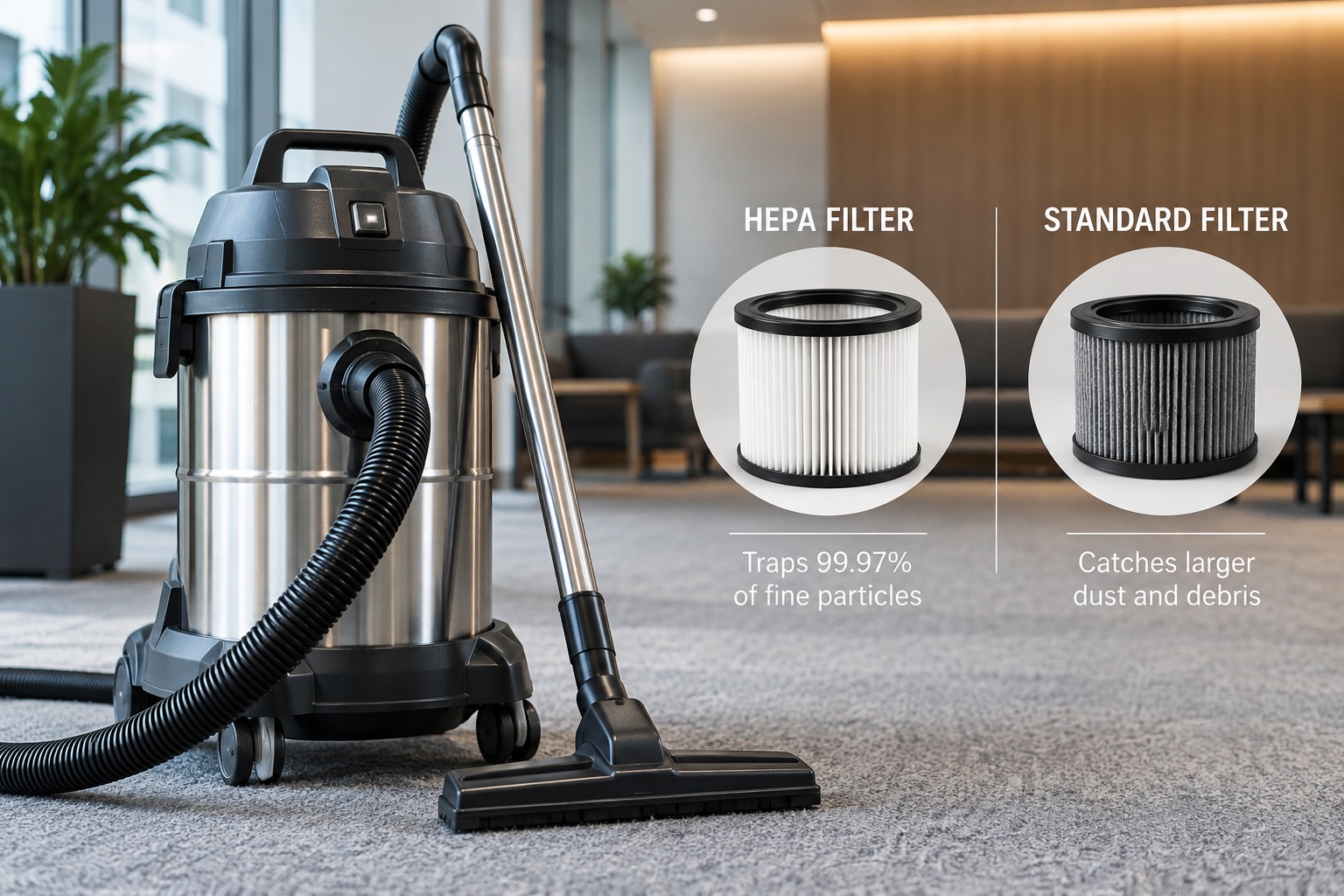
HEPA vs Standard Filters: Why the Difference Matters
When sourcing a commercial vacuum cleaner, buyers often focus first on suction power, motor wattage, tank capacity, noise level, and price. Filtration, however, can have an equally important impact on the actual cleaning experience.
A vacuum cleaner does more than collect visible debris. Air drawn into the machine must eventually leave it again. The filtration system determines how much of the captured fine particulate matter remains inside the vacuum instead of being carried back into the surrounding environment.
This is where the choice between a HEPA filter vacuum cleaner and a machine equipped with a conventional filter becomes important.
For a hotel buyer, filtration may influence guest-room cleaning requirements. For a warehouse operator, airflow and large-volume debris collection may receive greater priority. For a hospital or other controlled facility, fine-particle management can become a much more important purchasing consideration.
There is therefore no universal answer that says HEPA is automatically the correct filter for every commercial machine. Buyers should match the filtration system to the application, expected dust load, maintenance routine, and total operating cost. 🔍
1. What Is a Standard Vacuum Cleaner Filter?
“Standard filter” is a broad commercial term rather than a single filtration specification. Depending on the vacuum design, it may refer to a cloth filter, cartridge filter, foam filter, nonwoven filter, paper filter, or another conventional filtration component.
These filters are commonly found in general-purpose commercial cleaning equipment and industrial cleaning equipment.
Their main advantages often include straightforward construction, convenient maintenance, good airflow, and relatively economical replacement costs.
For applications involving larger particles and routine dirt—such as warehouse floors, workshops, retail premises, offices, or construction cleanup—a properly designed standard filtration system can provide an effective balance between performance and cost.
For example, a wet dry vacuum cleaner for construction site applications may regularly collect sawdust, sand, fragments, and general construction debris. Depending on the dust characteristics and applicable workplace requirements, a conventional cartridge or other suitable filter may provide the required performance without introducing unnecessary filtration resistance.
The important point is to evaluate the complete machine rather than assuming that the filter label alone determines vacuum quality.
2. What Makes a HEPA Filter Different?
HEPA stands for High-Efficiency Particulate Air. In practical vacuum-cleaner purchasing, HEPA filtration is generally selected when controlling finer airborne particles is an important part of the cleaning requirement.
A genuine HEPA system should not be confused with vague marketing descriptions such as “HEPA-style,” “HEPA-type,” or “high-efficiency filter.” Professional buyers should ask a vacuum cleaner manufacturer for the relevant filtration specification and supporting test information when a particular filtration classification is required.
The effectiveness of a HEPA-equipped vacuum also depends on the complete airflow path.
Even an efficient filter cannot deliver its intended system-level performance if unfiltered air can escape through poorly sealed housings, joints, or other leakage points. For this reason, experienced buyers and product engineers should evaluate filter efficiency together with sealing design, airflow management, motor performance, and machine construction.
A properly engineered HEPA filter vacuum cleaner can be particularly relevant for environments where fine dust control is a priority. 🛡️
3. Filtration Efficiency vs Airflow
One of the most important engineering considerations is the relationship between filtration and airflow.
Vacuum cleaners depend on airflow to transport dust and debris from the floor or work surface into the collection system. As filtration becomes finer, the filter can introduce additional resistance to airflow.
That does not mean a HEPA vacuum necessarily has weak suction. A well-designed high suction power vacuum cleaner can combine strong airflow with fine filtration when the motor, fan system, air channels, seals, and filter surface area have been engineered as a complete system.
Problems are more likely to occur when filtration is added without optimizing the rest of the machine.
As filters accumulate dust, resistance can increase further. This is why filter size, cleaning method, replacement intervals, and access for maintenance matter in professional equipment.
For procurement teams comparing machines, advertised motor wattage alone is therefore insufficient. Consider how the vacuum performs as the filter begins to load with dust during actual operation.
⚙️ Buyer Tip: Ask suppliers about airflow, suction performance, filter construction, filter replacement procedures, and recommended maintenance intervals—not only nominal motor power.
4. Where HEPA Filtration Can Be Valuable
HEPA filtration can be useful in commercial environments where controlling fine particulate matter is important.
Hotels and Hospitality
A commercial vacuum cleaner for hotel use may operate in guest rooms, corridors, meeting areas, and other indoor spaces every day. Buyers may prioritize filtration alongside low noise, portability, and operator comfort.
A Portable Quiet Vacuum Cleaner with an appropriate filtration system can be particularly useful where cleaning takes place near guests or occupied areas.
Healthcare and Controlled Facilities
For certain hospital cleaning equipment applications, filtration specifications may be part of broader cleaning and facility protocols.
However, purchasing teams should verify the specific standards and procedures applicable to their facility rather than assuming that the presence of a HEPA filter alone makes a vacuum appropriate for every healthcare environment.
Commercial Cleaning Contractors
Professional cleaning contractors often work across multiple customer sites. A commercial grade vacuum cleaner with higher-efficiency filtration can provide greater flexibility when contracts include offices, hotels, schools, retail facilities, and other environments where fine dust management matters.
Fine-Dust Applications
Some industrial environments generate significant quantities of fine particles. In these situations, an industrial dust extractor or specialized vacuum system may be more appropriate than a general-purpose commercial vacuum.
The dust itself should always be evaluated. Certain hazardous materials require dedicated equipment, certified systems, or specific handling procedures.
5. When a Standard Filter May Be the Practical Choice
Higher filtration is not automatically necessary for every cleaning task.
Warehouses, logistics centers, workshops, garages, and construction environments often generate large quantities of visible debris. In these situations, durability, tank volume, mobility, suction consistency, and convenient disposal may be higher priorities.
Consider a distribution warehouse where operators regularly collect packaging fragments, floor dirt, sand, and other coarse debris. A Large-Capacity Wet Dry Vacuum Cleaner with a durable standard filter may provide a practical solution when specialized fine-particle filtration is not required.
Similarly, a heavy duty vacuum cleaner used for general workshop cleanup may benefit from a simple filter system that operators can inspect, clean, and replace quickly.
For wet applications, filter configuration becomes especially important. A wet and dry suction system must be designed so that the machine can safely transition between appropriate wet and dry cleaning operations according to the manufacturer's instructions.
💧 This is why professional buyers should specify the actual material being collected rather than simply asking for the “best” filter.
6. Maintenance and Total Cost of Ownership
Initial purchase price tells only part of the story.
Filters are consumable components, and their replacement frequency can affect the lifetime operating cost of a large commercial fleet.
A distributor evaluating a bulk vacuum cleaner purchase, for example, should consider:
Replacement filter price and availability
Recommended filter service intervals
Ease of filter removal and installation
Washable versus disposable designs
Local availability of replacement parts
Labor required for routine maintenance
Performance as the filter accumulates dust
Packaging and logistics requirements for spare filters
HEPA filters may cost more than conventional filters, particularly when they require careful handling or more frequent replacement in demanding environments.
Standard filters may offer lower replacement costs, but the correct comparison depends on the application.
An inexpensive filter that clogs rapidly can increase downtime and labor costs. Conversely, installing a more expensive filtration system where it provides no operational benefit may unnecessarily increase the customer's total cost of ownership.
For wholesalers and distributors, stocking replacement filters is also an important after-sales consideration. 📦
7. Case Example: Warehouse Cleaning Equipment Selection
Consider a hypothetical logistics company operating a 20,000-square-meter warehouse.
The facility needs vacuum cleaners for loading zones, packaging areas, storage aisles, and administrative spaces.
In the main warehouse, cleaning teams frequently collect cardboard fibers, packaging fragments, sand, dust, and occasional liquid spills. Here, the purchasing team may prioritize a wet dry vacuum cleaner, robust wheels, a stainless steel vacuum tank, high capacity, and convenient drainage.
For the office area, however, the priorities change. Operators may prefer a lower-noise machine with finer filtration because cleaning occurs around desks, electronics, and employees.
Instead of forcing one configuration to serve every task, the buyer can divide the requirement into application groups.
A Multi-Functional Durable Vacuum Cleaner can cover general warehouse duties, while a smaller HEPA-equipped commercial model can serve indoor office areas.
This approach illustrates an important procurement principle: the right filtration specification should follow the cleaning environment rather than a one-size-fits-all purchasing policy.
8. Case Example: Hotel Distributor Comparing Product Lines
Imagine a distributor sourcing machines for hotel customers across several markets.
The customers want lightweight equipment, low operating noise, easy maneuverability, reliable spare parts, and competitive wholesale pricing.
For guest-room applications, the distributor might prioritize a low noise vacuum cleaner with effective fine-particle filtration. For maintenance departments, a larger wet and dry vacuum cleaner may be needed for utility rooms, entrances, renovation cleanup, and occasional liquid collection.
Instead of selecting products only according to motor power, the distributor asks its industrial vacuum cleaner supplier to provide filtration specifications, replacement filter costs, tank capacities, noise information, accessories, and packaging details.
The resulting product portfolio serves different hotel cleaning tasks more effectively while allowing the distributor to explain clear differences between models to its customers.
9. What OEM and ODM Buyers Should Ask Manufacturers
Filtration becomes even more important when developing an OEM vacuum cleaner, ODM vacuum cleaner, or private label vacuum cleaner.
International buyers should discuss the intended application early in product development.
Useful questions include:
What particles will the machine collect?
General dirt, fine dust, construction debris, liquids, workshop waste, and vehicle-interior debris can require different configurations.
What filtration level does the target market expect?
A professional buyer should communicate measurable requirements instead of simply requesting “better filtration.”
How does the filter affect airflow?
The manufacturer should evaluate the filtration system together with the motor and air path.
Can customers obtain replacement filters easily?
After-sales availability can directly affect distributor satisfaction and repeat business.
Can the filter configuration be customized?
An experienced OEM industrial vacuum cleaner manufacturer may be able to adjust filters, accessories, tanks, motors, packaging, branding, and other specifications according to project requirements.
For buyers looking to import vacuum cleaner from China, these discussions are particularly valuable before tooling, packaging, certification, and production schedules are finalized.
10. HEPA or Standard: A Practical Procurement Framework
Before placing a wholesale order, buyers can evaluate five areas.
Cleaning Environment 🏢
Identify whether the equipment will be used in hotels, warehouses, factories, retail spaces, vehicle-detailing businesses, offices, construction sites, or other facilities.
Material Being Collected 🧹
Define the expected debris. Large particles, general floor dirt, fine dust, liquids, and application-specific materials may require different solutions.
Filtration Requirement 🌬️
Determine whether fine-particle control is a major requirement and whether the project specifies a particular filtration standard.
Operating Conditions ⚡
Consider daily operating hours, tank capacity, motor configuration, mobility, noise, energy use, and maintenance frequency.
An Energy-Saving Efficient Powerful Vacuum Cleaner should be evaluated by actual system performance rather than power consumption alone.
Commercial Requirements 📊
For wholesalers and importers, evaluate MOQ, lead time, replacement parts, customization, packaging, certifications required for the destination market, and long-term supply capability.
A reliable vacuum cleaner supplier China relationship involves more than obtaining the lowest unit quotation.
11. What About Budget Commercial Vacuums?
Searches such as best vacuum on a budget, good budget vacuum, and best affordable vacuum show that cost remains important to many buyers and end users.
However, “budget” should be evaluated in terms of value rather than simply the lowest purchase price.
For commercial operations, a machine that costs slightly more but offers durable construction, readily available filters, appropriate suction performance, and easier maintenance may provide better long-term economics.
Wholesale buyers should therefore compare acquisition cost with replacement parts, expected operating life, serviceability, and the requirements of the end customer.
The best value for money hoover for a small retail shop may be completely different from the right machine for a warehouse or construction contractor.
12. Working With a Vacuum Cleaner Manufacturer
For importers and distributors, working directly with a capable vacuum cleaner manufacturer in China can make it easier to develop different filtration configurations for different market segments.
Lanxstar can discuss commercial and industrial vacuum cleaner requirements based on application, filtration, capacity, suction, noise expectations, accessories, and OEM/ODM requirements.
Rather than treating HEPA as a simple marketing upgrade, professional buyers should define what their customers actually need and then configure the machine accordingly.
This is especially relevant for distributors developing multiple SKUs. One product family might include a general-purpose standard-filter model, a HEPA-equipped version for more demanding indoor environments, and a Large-Capacity Wet Dry Vacuum Cleaner for heavy commercial applications.
Such segmentation can make a wholesale product range easier to position across different customer groups.
Conclusion
HEPA and standard filters each have a place in professional vacuum cleaning.
HEPA filtration can be valuable when finer particulate control is an important requirement, while conventional filtration can provide an efficient, economical solution for many general commercial and industrial cleaning tasks.
The right decision depends on the complete application: the type of debris, environment, airflow requirements, maintenance routine, replacement-filter cost, machine design, and applicable standards.
For global importers, wholesalers, retailers, facility managers, and product engineers, filtration should therefore be evaluated as part of the entire vacuum system—not as an isolated specification.
Whether you are sourcing a commercial vacuum cleaner, developing an OEM vacuum cleaner, evaluating an industrial vacuum cleaner factory, or planning a bulk order vacuum cleaner project, matching filtration technology to real operating conditions can lead to a more practical product and a stronger long-term purchasing decision. 🌍
For more information about commercial and industrial vacuum cleaner solutions, visit www.lxvacuum.com.
If you are interested, please feel free to contact us.
50 Related SEO Keywords:
High Suction Vacuum Cleaner, Portable Quiet Vacuum Cleaner, Multi-Functional Durable Vacuum Cleaner, Large-Capacity Wet Dry Vacuum Cleaner, wet and dry vacuum cleaner, wet dry vacuum cleaner, industrial vacuum cleaner, commercial vacuum cleaner, industrial vacuum cleaner supplier, vacuum cleaner manufacturer, industrial cleaning equipment, commercial cleaning equipment, vacuum cleaner supplier, vacuum cleaner manufacturer in China, industrial vacuum cleaner factory, wholesale vacuum cleaner, bulk vacuum cleaner purchase, OEM vacuum cleaner, ODM vacuum cleaner, private label vacuum cleaner, cleaning equipment supplier, industrial equipment supplier, warehouse cleaning solution, hotel cleaning equipment, hospital cleaning equipment, factory floor cleaning, logistics warehouse cleaning, car detailing vacuum cleaner, commercial cleaning service equipment, facility management cleaning equipment, retail cleaning equipment, HEPA filter vacuum cleaner, high suction power vacuum cleaner, heavy duty vacuum cleaner, dual motor vacuum cleaner, stainless steel vacuum tank, low noise vacuum cleaner, energy efficient vacuum cleaner, wet and dry suction system, industrial dust extractor, commercial grade vacuum cleaner, buy industrial vacuum cleaner, vacuum cleaner price wholesale, vacuum cleaner supplier China, commercial vacuum cleaner for sale, factory direct vacuum cleaner, heavy duty vacuum cleaner supplier China, OEM industrial vacuum cleaner manufacturer, Lanxstar, vacuum cleaner maker