Hi, message us with any questions.
We're happy to help!





、
Why Filtration Matters to Commercial Vacuum Performance
When purchasing a commercial vacuum cleaner, it is easy to focus on specifications that look impressive on a product sheet: motor wattage, tank capacity, suction power, number of motors, noise level, and accessories.
Filtration sometimes receives less attention.
That can be a mistake.
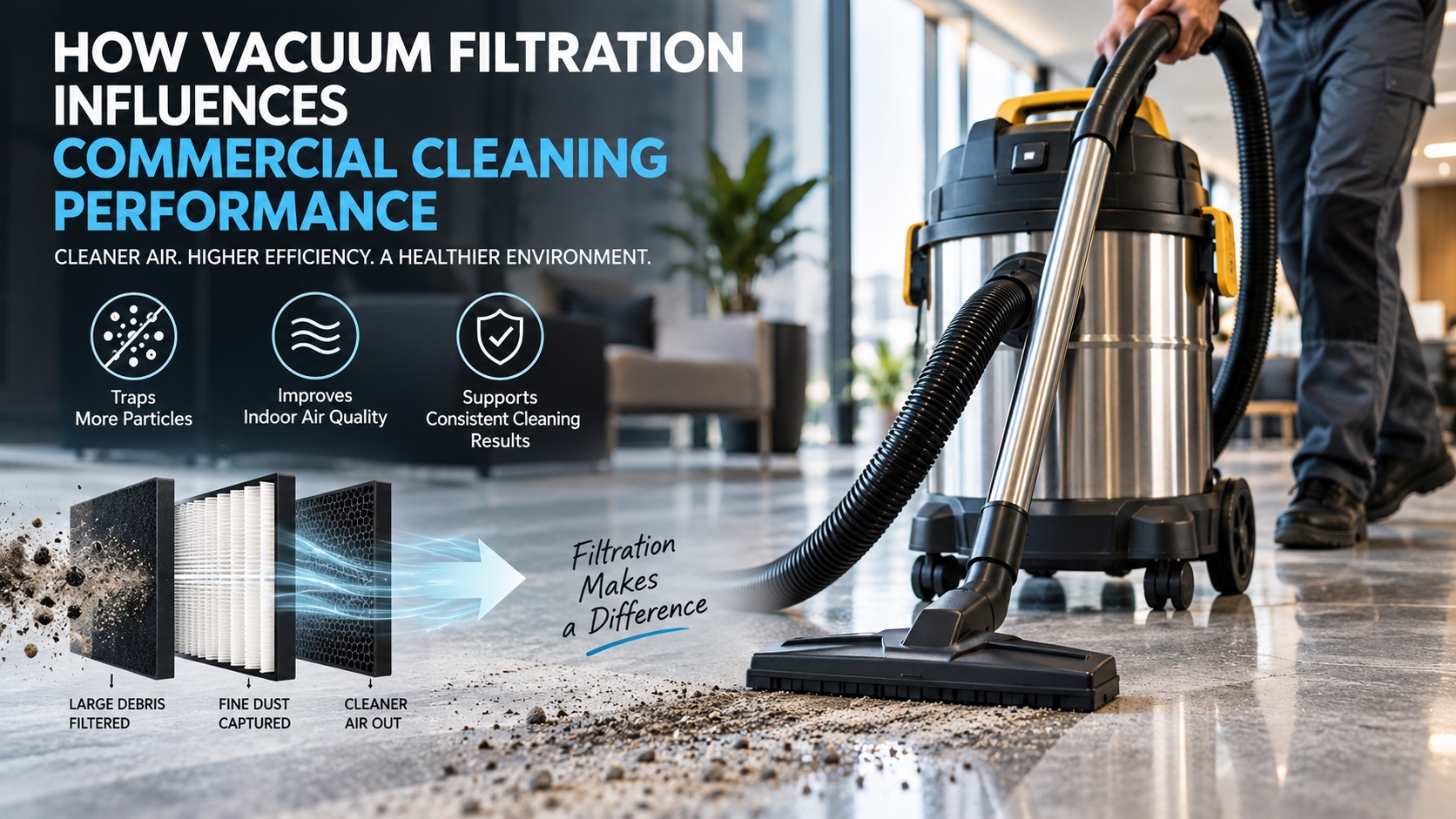
A vacuum cleaner is fundamentally an airflow system. Air enters through the floor tool, nozzle, or hose, transports dirt through the machine, passes through the collection and filtration system, and eventually exits the vacuum.
The filter sits directly in this airflow path.
Its characteristics can therefore influence not only how much fine particulate matter is captured but also airflow resistance, suction consistency, maintenance intervals, operator productivity, and even the practical operating cost of the machine.
For buyers comparing industrial cleaning equipment or commercial cleaning equipment, understanding this relationship can lead to better purchasing decisions.
For engineers, it can lead to better machine design.
And for distributors, it can help match the correct vacuum configuration to the correct customer. 🔍
1. Filtration Is Part of the Vacuum System, Not an Add-On
A filter should never be evaluated completely independently from the rest of the vacuum cleaner.
A commercial vacuum includes multiple interconnected elements:
Motor and fan system
Intake opening
Floor tool or nozzle
Hose diameter and length
Internal airflow channels
Collection tank or bag
Filtration system
Seals and gaskets
Exhaust path
Changing one component can affect the others.
For example, installing a finer filter may improve particle capture, but it can also increase airflow resistance. If the filter surface area, motor characteristics, and airflow channels are not designed appropriately, actual cleaning performance may decline as the filter loads with dust.
This is why a vacuum cleaner manufacturer should consider filtration during the engineering stage rather than treating it as a final accessory choice.
A well-designed system balances filtration performance with usable airflow and suction.
⚙️ Engineering principle: The most advanced filter is not necessarily the best filter unless the complete vacuum has been designed to work with it.
2. The Relationship Between Airflow and Suction
“Suction power” is one of the most common phrases in vacuum cleaner marketing, but commercial cleaning performance is more complex than a single number.
Vacuum pressure helps the machine lift or loosen material, while airflow transports that material through the hose and into the collection system.
A High Suction Vacuum Cleaner still needs sufficient airflow to move debris effectively.
Filtration influences that airflow because air must pass through the filter media.
A relatively open filter may allow air to pass with less resistance. A finer filter may capture smaller particles but can create greater resistance depending on its material, surface area, construction, and condition.
As the filter collects dust, resistance may increase further.
This means a vacuum can perform differently after thirty minutes of demanding cleaning than it does with a completely clean filter.
For commercial buyers, sustained performance can therefore be more meaningful than impressive initial performance.
A cleaning contractor does not earn productivity from a vacuum operating for only a few minutes under ideal laboratory conditions. The equipment must continue performing throughout the cleaning shift.
3. Filter Loading Can Change Real-World Performance
Imagine two commercial vacuums with similar motor specifications.
Machine A has a small filtration surface that becomes loaded quickly.
Machine B has a larger, properly designed filter system that handles the same dust volume more effectively.
When both machines are new and clean, their performance may appear similar.
After extended use, however, Machine A may require more frequent filter cleaning. Operators may notice declining airflow, spend additional time servicing the machine, or continue cleaning with reduced performance.
Machine B may maintain more consistent airflow for longer.
From a procurement perspective, this difference affects productivity.
If a worker spends five extra minutes cleaning a filter several times per shift, the business is paying for that maintenance time.
For a company operating dozens or hundreds of machines, small interruptions can become significant.
This is why professional buyers should evaluate filter capacity, cleaning method, replacement procedure, and maintenance frequency—not simply whether the product description says “high efficiency.”
4. HEPA Filtration and Commercial Cleaning
A HEPA filter vacuum cleaner may be appropriate when controlling fine particulate matter is an important requirement.
However, HEPA filtration should be evaluated in the context of the complete machine.
A high-efficiency filter can capture fine particles passing through it, but overall system performance also depends on sealing.
If unfiltered air bypasses the filter through gaps in the housing or poorly designed joints, the theoretical efficiency of the filter alone does not describe the performance of the complete vacuum.
This distinction is important for procurement teams.
Terms such as “HEPA,” “HEPA-type,” and “high-efficiency filtration” should not automatically be treated as equivalent. Where a defined filtration performance is required, buyers should request specifications and relevant supporting information from the industrial vacuum cleaner supplier.
For some commercial environments, HEPA filtration can provide meaningful benefits.
For others, a suitable standard filtration system may provide a more economical solution.
The application should determine the specification. 🛡️
5. Filtration and Commercial Cleaning Productivity
Filtration can influence how quickly workers complete cleaning tasks.
Consider a commercial cleaning contractor responsible for a large retail property.
Workers may vacuum entrances, corridors, offices, storage spaces, and customer-facing areas during the same shift.
If filters clog rapidly, operators may experience:
reduced pickup performance, repeated passes over the same area, more frequent filter cleaning, longer machine downtime, and additional maintenance.
These effects can reduce productivity even if the machine initially had strong suction.
By contrast, a properly matched filtration system can help maintain more stable performance over the cleaning cycle.
This does not necessarily mean choosing the finest possible filter.
It means selecting filtration appropriate for the debris load and operating environment.
For a commercial cleaning service equipment fleet, consistency can be as important as peak power.
🧹 A machine that performs reliably for an entire shift may create more value than one with higher theoretical specifications but frequent maintenance interruptions.
6. Case Study: A Distribution Center With High Dust Loads
Consider a hypothetical e-commerce distribution center operating 18 hours per day.
Its floors accumulate cardboard fibers, packaging fragments, dust, dirt from loading bays, pallet debris, and occasional liquid spills.
Management initially purchases compact commercial vacuums designed primarily for lighter indoor cleaning.
The machines provide adequate suction when their filters are clean, but operators soon discover that the filtration system loads rapidly in the warehouse environment.
Cleaning teams begin stopping frequently to service the filters.
Management then reassesses the application.
Instead of focusing only on motor wattage, the procurement team evaluates tank capacity, filter surface area, hose dimensions, wheel durability, drainage, airflow, and ease of maintenance.
For the main floor, it selects a Large-Capacity Wet Dry Vacuum Cleaner designed for higher debris volumes.
A stainless steel vacuum tank provides a durable collection solution, while the filtration configuration is selected for the actual warehouse dust load.
Smaller filtered commercial vacuums remain in administrative areas.
The result is not simply “more suction.” It is a better match between equipment and cleaning environment. 📦
7. Wet and Dry Filtration Requires Special Attention
A wet dry vacuum cleaner presents an additional engineering challenge because the machine may handle both dry debris and liquids.
Dry filtration and wet pickup are not necessarily performed with the same filter arrangement.
Depending on the vacuum design, operators may need to remove a dry filter, install another type of filter, use a foam element, or follow another manufacturer-defined procedure before collecting liquids.
This matters because moisture can affect filter media that were designed for dry use.
For an industrial or commercial fleet, switching procedures should be simple and clearly documented.
If operators repeatedly move between dry and wet cleaning, complicated filter changes can reduce productivity or increase the chance of incorrect use.
A well-designed wet and dry suction system therefore considers not only filtration efficiency but also operator behavior.
For an industrial wet and dry vacuum cleaner for warehouse cleaning supplier, this can become an important product-development consideration.
8. Filtration in Hotels and Hospitality Cleaning
Hotel cleaning creates a different set of priorities.
Guest rooms, corridors, conference spaces, restaurants, and public areas may require frequent cleaning while guests remain nearby.
Noise, mobility, exhaust air, filtration, weight, and ergonomics can all influence purchasing decisions.
A commercial vacuum cleaner for hotel use may therefore prioritize compact dimensions and quieter operation rather than extremely large tank capacity.
A Portable Quiet Vacuum Cleaner with an appropriate filtration system can be useful for room attendants who need to move between multiple floors and rooms.
Maintenance accessibility also matters.
If housekeeping employees must perform complicated filter servicing, daily productivity may suffer.
For a hotel procurement team, a practical filtration system should therefore balance particle capture, airflow, replacement cost, ease of use, and operating noise.
🏨 The “best” filter is the one that supports the hotel's complete cleaning workflow.
9. Filtration in Factory and Workshop Environments
Factory environments can expose vacuum equipment to very different types of material.
A machine may encounter metal fragments, packaging debris, general floor dirt, process dust, or other industrial material depending on the facility.
For routine factory floor cleaning, a heavy duty vacuum cleaner may require robust filtration that can tolerate high debris loads while remaining easy to service.
Some applications may require an industrial dust extractor designed for a particular dust type rather than a general-purpose industrial vacuum.
This distinction is critical.
A standard industrial vacuum should not be assumed suitable for every type of dust simply because it has powerful suction or a fine filter.
Facilities handling hazardous or specialized materials should identify the material and follow applicable safety requirements when selecting equipment.
For general industrial purchasing, filtration should be considered alongside tank construction, motor configuration, hose durability, mobility, and serviceability.
10. Dual Motors Do Not Eliminate Filtration Problems
A dual motor vacuum cleaner can provide substantial performance for demanding applications, but additional motor capacity does not eliminate the need for proper filtration design.
If airflow is heavily restricted by an overloaded or undersized filter, simply adding more motor power may not solve the underlying problem efficiently.
The complete airflow system still matters.
This is particularly relevant when buyers compare an Energy-Saving Efficient Powerful Vacuum Cleaner with higher-wattage alternatives.
Energy efficiency in a vacuum should not be judged solely by motor wattage.
The more useful question is how effectively the machine converts electrical energy into practical cleaning performance over its operating cycle.
A well-designed airflow path, appropriate filtration area, efficient motor system, and correct nozzle can all contribute to productive cleaning.
11. Filtration Can Influence Noise and User Experience
Filtration is rarely discussed in connection with noise, yet airflow management can influence acoustic performance.
Air moving through narrow passages, restrictive components, exhaust outlets, and motor systems can contribute to overall machine noise.
Of course, filtration is only one factor. Motor design, insulation, housing construction, fan geometry, and vibration control are also important.
Still, when developing a low noise vacuum cleaner, engineers should consider the entire air path.
This matters particularly in hotels, offices, retail stores, schools, and other occupied commercial environments.
A machine that provides acceptable suction but produces excessive noise may limit the hours during which cleaning teams can use it.
For buyers, cleaning performance therefore includes more than dirt pickup.
Operator comfort and disruption to surrounding occupants also matter.
12. Maintenance Cost Is Part of Filtration Performance
Commercial buyers often compare the initial purchase price but underestimate consumable costs.
Filters may need to be cleaned or replaced throughout the machine's service life.
For a single vacuum, the difference may appear modest.
For a bulk vacuum cleaner purchase involving 500 units, replacement filters become a much larger consideration.
Suppose one filter configuration costs less initially but requires replacement twice as often.
The purchasing team should calculate:
filter unit price, replacement frequency, labor time, shipping costs, inventory requirements, machine downtime, and expected operating life.
This provides a more meaningful total cost of ownership.
For wholesalers, filter availability can also affect customer satisfaction.
A distributor selling commercial machines should ideally maintain access to consumables for the expected product lifecycle.
Otherwise, even a well-performing vacuum can become difficult for customers to maintain.
13. Case Study: Commercial Cleaning Contractor Managing 120 Machines
Consider a hypothetical cleaning contractor with 120 vacuum cleaners deployed across office buildings, retail locations, and hotels.
The company originally buys equipment primarily according to unit price.
After one year, management analyzes maintenance records.
It discovers that some lower-cost machines require frequent filter replacement and lose noticeable performance when filters become partially loaded. Operators also report that filter access is inconvenient.
The company changes its procurement process.
For its next bulk order vacuum cleaner project, it compares not only machine price but also:
Replacement filter cost
Filter accessibility
Dust capacity
Airflow consistency
Noise
Spare-parts supply
Estimated maintenance time
Application suitability
The selected equipment has a slightly higher purchase price but requires less frequent servicing in the company's typical cleaning conditions.
The lesson is simple: vacuum cleaner price wholesale should be evaluated together with operating costs.
💰 Procurement value is created over the service life of the machine, not only on the purchase invoice.
14. Why Filter Design Matters for OEM and ODM Projects
For an OEM vacuum cleaner or ODM vacuum cleaner, filtration provides opportunities for meaningful product differentiation.
An importer may want to develop separate models for hotels, warehouses, workshops, vehicle detailing, or general commercial cleaning.
Instead of using the same filtration configuration across every product, the buyer can work with an OEM industrial vacuum cleaner manufacturer to adapt the machine.
Possible considerations include:
filter media, filtration area, pre-filter design, filter mounting, sealing, filter access, tank capacity, motor configuration, noise control, hose size, and accessories.
For a private label vacuum cleaner, replacement filters should also be considered during packaging and after-sales planning.
Will spare filters carry the buyer's brand?
How many should distributors stock?
Will the same filter fit several models?
Can filter packaging be optimized for international shipping?
These decisions can affect the commercial success of the product long after initial development.
15. What Global Vacuum Buyers Should Ask Suppliers
When sourcing from a vacuum cleaner manufacturer in China, professional buyers can ask several filtration-related questions before confirming an order.
What filter is included as standard?
Request information about material, construction, and intended application.
Is HEPA filtration available?
If so, ask for the actual specification rather than relying solely on marketing terminology.
What happens during wet pickup?
For a wet and dry vacuum cleaner, understand exactly which filters must be installed or removed.
How is the filter cleaned?
Consider whether maintenance is practical for the target customer.
What replacement filters are available?
Confirm part numbers, pricing, MOQ, packaging, and long-term availability.
How does filter loading affect performance?
Where possible, discuss performance under realistic dust-loading conditions.
Can filtration be customized?
For OEM/ODM projects, determine which changes are feasible without compromising airflow or machine reliability.
These questions help buyers evaluate a vacuum cleaner supplier China beyond basic price comparison.
16. Filtration and Car Detailing Vacuums
A car detailing vacuum cleaner provides another example of application-specific filtration.
Vehicle detailing can involve sand, crumbs, carpet fibers, dust, dirt, and debris trapped in narrow interior spaces.
Strong suction is useful, but portability, nozzle selection, hose flexibility, noise, and filter maintenance also affect operator productivity.
A detailing business may use the machine repeatedly throughout the day.
A filter that becomes restricted too quickly can reduce productivity between vehicles.
At the same time, an unnecessarily complicated filtration system may increase consumable costs without providing meaningful benefits for the intended work.
Again, matching filtration to the actual debris and cleaning process produces a more practical machine.
🚗 Good filtration design supports the workflow rather than becoming an obstacle to it.
17. How Filtration Relates to Budget and Value
End users frequently search for phrases such as best vacuum on a budget, best budget vacuum, good budget vacuum cleaner, or best affordable vacuum.
Commercial buyers should interpret “budget” carefully.
The lowest-priced vacuum may not deliver the lowest cleaning cost.
If poor filtration design causes rapid clogging, repeated cleaning passes, frequent consumable replacement, or early equipment failure, the initial saving can disappear quickly.
A best value for money hoover should therefore be evaluated according to the intended workload.
For occasional light cleaning, a simple economical machine may be entirely appropriate.
For daily commercial operation, durability, filter serviceability, suction consistency, spare-parts availability, and maintenance cost become much more important.
The right value calculation depends on how intensively the vacuum will be used.
18. A Practical Filtration Checklist for Commercial Buyers
Before purchasing a commercial or industrial vacuum, procurement teams can evaluate six areas.
🔹 Application: Where will the vacuum operate?
🔹 Debris: What types and volumes of material will it collect?
🔹 Filtration: What filtration performance is actually required?
🔹 Airflow: Can the machine maintain practical cleaning performance as the filter loads?
🔹 Maintenance: How quickly can operators clean or replace filters?
🔹 Lifetime Cost: What will filters, labor, spare parts, and downtime cost over the machine's useful life?
For wet dry machines, add a seventh question:
🔹 Wet/Dry Transition: What must the operator do to switch safely between dry debris and liquid pickup?
These questions provide a stronger purchasing framework than selecting equipment by motor wattage alone.
19. Choosing the Right Filtration With a Vacuum Manufacturer
A capable industrial vacuum cleaner factory should be able to discuss filtration as part of the complete product specification.
For wholesalers and importers, this is especially important when building a product range.
A distributor might require:
a compact commercial model for hotels and offices, a Fast Lightweight Vacuum Cleaner for mobile cleaning teams, a large wet dry model for warehouses, a high suction power vacuum cleaner for demanding commercial tasks, and a heavy-duty model for industrial customers.
Each product can require a different balance of filtration, airflow, capacity, noise, mobility, and price.
Lanxstar can discuss commercial and industrial vacuum cleaner configurations based on these application requirements, including OEM and ODM development for international buyers.
Rather than adding filtration features simply to make a specification sheet longer, the objective should be to build a vacuum that performs consistently in its intended environment. 🌍
Conclusion
Vacuum filtration has a direct relationship with commercial cleaning performance because it operates at the center of the machine's airflow system.
The right filtration design can support fine-particle control, stable airflow, efficient debris collection, practical maintenance, and productive cleaning. A poorly matched system can contribute to airflow restriction, frequent maintenance, downtime, and higher operating costs.
For global importers, wholesalers, cleaning contractors, facility managers, and engineers, filtration should therefore be evaluated alongside suction, airflow, tank capacity, motor configuration, noise, accessories, maintenance, and total cost of ownership.
A HEPA filter vacuum cleaner may be appropriate where fine-particle filtration is a priority. A conventional filter may provide better value for many general commercial applications. A wet dry vacuum cleaner may require different filtration arrangements depending on whether it is collecting dry debris or liquids.
Ultimately, effective commercial cleaning comes from matching the complete vacuum system to the real cleaning environment.
For commercial, industrial, wholesale, OEM, and ODM vacuum cleaner solutions, visit www.lxvacuum.com.
If you are interested, please feel free to contact us.
50 Related SEO Keywords:
High Suction Vacuum Cleaner, Portable Quiet Vacuum Cleaner, Multi-Functional Durable Vacuum Cleaner, Fast Lightweight Vacuum Cleaner, Energy-Saving Efficient Powerful Vacuum Cleaner, Large-Capacity Wet Dry Vacuum Cleaner, wet and dry vacuum cleaner, wet dry vacuum cleaner, industrial vacuum cleaner, commercial vacuum cleaner, industrial vacuum cleaner supplier, vacuum cleaner manufacturer, industrial cleaning equipment, commercial cleaning equipment, vacuum cleaner supplier, vacuum cleaner manufacturer in China, industrial vacuum cleaner factory, wholesale vacuum cleaner, bulk vacuum cleaner purchase, OEM vacuum cleaner, ODM vacuum cleaner, private label vacuum cleaner, cleaning equipment supplier, industrial equipment supplier, warehouse cleaning solution, hotel cleaning equipment, factory floor cleaning, logistics warehouse cleaning, car detailing vacuum cleaner, commercial cleaning service equipment, facility management cleaning equipment, retail cleaning equipment, HEPA filter vacuum cleaner, high suction power vacuum cleaner, heavy duty vacuum cleaner, dual motor vacuum cleaner, stainless steel vacuum tank, low noise vacuum cleaner, energy efficient vacuum cleaner, wet and dry suction system, industrial dust extractor, commercial grade vacuum cleaner, buy industrial vacuum cleaner, vacuum cleaner price wholesale, commercial vacuum cleaner for sale, factory direct vacuum cleaner, bulk order vacuum cleaner, OEM industrial vacuum cleaner manufacturer, Lanxstar, vacuum cleaner maker