Hi, message us with any questions.
We're happy to help!





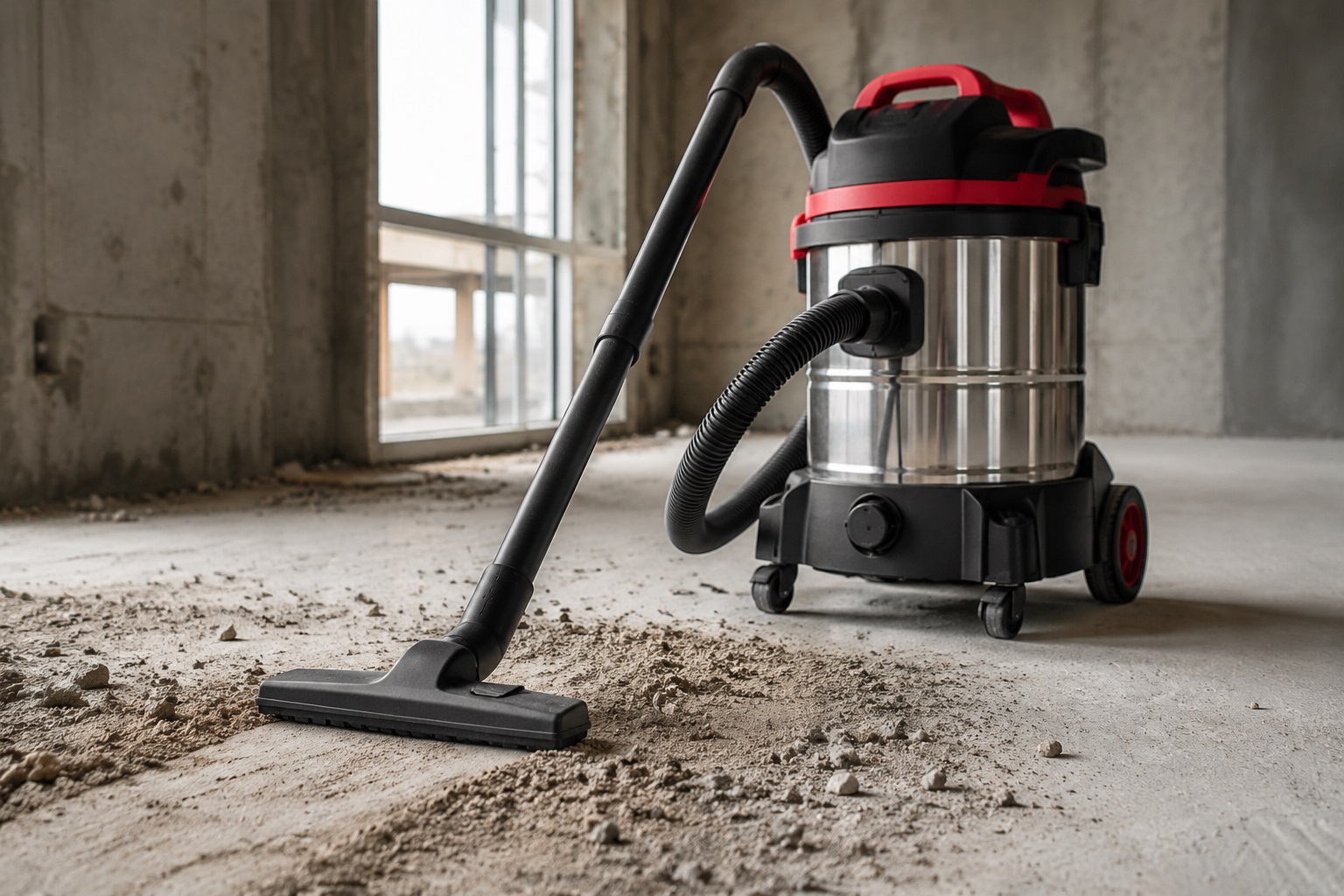
For B2B buyers, distributors, and industrial vacuum system engineers in Europe and North America, construction dust control is no longer a maintenance concern—it is a procurement decision driven by ROI, compliance risk, and operational uptime.
Modern contractors are shifting from basic construction site cleaning to engineered dust management systems that integrate contractor vacuum equipment, centralized airflow design, and high-efficiency filtration networks. The reason is simple: dust is now a measurable cost driver, not just a byproduct.
This article breaks down how professional contractors actually design dust systems—and more importantly, how these systems generate financial returns.
🧱 1. Why Traditional Cleaning Models Fail (Hidden Cost Breakdown)
Most job sites still rely on manual sweeping and portable vacuums. On paper, this looks cheap. In reality, it is the most expensive model.
❌ Hidden inefficiencies of traditional cleaning:
Re-contamination within 30–90 minutes after cleaning
High labor dependency (2–6 workers per shift in medium sites)
Equipment wear caused by fine silica dust infiltration
Uncontrolled airborne spread affecting multiple zones
💡 Real cost example (EU mid-size construction site):
Manual cleaning labor: €18–€28/hour per worker
4 workers × 8 hours/day = €576–€896/day
Monthly cost: €12,000–€20,000
Yet dust still returns continuously.
👉 Conclusion: manual building site maintenance is not scalable in modern construction environments.
⚙️ 2. How Industrial Dust Extraction Changes the Cost Structure
A properly engineered industrial dust extraction system replaces repetitive labor with continuous airflow control.
Instead of cleaning dust after it spreads, contractors now:
Capture dust at the source
Maintain negative pressure zones
Centralize filtration instead of distributed cleanup
📊 Performance comparison:
| System Type | Labor Cost | Efficiency | Downtime Impact |
|---|---|---|---|
| Manual cleaning | High | Low | High |
| Portable vacuum only | Medium | Medium | Medium |
| Central dust extraction system | Low | High | Low |
👉 The shift is not operational—it is financial.
🧰 3. Contractor Vacuum Equipment: From Tool to Infrastructure Asset
Modern contractor vacuum equipment is no longer a handheld tool—it is integrated infrastructure.
Key system types used in professional sites:
HEPA H13/H14 industrial vacuum units
Tool-triggered extraction systems (grinders, saws, drills)
Centralized vacuum pipelines for large-scale construction
Continuous-duty cyclone pre-separation systems
💡 Engineering insight most suppliers ignore:
Airflow stability under filter load is more important than peak suction power.
For example:
Entry-level system: 300–500 CFM (drops 40% under load)
Industrial system: 2,000–10,000 CFM (auto-clean filter stabilization)
👉 This difference directly affects ROI because suction loss = productivity loss.
🧪 4. Real-World ROI Case Studies (What Buyers Actually Care About)
Below are simplified but realistic deployment models based on European and industrial site standards.
🏢 Case 1: High-Rise Construction Project (Germany)
Problem:
Fine concrete dust spreading across 20+ floors
Manual cleaning required 5 workers daily
Frequent HVAC contamination delays inspection approval
Solution:
Centralized dust extraction system installed (4,000 m³/h capacity)
Negative pressure zoning per floor
HEPA H14 filtration stage
Results:
Labor cost reduction: 62%
Inspection delays reduced: 80%
Dust re-contamination rate: near zero
👉 ROI break-even: 14–18 months
🏭 Case 2: Industrial Metal Workshop (Netherlands)
Problem:
Welding + grinding dust damaging machinery bearings
High filter replacement frequency (every 2–3 weeks)
Solution:
Cyclone pre-separation + multi-stage filtration
Tool-integrated vacuum extraction
Continuous airflow balancing system
Results:
Filter lifespan extended: +200%
Machine maintenance cost reduced: 35%
Downtime reduction: 22%
👉 ROI break-even: 12 months
🏥 Case 3: Hospital Renovation (UK)
Problem:
Strict zero-contamination requirement
Dust leakage causing compliance risk
Solution:
Negative pressure containment system
Real-time particle monitoring sensors
HEPA H14 sealed extraction units
Results:
Compliance approval achieved on first inspection
Zero cross-zone contamination incidents
Reduced rework cost: 40%
👉 ROI break-even: 18–24 months
🌬️ 5. Engineering Principle: Dust Control = Airflow Economics
Advanced contractors treat dust as a fluid dynamic system, not waste.
Key design logic:
Air always moves toward negative pressure zones
Particle size determines filtration stage design
Air velocity determines capture efficiency
Core equation (simplified engineering model):
Higher airflow stability → lower rework cost → higher site throughput
This is why modern construction dust control is now integrated into building design, not added afterward.
💰 6. Total Cost of Ownership (TCO) Comparison
5-year cost model:
| Category | Manual System | Industrial Extraction System |
|---|---|---|
| Labor cost | Very high | Low |
| Equipment cost | Low | Medium |
| Maintenance cost | Medium | Low |
| Downtime cost | High | Very low |
| Compliance risk | High | Low |
👉 Over 5 years, industrial systems reduce total cost by 30–55% depending on site complexity.
🧠 7. Procurement Insight: What Smart Buyers Evaluate
For B2B vacuum distributors and procurement teams, the real decision factors are:
✔ Airflow stability under load (not peak rating)
✔ Filter lifecycle cost (not filter price)
✔ System scalability (modular expansion)
✔ Compliance alignment (OSHA / EU silica dust standards)
✔ Integration with tools and workflows
Most suppliers fail because they sell machines—not systems.
🏁 Conclusion: Dust Control Is Now a Financial System, Not a Cleaning Function
Modern construction sites are evolving into controlled airflow environments where construction dust control is directly linked to productivity and profit.
The transition from manual construction site cleaning to engineered industrial dust extraction systems is not optional—it is already the industry standard for competitive contractors.
For B2B buyers and system integrators, the key shift is clear:
You are not buying a vacuum—you are buying reduced downtime, lower labor dependency, and predictable operational cost.
📌 Hashtags
constructiondustcontrol, constructiondustsystem, industrialdustextraction, dustremovalsolution, constructionsitecleaning, buildingsitemaintenance, contractorvacuumequipment, industrialvacuumsystem, hepaindustrialvacuum, centralvacuumsystem, negativepressuresystem, dustcontainmentsolution, constructionairflow, jobsitecleaning, silica dust extraction, fineparticulatecontrol, pm25reduction, constructionengineering, constructionroi, constructioncostreduction, buildinginfrastructure, industrialcleaningsystem, airflowengineering, dustsuppressionsystem, wetdustcontrol, drydustextraction, toolintegratedvacuum, cyclonefiltration, multistagefiltration, h13hepa, h14hepa, constructioncompliance, oshasafety, eusilicastandards, constructionproductivity, jobsiteefficiency, contractorworkflow, industrialmaintenance, equipmentlifecycle, vacuumtechnology, airflowoptimization, constructionlogistics, engineeringprocurement, b2bindustrialequipment, constructioninnovation, sustainableconstruction, greenbuilding, lowemissionconstruction, industrialcleaningsolutions, Lanxstar