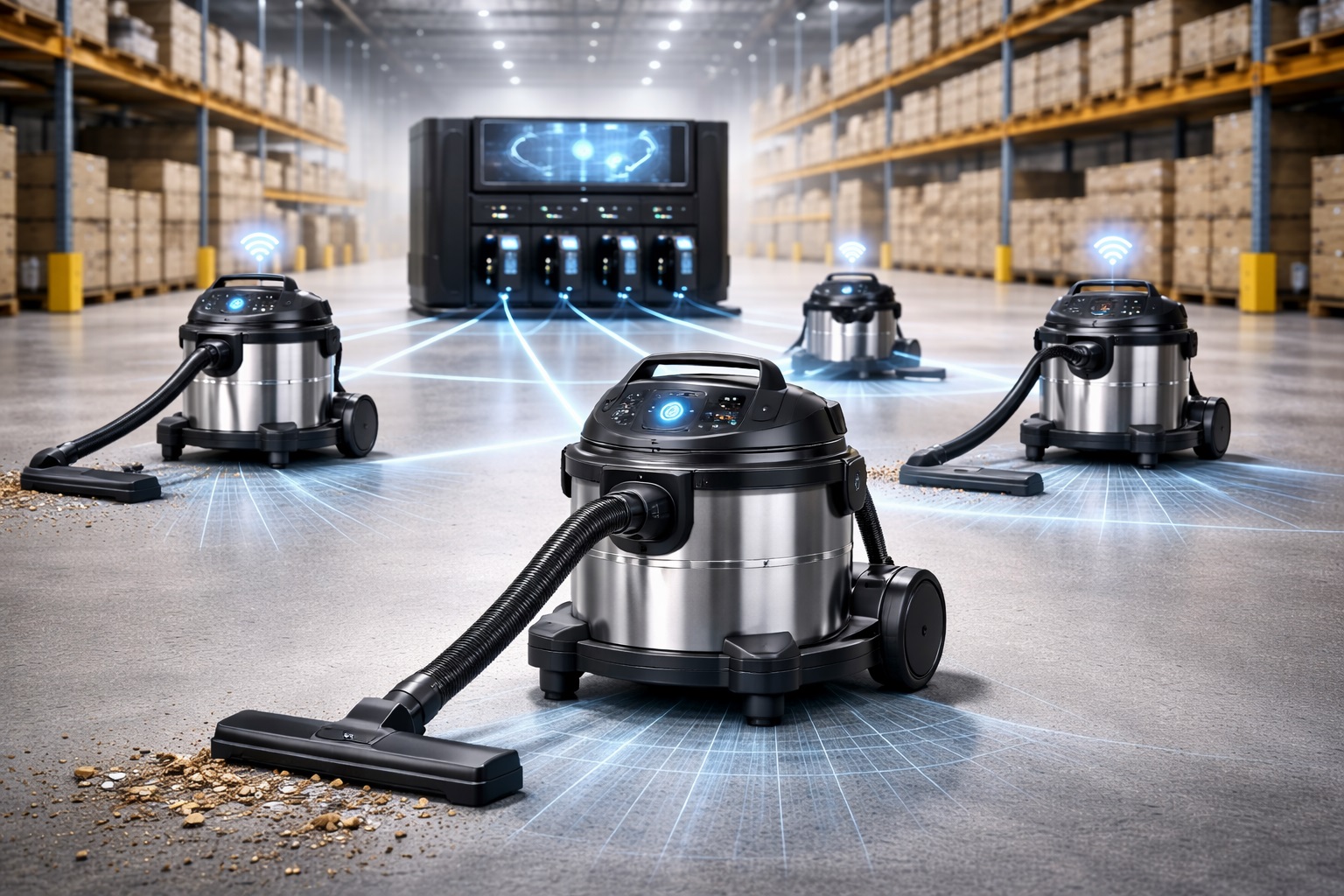
Large warehouses face unique cleaning challenges:
Vast floor areas
Continuous forklift traffic
Mixed debris (dust, packaging waste, liquid spills)
Limited downtime
Traditional portable cleaning approaches often lead to high labor intensity, equipment bottlenecks, and inconsistent cleanliness.
A centralized vacuum strategy changes the economics and efficiency of warehouse cleaning.
🧠 1. Why Traditional Warehouse Cleaning Hits a Scalability Wall
In many warehouses, cleaning relies on:
This creates problems:
Even high-quality portable units struggle once scale increases.
Core Insight:
Warehouse cleaning is a system problem, not a single-machine problem.
🏗️ 2. What Is Centralized Vacuum Cleaning in Warehouses?
Centralized vacuum cleaning means:
Strategic deployment of high-capacity core vacuum units
Multiple cleaning points or zones connected to shared capacity
Reduced need to move heavy equipment across long distances
Instead of 20 small machines, you operate:
This model is especially effective when handling:
💨 3. Large-Capacity Wet & Dry Vacuums = Fewer Interruptions
One of the biggest inefficiencies in warehouses is constant emptying and refilling.
A Large-Capacity Wet Dry Vacuum Cleaner:
Handles long cleaning cycles
Reduces downtime from tank changes
Maintains stable suction over large areas
Compared to small units:
Operational Gain:
More floor cleaned per hour, per operator.
🔄 4. Combine Central Power with Multi-Functional Endpoints
Centralized systems work best when paired with Multi-Functional Durable Vacuum Cleaner endpoints.
These endpoints:
Adapt to different surfaces (concrete, epoxy, ramps)
Handle both wet and dry debris
Reduce need for task-specific machines
This hybrid approach:
Result:
Central strength + local adaptability.
🔋 5. Cordless Vacuums for Spot & Peripheral Cleaning
Centralized systems don’t eliminate portable devices—they optimize their use.
A Cordless Vacuum Cleaner is ideal for:
Peripheral zones
Racks and shelving
Equipment interiors
Quick response cleaning
Instead of being the primary workhorse, cordless units:
This dramatically reduces idle time for both people and machines.
🤫 6. Quiet Operation Enables Night-Time Warehouse Cleaning
Warehouses often clean during:
Night shifts
Low-traffic windows
A Quiet Vacuum for Night Use is essential for:
Centralized systems allow:
Core units placed away from work zones
Lower noise exposure at cleaning points
Minimal disruption to night operations
Strategic Advantage:
Cleaning without stopping logistics flow.
🚗 7. Why Car Vacuums Still Matter in Warehouses
Warehouses aren’t just floors.
Forklifts, delivery vehicles, and utility carts:
A Car Vacuum Cleaner integrated into the cleaning plan:
Keeps operator cabins clean
Reduces dust recirculation
Improves equipment lifespan
Used alongside centralized systems, car vacuums:
📊 8. Centralized Systems Improve Labor Allocation
With centralized cleaning:
Fewer machines need supervision
Operators focus on cleaning, not logistics
Training complexity decreases
Labor benefits include:
Management Insight:
Centralized systems turn cleaning from a manpower issue into a process issue.
🧬 9. Maintenance Is Easier at Scale
Maintaining 30 small machines is harder than maintaining:
Centralized systems reduce:
Especially when paired with:
Durable designs
Wet & dry compatibility
✅ Conclusion: Centralized Vacuums Are a Force Multiplier for Warehouses
Cleaning large warehouses efficiently is not about buying stronger machines—it’s about restructuring how cleaning power is deployed.
A centralized vacuum strategy:
Maximizes suction where it matters
Reduces labor waste
Improves consistency across massive spaces
Enables quiet, continuous operation
By combining:
Large-capacity wet & dry core units
Multi-functional durable endpoints
Cordless and car vacuums for flexibility
Warehouses can achieve higher cleanliness with lower long-term cost.
In large-scale logistics, cleaning efficiency scales only when systems do.
📌 Suitable Reading Audience
Warehouse & Logistics Operations Managers
Industrial Facility Managers
Supply Chain Infrastructure Decision-Makers
B2B Industrial Cleaning Equipment Buyers
📌 Hashtags
wet and dry vacuum cleaner, Multi-Functional Durable Vacuum Cleaner, Cordless Vacuum Cleaner, Large-Capacity Wet Dry Vacuum Cleaner, Quiet Vacuum for Night Use, Car Vacuum Cleaner, Warehouse Cleaning Solutions, Centralized Vacuum Systems, Industrial Cleaning Efficiency, Logistics Facility Cleaning, Large Area Cleaning Equipment, Warehouse Floor Cleaning, Industrial Wet Dry Vacuums, Centralized Cleaning Strategy, Warehouse Maintenance Solutions, Dust Control Warehouses, Industrial Facility Management, Night Shift Cleaning Solutions, Quiet Industrial Vacuums, High Capacity Cleaning Systems, Warehouse Operations Optimization, Cleaning Equipment for Logistics, Industrial Vacuum Strategy, Scalable Cleaning Systems, Facility Cleaning ROI, Warehouse Safety Cleaning, Industrial Cleaning Automation, Multi-Zone Cleaning Strategy, Warehouse Equipment Maintenance, Sustainable Industrial Cleaning, Cleaning Systems Design, Large Facility Cleaning Best Practices, Industrial Cleaning Infrastructure, Warehouse Asset Protection, Forklift Cleaning Solutions, Dust Management Systems, Centralized Facility Cleaning, Industrial Operations Efficiency, Professional Industrial Cleaning, Logistics Center Maintenance, Cleaning Cost Reduction Warehouses, Industrial Cleaning Innovation, Facility Operations Strategy, B2B Industrial Cleaning, Lanxstar











