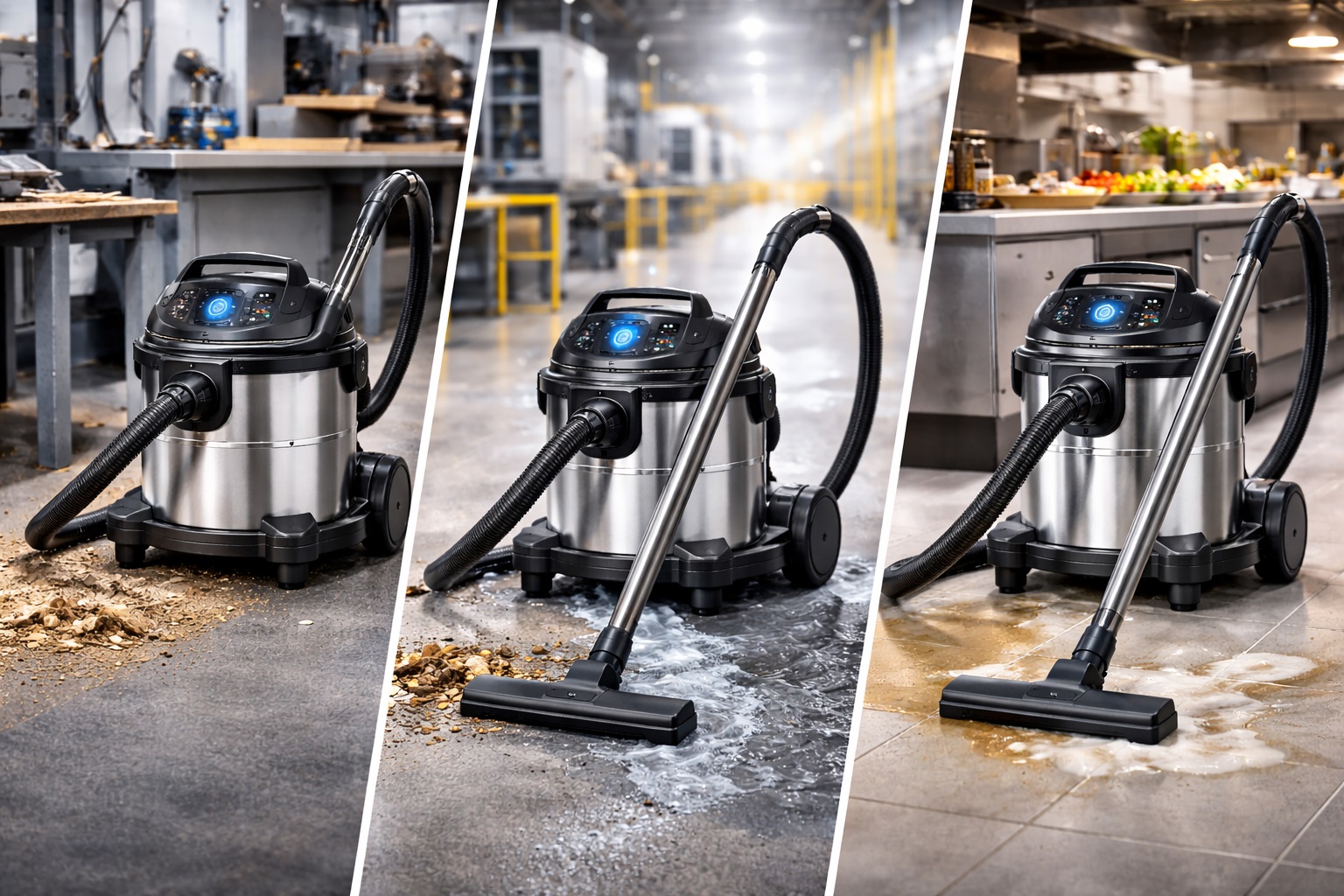
Factories and restaurants may look very different, but when it comes to cleaning, they share the same challenges:
Choosing the wrong wet-dry vacuum leads to:
This guide explains how to choose the right wet-dry vacuum cleaner specifically for factories and restaurants, based on real operational needs—not marketing claims.
🧠 1. Start with the Debris Reality, Not the Spec Sheet
Before looking at power numbers, ask one question:
What actually ends up on the floor?
In factories:
Metal shavings
Dust and powders
Coolants or oils
In restaurants:
This mixed reality immediately rules out single-purpose machines.
A true wet and dry vacuum cleaner must:
Handle liquids without damaging motors
Pick up solids without clogging
Switch between tasks without reconfiguration
Key Insight:
If your team switches machines mid-shift, you already chose wrong.
💨 2. Suction Power Matters — But Stability Matters More
Many buyers chase “maximum suction,” but in factories and kitchens, stable suction over time is what keeps operations moving.
A High Suction Vacuum Cleaner should:
Maintain airflow even when handling wet debris
Avoid sudden drops caused by filter saturation
Protect motors from moisture and grease
Look for:
Operational Truth:
Inconsistent suction = repeated passes = labor loss.
🔄 3. Why Multi-Functional Design Reduces Total Equipment Cost
Factories and restaurants rarely need more machines — they need fewer machines that do more.
A Multi-Functional Durable Vacuum Cleaner allows:
One unit for spills, solids, corners, and under equipment
Fewer storage requirements
Less staff training
Especially in restaurants, where space is limited, multi-functionality:
ROI Insight:
One multi-functional unit often replaces 2–3 single-purpose tools.
🏃 4. Fast & Lightweight Isn’t a Luxury — It’s a Productivity Tool
In high-frequency environments:
A Fast Lightweight Vacuum Cleaner enables:
Quick response to spills
Less operator fatigue
Faster area turnaround
This is critical in:
Assembly lines
Commercial kitchens
Prep zones
Counterintuitive Insight:
A lighter machine often cleans more area per hour than a heavier “industrial” unit.
🧬 5. Hygiene & Allergy Control: Often Overlooked, Always Costly
Factories with shared workspaces and restaurants with open kitchens must consider air quality.
A Vacuum Cleaner for Allergies helps by:
Capturing fine particles and food dust
Preventing recirculation of allergens
Supporting hygiene audits
This matters when:
Employees work long shifts
Customers can see prep areas
Compliance inspections are frequent
Hidden Risk:
Poor filtration turns cleaning into contamination redistribution.
🚗 6. Don’t Ignore Mobile & Auxiliary Cleaning Needs
Factories and restaurants aren’t just floors.
You also clean:
Delivery vehicles
Utility carts
Storage racks
A Car Vacuum Cleaner or compact auxiliary unit:
System Thinking:
Efficient cleaning is about closing the loop, not just floor coverage.
⚙️ 7. Durability Beats Raw Power in Real Environments
Grease, moisture, heat, vibration—these destroy consumer-grade machines fast.
For factories and restaurants, durability means:
A durable wet-dry vacuum:
Procurement Rule:
If it’s hard to clean the cleaner, it won’t survive your operation.
📊 8. Match the Vacuum to the Workflow, Not the Brand
Instead of asking:
“Which brand is best?”
Ask:
How often do we clean?
How fast must areas reopen?
Who operates the machine?
What happens if it fails mid-shift?
The right wet-dry vacuum:
✅ Conclusion: The Right Wet-Dry Vacuum Is a Process Decision
For factories and restaurants, choosing a wet-dry vacuum is not a hardware decision — it’s a process optimization decision.
The right choice:
Handles mixed debris without interruption
Maintains stable suction
Reduces equipment count
Improves hygiene and safety
Saves labor every single day
When selected correctly, a wet-dry vacuum becomes:
A productivity tool
A safety measure
A long-term cost reducer
In high-pressure environments, cleaning only works when equipment works with the workflow — not against it.
📌 Suitable Reading Audience
Factory Operations Managers
Restaurant Chain Facility Managers
Commercial Cleaning Equipment Buyers
Industrial & Food-Service Procurement Teams
📌 Hashtags
wet and dry vacuum cleaner, Multi-Functional Durable Vacuum Cleaner, High Suction Vacuum Cleaner, Fast Lightweight Vacuum Cleaner, Car Vacuum Cleaner, Vacuum Cleaner for Allergies, Factory Cleaning Equipment, Restaurant Cleaning Solutions, Commercial Kitchen Cleaning, Industrial Wet Dry Vacuum, Food Industry Cleaning Equipment, Spill Response Cleaning, Heavy Duty Cleaning Solutions, Hygiene Compliance Cleaning, Allergy Safe Cleaning Equipment, Commercial Cleaning Efficiency, Factory Floor Cleaning, Kitchen Safety Cleaning, Durable Commercial Vacuums, Multi-Purpose Cleaning Machines, Industrial Cleaning Best Practices, Wet Dry Vacuum for Restaurants, Manufacturing Facility Cleaning, Cleaning Equipment ROI, High Frequency Cleaning Solutions, Grease and Liquid Cleaning, Dust Control Solutions, Food Safety Cleaning Tools, Compact Cleaning Equipment, Portable Commercial Vacuums, Easy Maintenance Cleaning Machines, Commercial Cleaning Workflow, Professional Cleaning Equipment, Industrial Facility Maintenance, Restaurant Back of House Cleaning, Cleaning Equipment Durability, Safety Focused Cleaning, Commercial Hygiene Solutions, Efficient Spill Cleanup, Cleaning Equipment Selection Guide, B2B Cleaning Solutions, Facility Operations Cleaning, Industrial Kitchen Cleaning, Scalable Cleaning Systems, Lanxstar











