Hi, message us with any questions.
We're happy to help!





This article analyzes real-world warehouse dust challenges and equipment failures, and explains why traditional cleaning methods are no longer sufficient in high-density logistics environments.
It provides engineering-based solutions centered on industrial vacuum for warehouse cleaning, integrated cleaning systems, and ROI-driven maintenance strategies for B2B buyers.A1
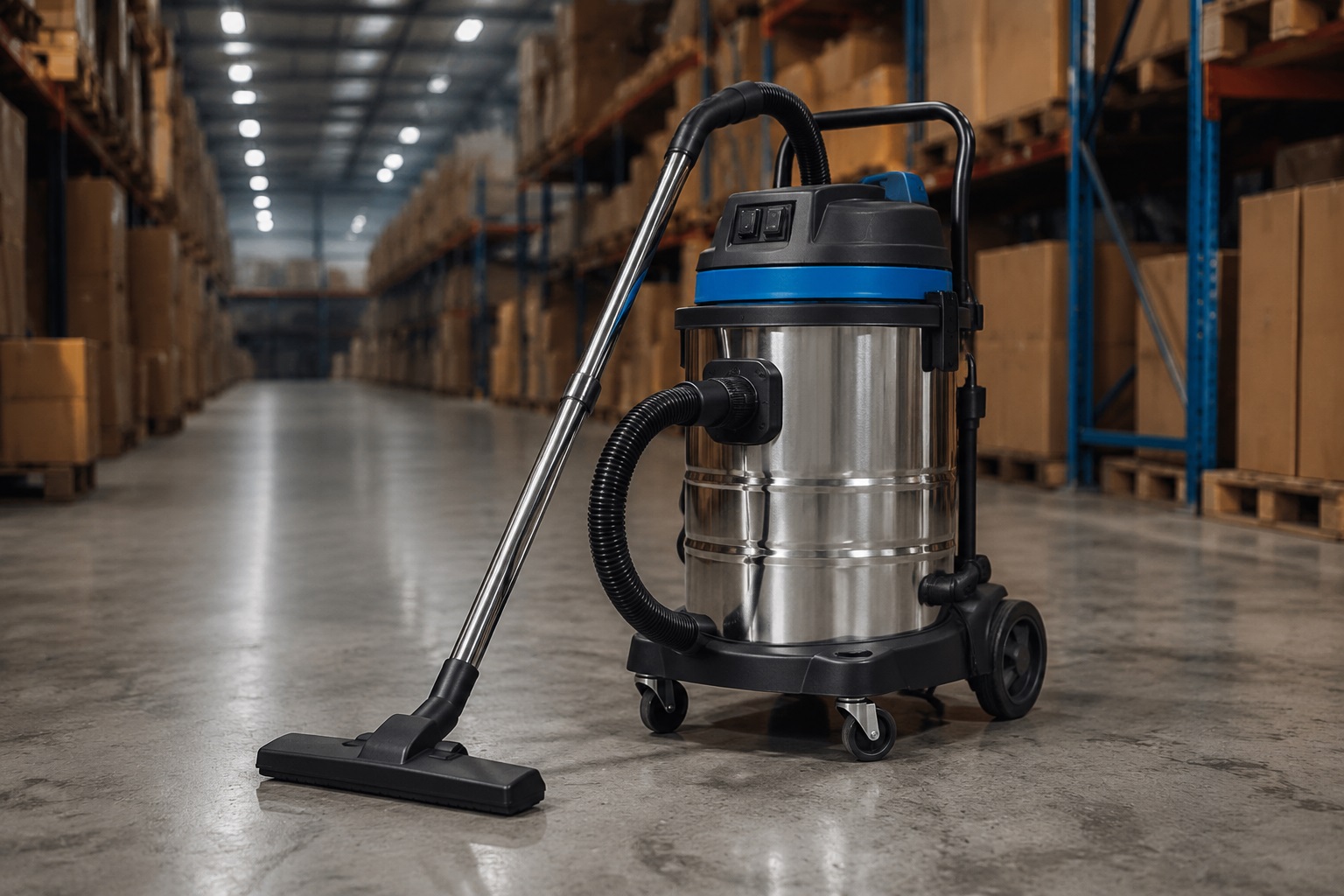
🧭 Introduction: Why Warehouse Cleaning Is Now a Core Industrial Performance Metric
In modern logistics infrastructure across Europe and the United States, warehouse cleaning is no longer treated as a “support service.” It has become a core operational KPI linked to safety compliance, automation uptime, and total logistics efficiency.
Large-scale distribution centers now operate with:
High-density storage systems
Autonomous forklifts and AGVs
24/7 order fulfillment cycles
Tight OSHA / EU safety requirements
In this environment, even minor dust accumulation can directly affect:
Conveyor belt failure rates
Sensor misreadings in automation systems
Slip-and-fall accident probability
Maintenance cost escalation
This is why advanced industrial vacuum for warehouse cleaning systems are increasingly considered part of infrastructure investment rather than cleaning equipment.
⚠️ 1. Real-World Warehouse Cleaning Challenges (What Actually Fails in Practice)
🧱 1.1 Case: 48,000㎡ E-commerce Fulfillment Center (Germany)
A Tier-1 logistics operator in Germany reported:
Daily manual sweeping used in high-traffic zones
Forklift traffic: 180+ units/day
Packaging waste dust accumulation rate: high
❌ Problem observed:
Dust resuspension after sweeping increased airborne particles by 2.4x
Conveyor sensor errors increased by 17%
Weekly maintenance downtime: ~6.5 hours
👉 Root issue: wrong cleaning method (manual sweeping instead of vacuum extraction)
🌪 1.2 Dust behavior in real logistics environments
Warehouse dust is not static. It is generated from:
Cardboard abrasion (largest source in retail logistics)
Pallet wood friction
Rubber tire micro-abrasion
Textile fiber shedding
But the real problem is:
Dust is continuously re-circulated by HVAC airflow + forklift turbulence
This makes warehouse dust removal fundamentally different from office cleaning or retail cleaning.
⚙️ 1.3 Case: US Automotive Parts Distribution Hub (Ohio)
Facility size: 65,000㎡
Shift system: 24/7 operation
Equipment: robotic picking + conveyor systems
❌ Failure scenario:
Standard commercial vacuum used initially
Filter clogging every 2–3 hours
Motor overheating after continuous operation
Result:
12% increase in unplanned downtime
Cleaning labor cost increased by 31%
👉 Key insight: non-industrial vacuum systems fail under continuous load conditions
🧯 1.4 Compliance pressure (EU + US)
Industrial warehouses must comply with:
OSHA walking surface safety rules (US)
EU Workplace Safety Directive
ISO 45001 occupational safety standards
Key measurable requirements:
Slip risk reduction
Airborne particle control
Documented cleaning cycles
🧠 2. Why Traditional Warehouse Cleaning Systems Fail
🧹 2.1 Mechanical sweeping creates invisible risk
Traditional cleaning methods:
Push brooms
Manual sweeping machines
❌ Hidden failure mechanism:
Dust is lifted into air instead of removed
Fine particles remain suspended for 30–120 minutes
Re-deposition occurs on machinery
👉 Result: “clean floor, dirty air system”
🧼 2.2 Incorrect equipment class selection
Most warehouses mistakenly use:
Commercial vacuums (designed for offices/hotels)
But warehouse environments require:
✔ Continuous-duty motors
✔ High suction stability under clogging load
✔ Multi-stage filtration systems
✔ Large-area coverage capability
This is where warehouse cleaning equipment selection becomes critical.
🔄 2.3 No zoning strategy = exponential inefficiency
High-performing logistics centers separate zones:
| Zone Type | Contamination Level | Cleaning Frequency |
|---|---|---|
| Docking areas | Very high | Daily |
| Picking aisles | Medium | 2–3x/week |
| Automation zones | Low but critical | Daily micro-cleaning |
Without zoning:
Cleaning cost increases 40–60%
Equipment wear accelerates
🌀 3. Engineering Solution: Industrial Vacuum-Centered Cleaning Architecture
🏭 3.1 Industrial vacuum as infrastructure, not a tool
Modern industrial vacuum for warehouse cleaning systems are designed as:
Centralized suction networks OR
Distributed high-power mobile units
Key engineering requirements:
Continuous operation (16–72h duty cycles)
HEPA / ULPA filtration
Anti-clog cyclone separation
High dust storage capacity (20–100L+)
📊 3.2 Case: UK 3PL Logistics Hub (Manchester)
Facility size: 52,000㎡
Upgrade: commercial vacuum → industrial vacuum system
Results after 90 days:
Dust-related equipment faults ↓ 42%
Cleaning labor hours ↓ 36%
Floor slip incidents ↓ 51%
Maintenance downtime ↓ 28%
👉 This demonstrates direct ROI impact from system upgrade.
🧼 3.3 Industrial floor cleaning integration
Best-performing facilities use hybrid systems:
Auto scrubbers (wet cleaning)
Vacuum recovery systems
Drying modules for anti-slip compliance
This improves:
Floor friction consistency
Forklift safety
Cleaning cycle efficiency
🌫 3.4 Airflow + dust control engineering
Cleaning alone is not enough.
High-performance warehouses also implement:
Dock door air curtains
Negative pressure loading zones
High-efficiency HVAC filtration (MERV 13–16)
👉 This reduces dust re-entry by up to 60%
🏗 4. Logistics Center Cleaning System Design (Advanced Model)
🧩 4.1 Predictive cleaning model
Instead of fixed schedules:
Modern systems use:
Forklift movement data
Dust sensor readings
Conveyor runtime cycles
Trigger-based cleaning logic:
Cleaning is activated by contamination level, not calendar time
📉 4.2 KPI framework used in advanced warehouses
Leading logistics operators track:
PM2.5 / PM10 levels
Cleaning cost per m²
Equipment failure rate due to dust
Slip incident rate
Cleaning cycle efficiency
🧪 5. Industrial Procurement Reality: What B2B Buyers Must Evaluate
🔍 5.1 Case: US Warehouse Equipment Buyer (Texas)
Initial mistake:
Purchased low-cost industrial-looking vacuum (non-certified)
Result after 6 months:
Motor burnout
Filter replacement cost exceeded equipment cost
Downtime increased
👉 Lesson: appearance ≠ industrial capability
🏭 5.2 True evaluation criteria (B2B standard)
Buyers should prioritize:
✔ Continuous load performance
Not peak power
✔ Total cost of ownership (TCO)
Filter lifecycle
Energy consumption
Maintenance intervals
✔ Integration capability
Warehouse layout compatibility
Multi-zone deployment
Mobility vs centralization
💡 5.3 ROI model (realistic benchmark)
Upgrading to industrial-grade cleaning systems typically results in:
Labor cost reduction: 25–40%
Equipment downtime reduction: 20–45%
Safety incidents reduction: 30–60%
Payback period:
12–24 months (industry average)
📦 6. Comparative Analysis: Commercial vs Industrial Cleaning Systems
| Feature | Commercial Vacuum | Industrial Vacuum System |
|---|---|---|
| Duty cycle | 2–4 hours | 16–72 hours |
| Dust capacity | Low | High |
| Filtration | Basic | HEPA/ULPA |
| Maintenance frequency | High | Low |
| Warehouse suitability | ❌ Poor | ✅ Excellent |
| ROI | Low | High |
📈 7. Strategic Conclusion: Cleaning = Infrastructure Layer of Logistics
Modern logistics centers are not storage spaces anymore — they are high-speed automated production systems for order fulfillment.
Therefore:
Cleaning is not maintenance
It is not hygiene
It is not labor task
It is:
🧠 A system-level engineering function that directly affects uptime, safety, and profitability
Facilities that adopt integrated warehouse cleaning equipment, industrial vacuum systems, and predictive warehouse maintenance models consistently outperform competitors in:
Operational stability
Compliance readiness
Long-term cost efficiency
🔖 Hashtags
industrial vacuum for warehouse cleaning, warehouse cleaning equipment, logistics center cleaning, warehouse dust removal, warehouse maintenance, industrial floor cleaning, warehouse cleaning system design, industrial cleaning automation, logistics warehouse optimization, warehouse hygiene engineering, industrial dust control system, HEPA industrial vacuum, continuous duty vacuum system, warehouse cleaning ROI, warehouse safety compliance, OSHA warehouse cleaning, EU warehouse safety standards, logistics center hygiene control, warehouse airflow management, dust suppression system warehouse, forklift dust management system, conveyor belt cleaning system, warehouse automation maintenance, predictive cleaning system logistics, smart warehouse maintenance, industrial cleaning engineering, warehouse contamination control, warehouse operational efficiency, B2B industrial vacuum procurement, industrial vacuum distributor Europe, industrial vacuum distributor USA, heavy duty cleaning equipment, warehouse floor scrubber system, industrial cleaning lifecycle cost, warehouse infrastructure optimization, logistics facility cleaning strategy, warehouse cleaning KPI system, industrial hygiene management, warehouse dust sensor system, cleaning automation warehouse, warehouse maintenance scheduling, industrial vacuum system design, warehouse compliance cleaning, industrial cleaning ROI model, warehouse safety improvement system, logistics hub cleaning solution, warehouse environmental control, industrial facility cleaning strategy, B2B warehouse equipment sourcing, warehouse engineering solutions, Lanxstar