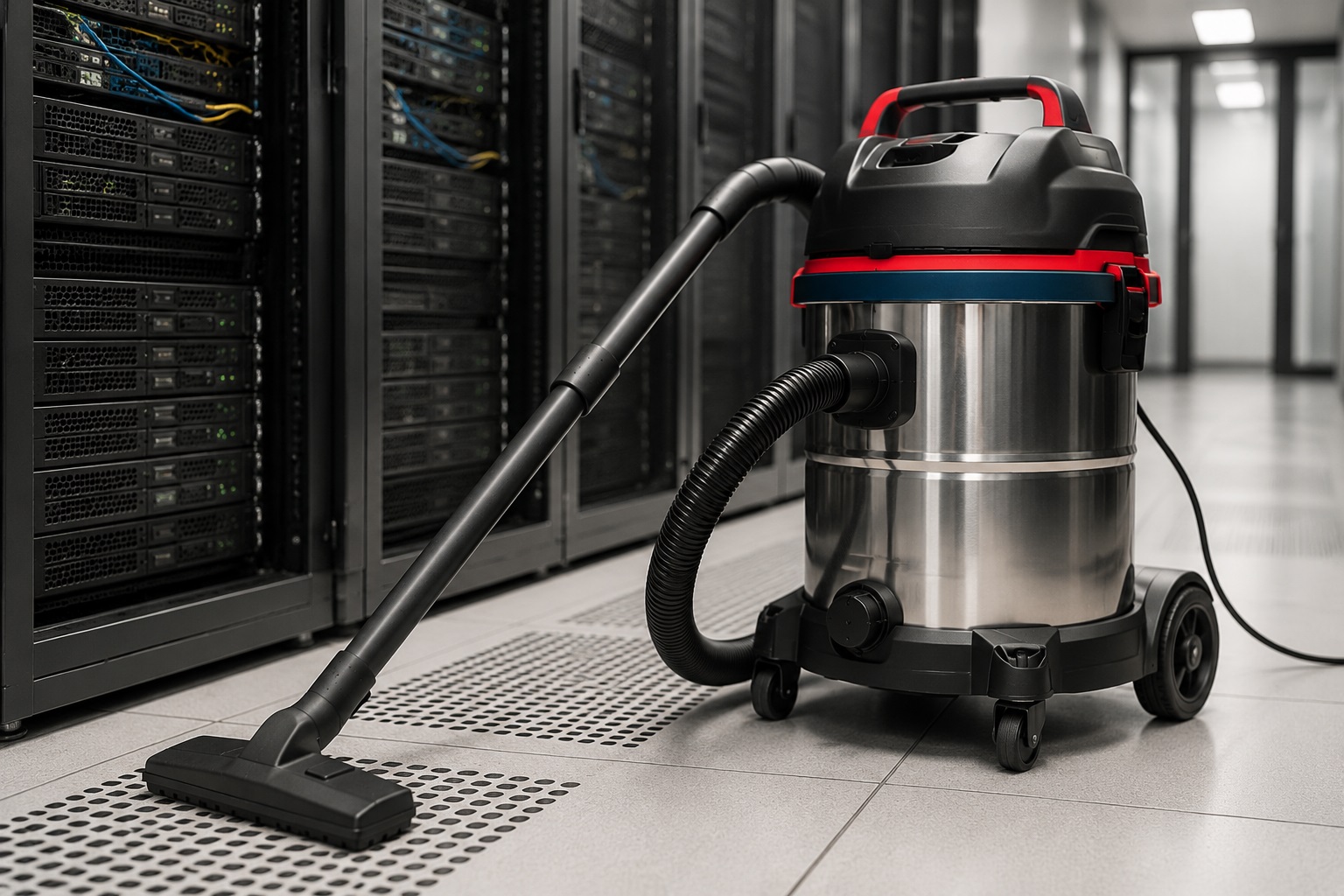
 In modern IT environments, server room dust control is not just a maintenance task—it is a direct performance optimization strategy. Even microscopic dust accumulation can significantly degrade cooling efficiency, increase failure rates, and shorten hardware lifespan.
For enterprises relying on continuous data center maintenance, understanding how dust impacts infrastructure is essential for designing effective dust prevention solutions and protecting high-value IT assets.
🌬️ 1. Dust Is Not Just Dirt—It Is a Thermal Performance Barrier
In a server environment, dust behaves like an insulating layer.
❌ What dust does inside servers:
Blocks airflow through heatsinks and fans
Creates thermal insulation on CPU and GPU surfaces
Reduces heat dissipation efficiency
Forces cooling systems to work harder
💡 Key insight:
Even a thin dust layer can reduce heat transfer efficiency dramatically, leading to system instability under load.
👉 This is why server room cleaning is directly linked to system performance, not just hygiene.
🧠 2. Cooling Efficiency Drops Before Hardware Fails
One of the most overlooked effects of dust is its gradual impact on cooling efficiency.
What happens in real environments:
Airflow resistance increases inside server racks
Fans compensate by spinning faster (higher energy consumption)
Hotspots form in high-density computing zones
Thermal throttling reduces CPU performance
📊 Operational consequence:
Before any hardware failure occurs, performance degradation is already happening silently.
👉 Dust is a progressive performance killer, not a sudden failure trigger.
🏗️ 3. Why Server Room Dust Control Is a System Engineering Problem
Effective server room dust control is not achieved through periodic cleaning alone—it requires system-level engineering.
✔ Core control strategies:
Positive pressure airflow systems
HEPA-filtered air intake systems
Controlled air circulation pathways
Sealed cable and floor management systems
💡 Engineering reality:
If airflow design is poor, even frequent cleaning cannot maintain long-term cleanliness.
⚙️ 4. IT Equipment Protection: Why Dust Causes Hidden Hardware Loss
Dust does not immediately break equipment—but it accelerates long-term degradation of critical components.
❌ Affected components:
Cooling fans (mechanical wear increase)
Power supplies (overheating stress)
Memory modules (thermal instability)
Storage devices (temperature fluctuations)
📉 Long-term effect:
Reduced stability leads to:
👉 This makes IT equipment protection a financial issue, not just a technical one.
🖥️ 5. Data Center Maintenance: Why Cleaning Frequency Alone Is Not Enough
Many operators assume that increasing cleaning frequency solves dust problems. In reality, it only treats symptoms.
❌ Common mistake:
Manual cleaning without airflow control
Reactive maintenance after dust buildup
Lack of zoned contamination management
✔ Professional approach:
Modern data center maintenance integrates:
Continuous air filtration systems
Scheduled infrastructure-level cleaning
Real-time particle monitoring
Preventive dust containment design
👉 Maintenance must be continuous, not reactive.
🌪️ 6. Dust Prevention Solution: Engineering vs Cleaning Mindset
A true dust prevention solution is not a cleaning method—it is an environmental control system.
✔ Engineering-based prevention includes:
Positive pressure design to block external dust entry
Multi-stage filtration (pre-filter + HEPA + ULPA)
Zoned airflow separation in server halls
Anti-static material usage in infrastructure
💡 Key insight:
Prevention always delivers higher ROI than cleaning after contamination.
📊 7. Real Impact on Data Center Operations
Dust affects data center operations across multiple dimensions:
❌ Operational risks:
Increased energy consumption due to cooling inefficiency
Reduced computing stability under peak load
Higher unplanned downtime risk
Increased hardware replacement cycles
✔ Performance improvements when dust is controlled:
Lower PUE (Power Usage Effectiveness)
More stable thermal performance curves
Reduced maintenance interventions
Longer infrastructure lifespan
👉 Even small dust improvements can scale into significant cost savings in hyperscale environments.
🧩 8. Engineering Insight: Why Dust Affects Performance Before Visibility
The most dangerous aspect of dust is that it is often invisible before it becomes operationally harmful.
Key mechanism:
Micro-particles accumulate in airflow channels
Heat exchange efficiency decreases gradually
System compensates by increasing energy usage
Performance loss occurs before detection thresholds are reached
👉 This is why monitoring systems are increasingly part of modern infrastructure cleaning strategies.
🏁 Conclusion: Dust Control Is Performance Engineering
In modern IT environments, server room dust control is directly tied to system performance, energy efficiency, and infrastructure longevity.
Dust is not a surface-level issue—it is a hidden variable that affects:
The real goal is not cleaning servers—it is maintaining a controlled thermal and airflow environment.
📌 Hashtags
serverroomdustcontrol, serverroomcleaning, datacentercleaning, coolingefficiency, datacentermaintenance, dustpreventionsolution, itequipmentprotection, datacenteroperations, infrastructurecleaning, airflowmanagement, thermalmanagement, serverperformance, datacenterinfrastructure, datacenterengineering, serverrackcooling, hepa filtration, airqualitycontrol, dustcontrolsystem, positivepressure, negativepressure, hvac optimization, datacenterdesign, cloudinfrastructure, hyperscale datacenter, edgecomputing, missioncriticalsystems, uptimeoptimization, hardwarereliability, cpu cooling, gpu cooling, fanperformance, heatdissipation, datacenterenergy, pue optimization, contaminationcontrol, technicalcleaning, precisioncleaning, industrialcleaning, b2binfrastructure, engineeringprocurement, facilitymanagement, buildingmaintenance, infrastructuremaintenance, systemreliability, datacentersecurity, airflowengineering, predictive maintenance, ai monitoring, Lanxstar