Hi, message us with any questions.
We're happy to help!





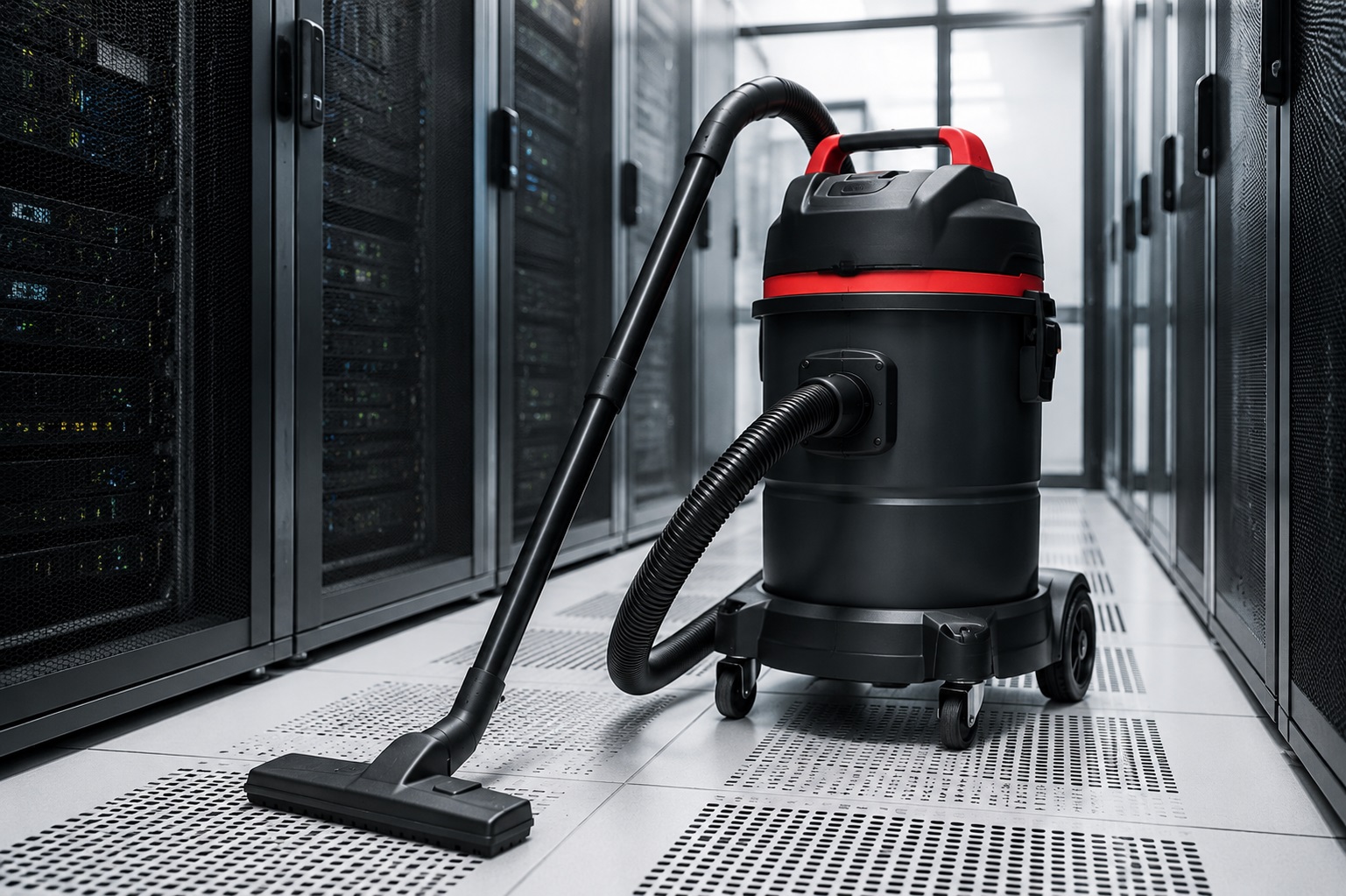
For modern enterprises, data center cleaning is no longer a facility maintenance task—it is a mission-critical operational requirement that directly impacts uptime, hardware lifespan, and system reliability.
Unlike traditional commercial spaces, data centers operate in ultra-sensitive environments where even microscopic dust particles can cause overheating, airflow disruption, or hardware failure. This is why professional-grade IT facility cleaning and engineered infrastructure cleaning systems have become essential for maintaining stable data center operations.
This article explains why cleaning standards in server environments are fundamentally different, what risks are often ignored, and how professional cleaning equipment protects mission-critical infrastructure.
🧱 1. Why Data Center Cleaning Is a Mission-Critical Operation
In a data center, dust is not just dirt—it is an operational risk multiplier.
❌ What dust causes in server environments:
Heat retention on CPU/GPU heat sinks
Airflow blockage in server racks
Fan overload and premature failure
Static electricity accumulation risks
Reduced cooling efficiency across the facility
Even minimal contamination can reduce cooling performance and increase energy consumption significantly.
👉 This is why professional data center cleaning is directly linked to uptime reliability and infrastructure cost control.
🧠 2. Why Standard Cleaning Methods Fail in Server Room Maintenance
Traditional cleaning tools are not suitable for server room maintenance due to three critical limitations:
❌ 1. Airborne dust redistribution
Basic sweeping or low-grade vacuums often reintroduce fine particles into airflow systems instead of removing them.
❌ 2. Electrostatic risk
Improper cleaning equipment can generate static discharge, which is dangerous for sensitive IT components.
❌ 3. Lack of HEPA-level filtration
Standard systems fail to capture micro-particles that accumulate inside rack ventilation systems.
👉 Result: short-term cleaning creates long-term contamination cycles.
🌬️ 3. What Makes a “Dust-Free Environment” Technically Possible
A true dust free environment in a data center is not achieved by cleaning frequency—it is achieved by airflow engineering + filtration control.
✔ Key engineering principles:
Positive air pressure zones prevent dust entry
HEPA/ULPA filtration removes micro-particles
Controlled airflow paths minimize turbulence
Zoned cooling reduces contamination spread
💡 Critical insight:
A dust-free data center is not “cleaned into existence”—it is engineered through continuous air management systems.
🏗️ 4. Infrastructure Cleaning vs Facility Cleaning: The Key Difference
Many operators confuse general facility cleaning with infrastructure cleaning, but they are fundamentally different.
❌ Facility cleaning:
Floors, surfaces, external areas
Visual cleanliness focus
Manual labor-based process
✔ Infrastructure cleaning:
Server racks and airflow systems
Cable pathways and raised floors
HVAC intake and exhaust systems
Precision dust removal inside controlled zones
👉 Infrastructure cleaning is engineering maintenance, not janitorial work.
⚙️ 5. Data Center Cleaning Equipment: What Professionals Actually Use
Professional data center cleaning requires specialized equipment designed for sensitive environments.
✔ Core equipment types:
HEPA H13/H14 anti-static vacuum systems
ESD-safe (electrostatic discharge safe) cleaning tools
Microfiber containment systems
Controlled airflow extraction devices
Low-noise, low-vibration cleaning systems
🧠 Engineering requirement:
All equipment must avoid particle redistribution while maintaining stable suction control.
🖥️ 6. How Cleaning Impacts Data Center Operations (Hidden Cost Layer)
Cleaning is often underestimated in data center operations, but its impact is measurable.
❌ Poor cleaning leads to:
Higher cooling system energy consumption
Increased server thermal throttling
Unexpected hardware downtime
Reduced hardware lifecycle (CPU, SSD, GPU)
✔ Professional cleaning improves:
Cooling efficiency (lower PUE ratio)
Hardware stability under load
Predictable maintenance cycles
Reduced unplanned outages
👉 Even a small improvement in airflow efficiency can translate into significant operational cost savings at scale.
📊 7. Real Operational Example (Industry Scenario)
🏢 Hypothetical Tier-3 Data Center (Enterprise Cloud Facility)
Problem:
Dust accumulation in raised floor airflow system
Uneven cooling distribution in server racks
Increasing fan failure rate in high-density zones
Solution:
Implementation of HEPA-grade IT facility cleaning system
Scheduled infrastructure cleaning cycles
Zoned airflow inspection and vacuum extraction
Results:
18% improvement in cooling efficiency
27% reduction in fan-related hardware failures
Lower emergency maintenance frequency
👉 Key takeaway: cleaning improved system reliability, not just appearance.
🧩 8. Why Professional Cleaning Equipment Is an Infrastructure Investment
For modern facilities, cleaning systems are not consumables—they are part of infrastructure strategy.
✔ Investment-level benefits:
Reduced hardware replacement cost
Improved system uptime
Lower cooling energy consumption
Compliance with ISO cleanliness standards
💡 Strategic insight:
In large-scale data centers, cleaning quality directly affects infrastructure ROI, not just maintenance budgets.
🔐 9. Future Trend: Automated & Sensor-Based Cleaning Systems
The future of data center cleaning is shifting toward automation and monitoring.
Emerging technologies:
AI-based dust particle detection systems
Autonomous robotic cleaning units
Real-time airflow contamination sensors
Predictive maintenance cleaning schedules
👉 This transforms cleaning from a manual process into a data-driven infrastructure function.
🏁 Conclusion: Clean Data Centers Are High-Performance Data Centers
Modern data center cleaning is not about appearance—it is about system reliability, energy efficiency, and operational stability.
Professional IT facility cleaning and engineered infrastructure cleaning systems ensure that server environments remain stable, predictable, and scalable.
For operators and infrastructure managers, the key insight is clear:
You are not cleaning a room—you are protecting a computing system that powers critical business operations.
📌 Hashtags
datacentercleaning, serverroommaintenance, dustfreeenvironment, itfacilitycleaning, datacenteroperations, infrastructurecleaning, servercleaning, datahallmaintenance, datacenterinfrastructure, hepa cleaning, esd safe cleaning, industrialcleaningequipment, airflowmanagement, coolingefficiency, pueoptimization, datacenteruptime, missioncriticalsystems, itmaintenance, serverrackcleaning, datacenterengineering, cloudinfrastructure, hyperscale datacenter, edgecomputing, datacentersecurity, thermalmanagement, heatdissipation, fanfailureprevention, hardwarelifecycle, ssd reliability, cpu cooling, rack airflow, raisedfloorcleaning, hvac datacenter, filtration systems, airqualitycontrol, contaminationcontrol, precisioncleaning, technicalcleaning, facilitymanagement, infrastructuremaintenance, industrialvacuum, cleaningautomation, ai maintenance, predictive maintenance, datacentertechnology, b2binfrastructure, engineeringprocurement, missioncriticalinfra, Lanxstar