Hi, message us with any questions.
We're happy to help!





1. What Is a Private Label Vacuum Cleaner? 🏷️
A private label vacuum cleaner is a vacuum cleaner manufactured by one company and sold under another company's brand.
For an importer, this model provides a practical route into the cleaning-equipment market because the buyer does not necessarily need to develop a vacuum cleaner from the ground up.
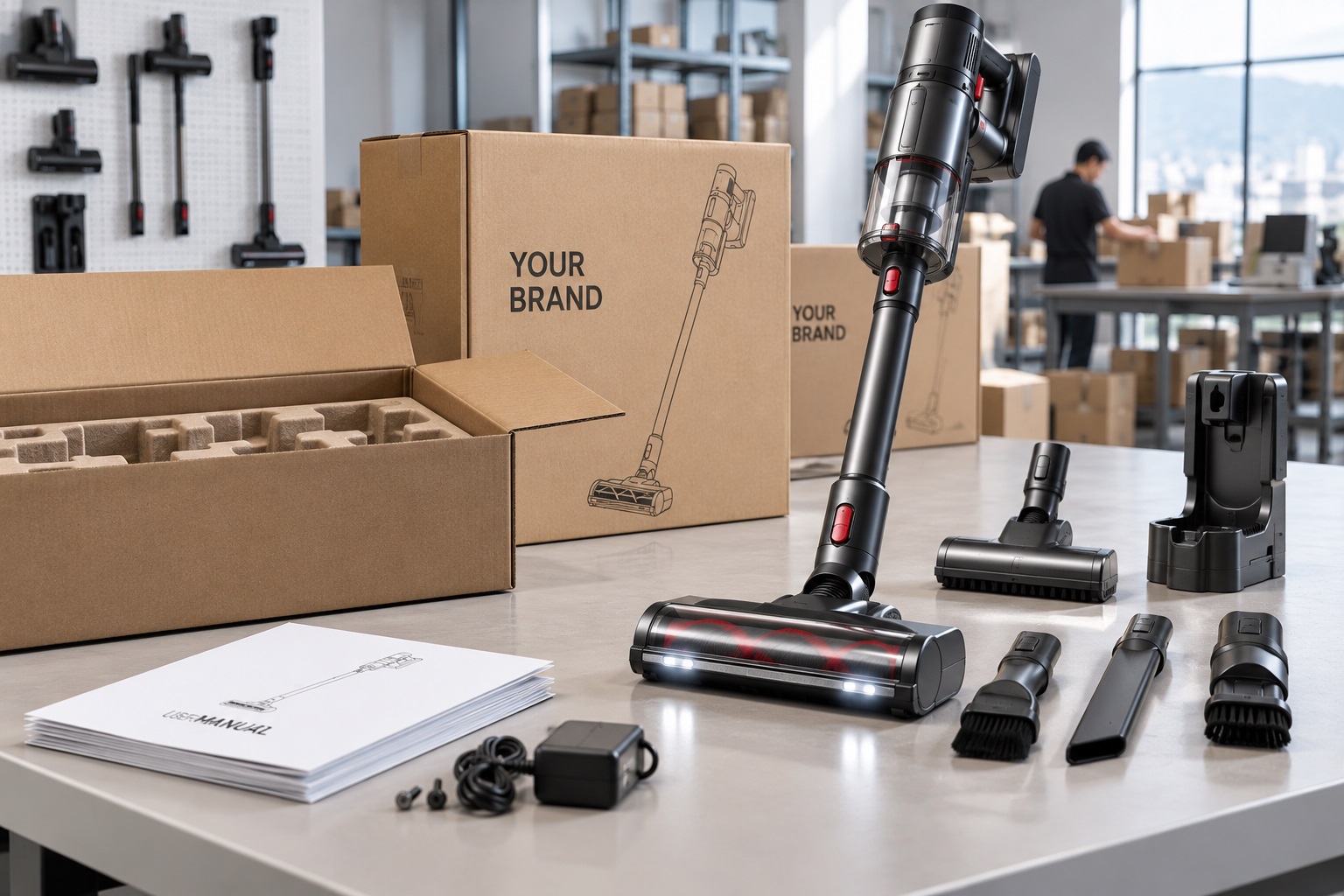
Instead, an importer can work with an established vacuum cleaner manufacturer, select a suitable product platform, and customize elements such as the logo, product color, rating label, packaging, manual, accessory configuration, and other agreed features.
Private labeling can cover many categories, including wet dry vacuum cleaner, industrial vacuum cleaner, commercial vacuum cleaner, and specialized cleaning equipment.
The degree of customization varies.
At the simplest level, a buyer might take an existing machine and add branded packaging.
More advanced projects can include modifications to tank capacity, motor configuration, filtration, hose length, cable, accessories, colors, and selected structural components.
For importers, the key is to determine how much differentiation the target market actually requires before investing in customization.
2. Step 1: Define Your Target Customer and Application 🎯
Before requesting quotations, identify exactly who will use the product.
This sounds obvious, but it is one of the most important parts of successful private-label sourcing.
A professional contractor searching for a wet dry vacuum cleaner for construction site applications has different requirements from a hotel purchasing manager looking for a commercial vacuum cleaner for hotel use.
Likewise, a warehouse cleaning solution may require larger capacity and easy mobility, while a car-care business may prioritize compact dimensions and specialized accessories in a car detailing vacuum cleaner.
Possible target applications include:
Commercial buildings, warehouses, logistics centers, factories, workshops, hotels, retail facilities, construction projects, automotive detailing, professional cleaning services, and facility management.
After selecting the market, define the product position.
Will it be an entry-level machine, a value-oriented professional model, or a heavy duty vacuum cleaner for demanding applications?
This decision influences product specifications, manufacturing cost, packaging, sales channels, and marketing.
3. Step 2: Build a Product Requirement Sheet ⚙️
Do not approach suppliers with only a photo and the question, “How much?”
A structured RFQ—request for quotation—produces much more useful results.
For a wet and dry vacuum cleaner, your requirement sheet can include tank capacity, voltage, frequency, plug type, rated power, motor configuration, suction requirements, airflow requirements, filtration, noise expectations, hose dimensions, cable length, wheels, accessories, tank material, packaging, logo requirements, and estimated order quantity.
If you want a High Suction Vacuum Cleaner, specify how suction performance should be measured.
If you need a Portable Quiet Vacuum Cleaner, establish practical weight and noise targets.
If your market requires a HEPA filter vacuum cleaner, define the filtration requirement and confirm the relevant test or documentation expectations.
Similarly, descriptions such as Multi-Functional Durable Vacuum Cleaner, Fast Lightweight Vacuum Cleaner, and Energy-Saving Efficient Powerful Vacuum Cleaner should be converted into measurable specifications.
Clear technical requirements make quotations easier to compare.
4. Step 3: Decide How Much Customization You Need
Private label, ODM, and OEM projects can overlap.
A basic private-label project normally begins with an existing product.
An ODM vacuum cleaner may allow buyers to select from manufacturer-developed platforms and modify available options.
An OEM vacuum cleaner project can involve more extensive buyer-defined requirements and engineering work.
For a new importer, changing every component rarely makes sense.
Instead, identify which modifications actually create customer value.
For example, a distributor targeting commercial workshops might benefit more from an improved accessory kit, longer cable, better filtration, and convenient storage than from an expensive cosmetic redesign.
On the other hand, an established brand with substantial sales volume may justify custom molds, exclusive colors, unique components, or deeper structural changes.
Customization should support your business strategy—not exist merely for the sake of being different.
5. Step 4: Search for the Right Vacuum Cleaner Manufacturer 🔍
Once your specification is ready, begin supplier research.
Common sourcing searches include vacuum cleaner manufacturer, industrial vacuum cleaner supplier, industrial vacuum cleaner factory, vacuum cleaner manufacturer in China, vacuum cleaner supplier China, and heavy duty vacuum cleaner supplier China.
Do not qualify a supplier solely by website appearance or quotation.
Ask what products the company manufactures, what processes are completed internally, what customization it supports, how quality control is managed, what export markets it serves, and how engineering changes are documented.
Importers should also understand whether they are dealing with a factory, trading company, or integrated supplier.
Each business model can have advantages, but transparency matters.
For customized products, direct access to technical communication can be particularly useful.
A capable cleaning equipment supplier should be able to discuss specifications, samples, production, quality, and documentation—not simply send a price list.
6. Step 5: Compare Suppliers Beyond the Unit Price 💰
Suppose Supplier A quotes $3 less per unit than Supplier B.
Is Supplier A automatically the better choice?
Not necessarily.
Compare equivalent specifications first.
One machine may use a different motor, filter, hose, cable, tank, accessory set, packaging method, or component configuration.
Importers should consider total landed and lifecycle economics, including product cost, packaging, tooling, testing, inspection, freight, duties, warehousing, warranty, spare parts, returns, and after-sales service.
This is particularly important when researching vacuum cleaner price wholesale or industrial vacuum cleaner cost.
A cheaper machine with an elevated return rate can quickly eliminate the initial saving.
For professional buyers, value should be assessed across cost + performance + consistency + serviceability + supply reliability.
That is a more useful purchasing framework than comparing factory prices in isolation.
7. Step 6: Order and Test Samples 🧪
Samples are one of the most important stages of private-label development.
Before committing to a bulk vacuum cleaner purchase, obtain a representative sample of the configuration you plan to sell.
Do more than switch it on for several minutes.
Evaluate the machine under conditions similar to the intended application.
For an industrial vacuum cleaner, consider suction-related performance, airflow, mobility, stability, hose handling, accessory fit, filtration, tank emptying, cable management, noise, assembly, and repeated use.
For a wet and dry suction system, test both appropriate dry and wet pickup functions according to the manufacturer's operating instructions.
If you are developing a dual motor vacuum cleaner, evaluate relevant operating configurations.
For a stainless steel vacuum tank, inspect construction, finish, assembly, and suitability for the intended environment.
Document your findings and send structured feedback to the supplier.
8. Case Study: Importer Developing a Warehouse Private Label 📦
Consider a hypothetical importer supplying cleaning equipment to logistics companies.
Customer feedback indicates demand for a larger industrial wet and dry vacuum cleaner for warehouse cleaning.
The importer initially searches for a completely custom product. After discussing requirements with several suppliers, however, it discovers that an existing platform already satisfies approximately 80% of its needs.
The buyer therefore chooses a private-label/ODM approach.
The proposed changes include a customized color, branded labels, a longer cable, selected filtration, a revised accessory kit, branded cartons, and destination-market documentation.
Samples are evaluated by both the purchasing team and several commercial users.
During testing, operators report that wheel maneuverability and cable length matter more in daily warehouse use than one cosmetic feature the importer originally planned.
The buyer adjusts the specification before mass production.
This saves unnecessary customization cost while improving practical usability.
The lesson is simple: real application feedback should influence private-label product development.
9. Step 7: Design Your Branding and Packaging 🎨
Once the technical configuration is stable, finalize branding.
Private labeling can include the product logo, color, rating label, carton, instruction manual, accessory packaging, warranty materials, barcode, model number, and other market-specific information.
Brand consistency matters.
If your machine is positioned as commercial grade vacuum cleaner equipment, the packaging and documentation should communicate professional use clearly.
If your market emphasizes portability and quiet operation, the product presentation should support that position without making unsupported performance claims.
Packaging also has a practical function.
Importers should evaluate carton dimensions, internal protection, loading efficiency, handling, and expected transportation conditions.
A beautiful retail carton is of little value if the product is insufficiently protected during international shipping.
For wholesale and distributor channels, packaging should balance branding, protection, logistics efficiency, and cost.
10. Step 8: Verify Compliance Before Mass Production 📋
Compliance is a critical importer responsibility.
Applicable requirements depend on the vacuum cleaner configuration, destination market, sales channel, and intended use.
Do not assume that documentation for one product automatically applies to a customized version.
Changes to electrical components, motors, plugs, filters, materials, or other specifications may affect applicable testing or documentation.
Ask the vacuum cleaner supplier to provide documentation relevant to the exact model and configuration you plan to purchase.
Then verify requirements for your destination market with appropriate testing, compliance, customs, or legal professionals where necessary.
This step is especially important for companies planning to import vacuum cleaner from China and distribute products across multiple countries.
Compliance planning should happen before mass production rather than immediately before shipment.
11. Step 9: Confirm the Golden Sample and Purchase Specification ⭐
Before approving a large order, create a clear reference point.
Many importers use an approved pre-production or “golden” sample together with written specifications.
The documentation should identify the agreed product configuration.
This can include model, motor, tank, filtration, hose, cable, accessories, wheels, color, labels, packaging, manual, carton markings, and other relevant details.
Why is this important?
Because conversations can be interpreted differently.
A written specification combined with an approved physical sample provides a stronger basis for production and inspection.
If a component must change because of availability or engineering considerations, establish a formal approval process.
The manufacturer should not make commercially significant substitutions without the agreed communication and approval procedure.
This becomes increasingly important as order quantities grow.
12. Step 10: Negotiate MOQ, Pricing, and Commercial Terms 🤝
When buyers search for wholesale vacuum cleaner, bulk order vacuum cleaner, or factory direct vacuum cleaner, MOQ is usually an important consideration.
Minimum order quantities can depend on product configuration, packaging, custom colors, components, logos, and manufacturing requirements.
Ask how pricing changes across realistic volume levels.
For example, request quotations for several quantities that match your forecast rather than asking only for the lowest possible price at an unrealistic volume.
Also clarify payment terms, Incoterms, tooling costs where applicable, packaging costs, sample charges, production lead time, spare-parts arrangements, and warranty handling.
If you expect recurring orders, discuss forecast communication and reorder lead times.
A sustainable supplier relationship is usually more valuable than extracting a small one-time price reduction that creates quality or service problems later.
13. Step 11: Establish Pre-Shipment Quality Control ✅
Your quality-control plan should be defined before production.
For commercial cleaning equipment and industrial cleaning equipment, inspection criteria can include appearance, assembly, labels, accessories, packaging, electrical checks, operational testing, filtration components, hoses, tanks, cables, wheels, and other agreed specifications.
The exact inspection plan should match the product.
Buyers may conduct inspections using their own team, the manufacturer's QC department, or an independent inspection company.
For significant orders, independent verification can provide another layer of visibility.
Most importantly, determine in advance what constitutes a critical, major, or minor defect and what happens if inspection results do not meet the agreed standard.
Quality control works best when acceptance criteria are defined before problems occur.
14. Step 12: Plan Shipping, Inventory, and Reorders 🚢
Production completion is not the end of the import process.
Importers must coordinate shipping, customs documentation, inventory planning, warehousing, and distribution.
Before placing a bulk order, calculate carton dimensions, gross weight, loading quantities, estimated freight costs, and warehouse requirements.
Large-capacity machines can consume substantial container and storage space, so logistics efficiency can influence landed cost.
Also plan reorder timing.
If production and international transport require several weeks, waiting until inventory is nearly exhausted can lead to stockouts.
For distributors, maintaining a reasonable demand forecast can help the vacuum cleaner manufacturer plan materials and production capacity.
This becomes especially valuable as your private-label brand grows across multiple models.
15. Step 13: Prepare Spare Parts and After-Sales Service 🔧
Importers should think about the entire product lifecycle.
Filters, hoses, brushes, connectors, wheels, and other parts may need replacement over time.
For a heavy duty vacuum cleaner or other professional machine, serviceability can strongly influence customer satisfaction.
Ask your supplier which components are replaceable and how spare parts are ordered.
Consider purchasing an appropriate spare-parts quantity alongside the initial production order.
Also develop a clear warranty procedure.
Who diagnoses failures? What evidence is required? Are defective components replaced or credited? How are recurring problems reported to the factory?
A strong private-label brand needs an after-sales system, not merely inventory.
16. Case Study: Why the Lowest Wholesale Price Can Cost More 📊
Imagine two hypothetical suppliers quoting a commercial wet dry vacuum.
Supplier A offers the lower unit price.
Supplier B is slightly more expensive but provides a better-documented specification, more suitable accessories, structured inspection records, and readily available replacement parts.
The importer chooses Supplier A based primarily on purchase price.
After launch, several issues emerge. Packaging damage increases returns, replacement filters are difficult to obtain, and component consistency creates additional service work.
The initial saving is gradually consumed by warranty expenses and operational costs.
This example illustrates an important principle for buyers researching the best affordable vacuum, good budget vacuum, or best value for money hoover:
Purchase price and total commercial value are not the same thing.
For an importer, a good budget product must still meet defined performance, quality, support, and compliance requirements.
17. Step 14: Build SEO Pages Around Buyer Intent 📈
After launching your private-label product, avoid putting every keyword onto a single page.
Different searches represent different purchasing intentions.
A distributor searching industrial vacuum cleaner supplier may be looking for a manufacturing partner.
Someone searching buy industrial vacuum cleaner may already be evaluating products.
A procurement manager searching commercial vacuum cleaner for sale may have transactional intent.
An importer searching OEM industrial vacuum cleaner manufacturer is likely investigating customization.
Application queries such as wet dry vacuum cleaner for construction site, commercial vacuum cleaner for hotel use, warehouse cleaning solution, and factory floor cleaning require application-specific content.
Consumer-oriented phrases such as best vacuum on a budget, best budget hoover, good budget vacuum cleaner, best affordable vacuum, and best vacuums on a budget represent another search category.
Create separate product, application, sourcing, comparison, FAQ, and technical pages where appropriate.
This approach allows your website to develop a coherent content matrix instead of repeating the same keywords unnaturally across every page.
18. Step 15: Develop a Long-Term Supplier Relationship
A successful private-label project should not be treated as a one-time transaction.
After the first shipment, monitor customer feedback, warranty data, sales performance, frequently requested accessories, and product improvements.
Share structured information with your industrial vacuum cleaner supplier.
If customers consistently request a longer cable, different nozzle, improved accessory storage, or another tank capacity, that information can guide the next production version.
As sales grow, you may move from basic private labeling toward deeper ODM or OEM development.
You may also expand from one wet dry vacuum cleaner into a broader family of commercial vacuum cleaner, industrial, workshop, warehouse, or specialized models.
Continuous improvement creates more defensible differentiation than simply changing logos.
19. Working with Lanxstar for Private Label Vacuum Cleaner Projects 🏭
Importers evaluating private-label manufacturing can discuss their sourcing requirements with Lanxstar based on the intended product platform, market, specifications, and order requirements.
A detailed inquiry can include:
Destination market, target customers, application, estimated annual demand, initial order quantity, voltage/frequency, plug type, tank capacity, motor configuration, filtration, cable length, hose, accessories, colors, logo, packaging, documentation, target price range, and expected delivery schedule.
This helps a vacuum manufacturer determine whether an existing product can support the project or whether ODM/OEM customization should be evaluated.
For example, an importer developing hotel cleaning equipment may emphasize mobility and noise, while a buyer sourcing construction site cleaning equipment may emphasize structural durability and practical debris collection.
A distributor targeting warehouses may instead prioritize capacity, maneuverability, filtration, and maintenance.
The more clearly the application is defined, the more productive supplier discussions can become.
20. Private Label Vacuum Cleaners: From Importer to Brand Owner
Private labeling provides importers with a practical way to move beyond distributing generic products and begin building their own brand equity.
The process should be systematic:
Define the market → specify the product → identify manufacturers → compare suppliers → test samples → finalize customization → verify compliance → approve a reference sample → negotiate commercial terms → inspect production → arrange shipping → support customers → improve future versions.
Importers should resist two common shortcuts: choosing products solely on price and customizing products solely for appearance.
A commercially successful private label vacuum cleaner needs to solve a real customer problem while delivering consistent quality at a viable landed cost.
Whether your target category is a wet and dry vacuum cleaner, commercial vacuum cleaner, industrial vacuum cleaner, or specialized professional cleaning machine, careful supplier qualification and product planning can reduce sourcing risks and create a stronger foundation for long-term growth.
For information about private-label vacuum cleaners, OEM/ODM projects, wholesale sourcing, and manufacturing options, visit www.lxvacuum.com.
If you are interested, please feel free to contact us.
50 Related SEO Keywords
Lanxstar, vacuum manufacturer, vacuum cleaner maker, private label vacuum cleaner, OEM vacuum cleaner, ODM vacuum cleaner, wet dry vacuum cleaner, wet and dry vacuum cleaner, industrial vacuum cleaner, commercial vacuum cleaner, vacuum cleaner manufacturer, vacuum cleaner supplier, industrial vacuum cleaner supplier, vacuum cleaner manufacturer in China, vacuum cleaner supplier China, industrial vacuum cleaner factory, wholesale vacuum cleaner, bulk vacuum cleaner purchase, bulk order vacuum cleaner, factory direct vacuum cleaner, import vacuum cleaner from China, OEM industrial vacuum cleaner manufacturer, cleaning equipment supplier, industrial cleaning equipment, commercial cleaning equipment, industrial equipment supplier, heavy duty vacuum cleaner, high suction power vacuum cleaner, HEPA filter vacuum cleaner, low noise vacuum cleaner, energy efficient vacuum cleaner, dual motor vacuum cleaner, stainless steel vacuum tank, wet and dry suction system, industrial dust extractor, commercial grade vacuum cleaner, warehouse cleaning solution, construction site cleaning equipment, hotel cleaning equipment, hospital cleaning equipment, factory floor cleaning, logistics warehouse cleaning, car detailing vacuum cleaner, facility management cleaning equipment, retail cleaning equipment, commercial vacuum cleaner for sale, wet dry vacuum cleaner for construction site, commercial vacuum cleaner for hotel use, heavy duty vacuum cleaner supplier China, industrial wet and dry vacuum cleaner supplier