Hi, message us with any questions.
We're happy to help!





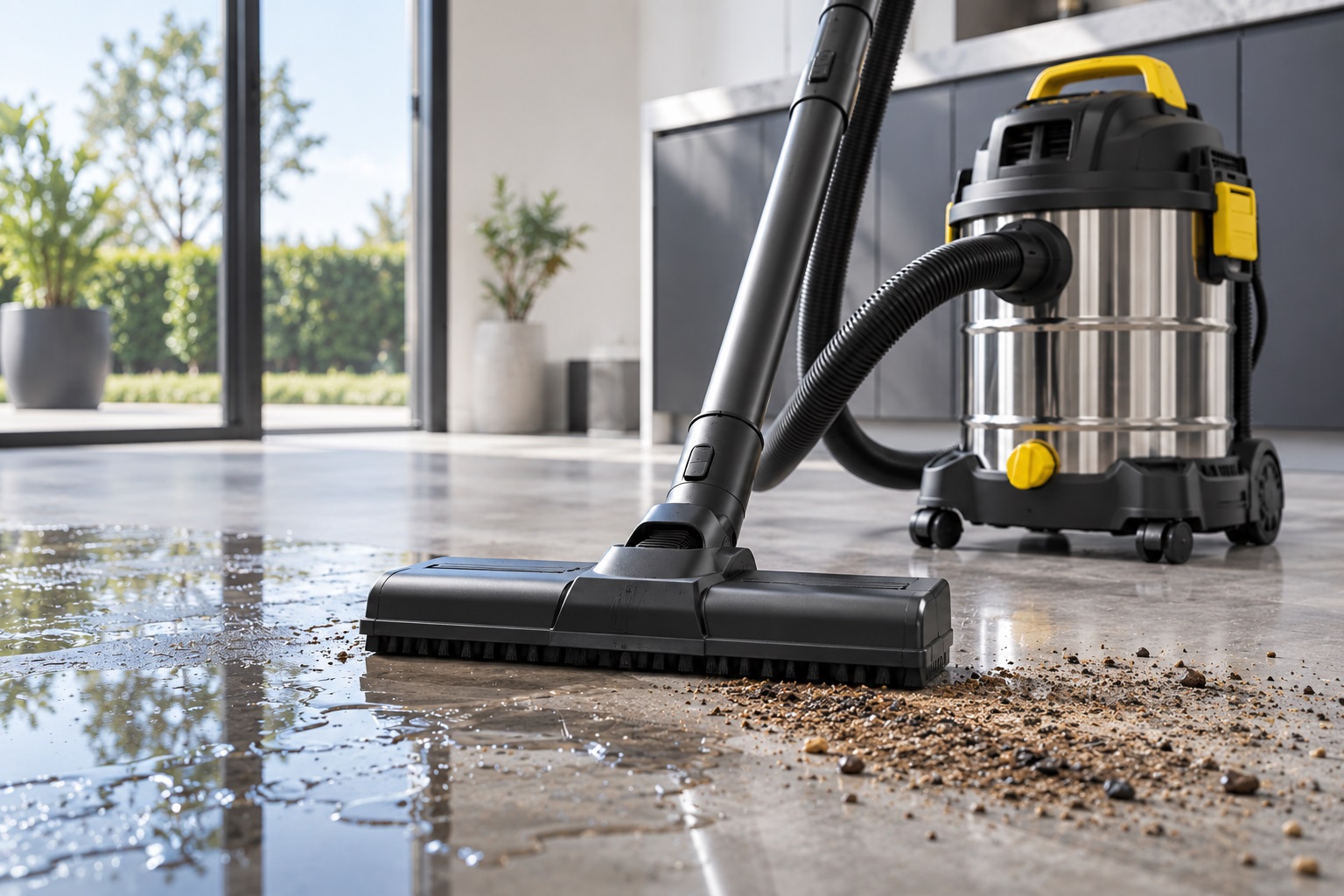
1. Start with the Market, Not the Vacuum Cleaner 🎯
Launching your own wet dry vacuum cleaner brand can look straightforward: find a factory, choose a machine, add your logo, order packaging, and begin selling.
In reality, successful private-label development starts much earlier.
Before contacting a vacuum cleaner manufacturer, determine exactly who will buy your product and what cleaning problem it should solve.
A wet dry vacuum designed for residential garages is different from an industrial vacuum cleaner used on a factory floor. Likewise, a machine developed as hotel cleaning equipment may prioritize quiet operation and mobility, while construction site cleaning equipment can require durability, larger debris handling, robust accessories, and easy movement across rough surfaces.
Start by defining three things:
Target customer + application + price position.
For example:
“An affordable 30L wet dry vacuum for professional workshops.”
is much more actionable than:
“We want to sell a powerful vacuum cleaner.”
A defined market position helps your manufacturing partner recommend the right motor, tank, filtration, accessories, packaging, and product platform.
2. Identify Your Wet Dry Vacuum Cleaner Niche
The wet and dry vacuum market covers multiple customer groups.
Instead of attempting to compete in every segment, new brands can focus on a specific application or customer profile.
Potential categories include warehouse cleaning solution, factory floor cleaning, logistics warehouse cleaning, automotive detailing, hotels, retail facilities, workshops, construction sites, commercial cleaning companies, and facility-management contractors.
For example, a brand focused on workshops could develop a compact High Suction Vacuum Cleaner with wet and dry capability and practical accessory storage.
A warehouse-oriented brand might prioritize a Large-Capacity Wet Dry Vacuum Cleaner with durable wheels and a larger tank.
Hotels and commercial buildings may place greater value on a Portable Quiet Vacuum Cleaner or low noise vacuum cleaner.
Automotive businesses may prefer a maneuverable car detailing vacuum cleaner with suitable nozzles for seats, carpets, corners, and vehicle interiors.
Your niche affects almost every decision that follows—from product specifications to advertising language.
3. Decide Between Private Label, ODM, and OEM 🏭
Once your market position is clear, decide how extensively you want to customize the product.
A private label vacuum cleaner is usually the simplest route. You select an existing model from a manufacturer and apply your brand identity through logos, labels, manuals, cartons, and other packaging elements.
An ODM vacuum cleaner project can provide additional configuration options while still using an existing manufacturer-developed platform.
An OEM vacuum cleaner project generally involves deeper customization based on buyer-defined requirements.
For a new brand, an existing platform can reduce development complexity.
Suppose you want to launch a commercial vacuum cleaner for hotel use. If the factory already manufactures a suitable machine, developing an entirely new chassis may offer little commercial benefit. Instead, you could focus resources on filtration, accessory selection, color, branding, packaging, documentation, and customer support.
However, if you identify an unmet market need that existing products cannot satisfy, deeper OEM development may be justified.
The correct choice depends on differentiation, budget, order volume, engineering capability, and launch schedule.
4. Turn Marketing Ideas into Technical Specifications ⚙️
One of the most important steps in launching a vacuum cleaner brand is converting marketing language into measurable product requirements.
Terms such as High Suction Vacuum Cleaner, Fast Lightweight Vacuum Cleaner, Multi-Functional Durable Vacuum Cleaner, and Energy-Saving Efficient Powerful Vacuum Cleaner may describe customer benefits, but a factory needs specifications.
For a wet and dry vacuum cleaner, your specification sheet could include:
Tank capacity, rated input power, motor configuration, suction and airflow requirements, voltage and frequency, filtration system, hose length and diameter, power cable length, noise target, wet pickup requirements, wheel design, accessory kit, tank material, packaging, and intended operating environment.
If you want a HEPA filter vacuum cleaner, define the filtration requirements instead of using “HEPA” only as a marketing term.
If you need a dual motor vacuum cleaner, determine when one or both motors should operate and what performance you expect.
For an industrial model, a stainless steel vacuum tank may be considered depending on the application and product design.
Precise specifications make quotations easier to compare and reduce disagreements later in the project.
5. Find the Right Vacuum Cleaner Manufacturer
Searching for a factory is not simply about finding the lowest quotation.
Buyers may search Google for industrial vacuum cleaner supplier, vacuum cleaner supplier, vacuum cleaner manufacturer in China, industrial vacuum cleaner factory, vacuum cleaner supplier China, or OEM industrial vacuum cleaner manufacturer.
Regardless of the search phrase, supplier qualification should go deeper.
Ask potential manufacturers about their existing product platforms, manufacturing processes, quality-control procedures, customization capabilities, production capacity, sample process, lead times, export experience, component sourcing, packaging capabilities, and after-sales support.
Also determine whether the company is primarily a manufacturer, trading company, or a combination of both.
This distinction does not automatically determine supplier quality, but buyers should understand who is responsible for manufacturing and engineering.
A suitable cleaning equipment supplier should be able to discuss technical specifications—not only price.
6. Request Samples Before a Bulk Order 🔍
Never treat catalog photos as a substitute for product evaluation.
Before committing to a bulk vacuum cleaner purchase, obtain representative samples based on the configuration you intend to sell.
Test the vacuum under conditions that reflect the real application.
For example, if you plan to market a wet dry vacuum cleaner for construction site use, evaluate movement, hose handling, accessory attachment, tank stability, debris collection, wet pickup, emptying, filtration, and component durability.
For a commercial vacuum cleaner for hotel use, evaluate noise, maneuverability, cable length, accessory storage, transportation, and usability around furniture.
A warehouse product should be tested across the surfaces and cleaning conditions expected in logistics facilities.
Product engineers should also document results rather than relying on impressions such as “powerful” or “quiet.”
📌 Tip: Establish an approved reference sample before mass production. It can become an important benchmark for later quality inspections.
7. Case Study: Building a Private-Label Wet Dry Vacuum Brand 📦
Consider a hypothetical European cleaning-equipment distributor that already sells floor-care accessories but wants to enter the wet dry vacuum category.
The company initially considers developing a completely new machine.
After reviewing development costs and expected first-year volume, however, it decides that a customized ODM platform is more practical.
The distributor asks its manufacturing partner for a 30L machine suitable for workshops and light commercial environments.
Rather than redesigning the entire vacuum, the project focuses on several commercially meaningful changes:
A branded color scheme, customized labels, selected accessory kit, longer cable, product manual for the destination market, branded carton, and upgraded filtration option.
The distributor orders samples and sends them to its sales and technical teams for evaluation.
During testing, the team discovers that customers are likely to value accessory organization more than one of the cosmetic modifications originally proposed. The specification is adjusted before mass production.
This illustrates why sampling matters.
A successful private label vacuum cleaner should be designed around customer requirements—not simply around what looks different in a catalog.
8. Build a Brand Instead of Just Printing a Logo 🎨
Your brand identity should communicate a clear reason for customers to choose your vacuum cleaner.
A logo alone is not positioning.
Consider what you want customers to associate with the brand:
Durability? Professional performance? Value? Quiet operation? Portability? Industrial capability? Easy maintenance?
For example, a company targeting contractors might emphasize robust industrial cleaning equipment.
A brand serving hotels and offices could focus on practical commercial cleaning equipment.
A business serving warehouses might develop its identity around reliable facility management cleaning equipment and large-area cleaning applications.
Keep visual identity consistent across the machine, carton, manual, website, spare-parts packaging, sales materials, and distributor documentation.
This consistency becomes especially important when you expand from one vacuum cleaner into a broader product portfolio.
9. Understand Certification and Destination-Market Requirements
Compliance should be considered before placing the production order—not after the machines arrive at the destination port.
Requirements vary according to product configuration and market.
A manufacturer may already have documentation for certain models, but buyers should verify whether the exact product configuration being purchased is covered and whether documentation is appropriate for the destination market.
Changes to motors, plugs, electrical components, filters, or other product elements can potentially affect applicable testing or documentation.
This is particularly important for businesses planning to import vacuum cleaner from China for resale in multiple countries.
The importer, manufacturer, testing organization, and relevant compliance professionals should confirm applicable requirements before mass production.
Avoid assuming that documentation for one model automatically applies to every customized version.
10. Calculate the Real Cost of Your Vacuum Cleaner 💰
Many new brands focus almost exclusively on factory unit price.
That can produce misleading comparisons.
The real landed and operating economics may include product cost, customization, tooling, packaging, testing, inspection, freight, duties, warehousing, fulfillment, warranty reserves, replacement parts, marketing, distributor margin, and after-sales support.
When researching vacuum cleaner price wholesale or industrial vacuum cleaner cost, compare equivalent specifications and commercial terms.
A lower-cost model that creates higher warranty expenses may ultimately be less profitable.
Similarly, an energy efficient vacuum cleaner should be evaluated based on measurable energy use and cleaning performance.
For B2B buyers, the “best value for money hoover” is not necessarily the product with the lowest purchase price.
Value is determined by the relationship between cost, performance, durability, customer satisfaction, serviceability, and commercial margin.
11. Set Your MOQ and First Production Order Carefully
MOQ—minimum order quantity—is an important part of OEM and ODM negotiations.
Customization often affects MOQ.
A standard product with only a label change may support a different order structure from a machine requiring custom plastic colors, printed cartons, new accessories, or dedicated components.
New brands should avoid ordering volume based solely on optimistic sales projections.
Instead, consider expected monthly demand, inventory turnover, shipping economics, production lead time, seasonality, warehouse costs, and reorder cycles.
If you are searching for wholesale vacuum cleaner, bulk order vacuum cleaner, or factory direct vacuum cleaner options, ask the supplier to explain how order quantity affects unit pricing, packaging, customization, and lead time.
The objective is not simply to obtain the largest discount.
It is to establish an inventory level that supports sales without creating unnecessary working-capital pressure.
12. Create a Quality-Control Plan Before Production 🧪
Quality control should begin before the production line starts.
The buyer and vacuum cleaner manufacturer should agree on product specifications and inspection criteria.
Depending on the model, inspection points may cover appearance, labeling, dimensions, tank assembly, wheels, hoses, accessories, cable, switches, motor operation, suction-related performance, electrical checks, packaging, and carton markings.
For a heavy duty vacuum cleaner, buyers may also want application-specific durability checks.
For a wet and dry suction system, wet-pickup functionality should be included in the agreed evaluation process where applicable.
Define how defects are classified and how inspection results will be handled.
Photos, approved samples, specifications, packaging artwork, and signed product requirements can reduce ambiguity.
Consistency becomes increasingly important as your brand grows because customers expect the second order to perform like the first.
13. Plan Spare Parts and After-Sales Support
A vacuum cleaner brand does not end when the machine is sold.
Commercial and industrial customers may need hoses, filters, brushes, wheels, connectors, switches, or other replaceable components during the product lifecycle.
Discuss spare-parts availability with your vacuum cleaner supplier before launch.
Ask which parts are replaceable, how they are identified, how long the supplier expects to support them, and what quantities should be included with bulk orders.
This is especially relevant for a commercial grade vacuum cleaner or heavy duty vacuum cleaner used frequently in professional environments.
For distributors, spare parts can also become a competitive advantage.
Customers purchasing professional equipment often value predictable maintenance and parts availability alongside initial performance.
14. Build Your Sales Strategy Around Real Search Intent 📈
Once your product is ready, your website content should reflect how different buyers search.
A purchasing manager may search buy industrial vacuum cleaner.
A wholesaler might search vacuum cleaner price wholesale.
A distributor may search industrial vacuum cleaner supplier or heavy duty vacuum cleaner supplier China.
A sourcing company may search OEM industrial vacuum cleaner manufacturer.
Application-driven buyers might use much longer phrases such as industrial wet and dry vacuum cleaner for warehouse cleaning supplier or wet dry vacuum cleaner for construction site.
Consumer-oriented traffic may use phrases such as best vacuum on a budget, best budget hoover, good budget vacuum, best affordable vacuum, or best vacuums on a budget.
These searches represent different intentions.
Do not force all of them onto one product page.
Instead, create a content architecture consisting of product pages, application pages, OEM/ODM pages, purchasing guides, comparisons, FAQs, and technical articles.
This creates a more natural Google SEO content matrix and allows each page to target a specific search intention.
15. Case Study: From One Product to a Commercial Vacuum Range 🚀
Consider another hypothetical importer.
Its first product is a compact wet dry vacuum targeted at automotive workshops. After establishing distributor demand, the company collects feedback from customers.
Some want larger tank capacity. Others need stronger commercial configurations for workshop and warehouse use, while another customer group wants quieter equipment for indoor facilities.
Instead of forcing one machine to serve every application, the importer expands into several product positions.
The original machine remains the entry-level car detailing vacuum cleaner.
A larger model is introduced for workshop and factory floor cleaning.
Another configuration focuses on logistics warehouse cleaning.
A quieter model is positioned toward hotels and other indoor commercial environments.
This product-family approach allows the brand to grow around customer applications rather than accumulating unrelated models.
It also creates more SEO opportunities because each product and application can have dedicated content.
16. Working with Lanxstar on Private-Label and OEM Vacuum Cleaners 🤝
Businesses developing their own wet dry vacuum cleaner brand need a manufacturing partner capable of discussing both commercial requirements and product specifications.
Lanxstar works with vacuum cleaner sourcing and customization projects for international buyers. Depending on the product platform and project requirements, buyers can discuss private-label, ODM, OEM, wholesale, and bulk-order options.
A useful RFQ should include:
Target country, customer type, application, expected annual volume, initial order quantity, tank capacity, motor requirements, voltage/frequency, plug type, filtration, hose and cable requirements, accessories, color, logo, packaging, documentation, and expected delivery schedule.
The more complete your RFQ, the easier it becomes for a vacuum manufacturer to evaluate feasibility and prepare an appropriate proposal.
For buyers who already have an engineering specification, technical drawings or structured requirement sheets can further improve communication.
17. From Product Idea to Your Own Wet Dry Vacuum Cleaner Brand
Launching a wet dry vacuum cleaner brand is ultimately a combination of product development, sourcing, quality management, branding, and distribution.
Start with a clearly defined customer.
Choose an application where you can create meaningful value.
Decide whether private label, ODM, or OEM best matches your budget and differentiation strategy.
Translate marketing ideas into measurable specifications.
Evaluate your vacuum cleaner manufacturer carefully, test samples, confirm destination-market requirements, calculate the real commercial cost, establish quality standards, and plan spare-parts support before scaling.
Most importantly, treat the first vacuum cleaner as the beginning of a product system rather than an isolated SKU.
A carefully planned first model can eventually develop into a broader portfolio of industrial vacuum cleaner, commercial vacuum cleaner, wet and dry vacuum cleaner, and specialized cleaning solutions serving different customer groups.
For more information about vacuum cleaner manufacturing, private-label development, OEM/ODM projects, and bulk sourcing, visit www.lxvacuum.com.
If you are interested, please feel free to contact us.
50 Related SEO Keywords
Lanxstar, vacuum manufacturer, vacuum cleaner maker, wet dry vacuum cleaner, wet and dry vacuum cleaner, OEM vacuum cleaner, ODM vacuum cleaner, private label vacuum cleaner, industrial vacuum cleaner, commercial vacuum cleaner, vacuum cleaner manufacturer, vacuum cleaner supplier, industrial vacuum cleaner supplier, vacuum cleaner manufacturer in China, industrial vacuum cleaner factory, vacuum cleaner supplier China, wholesale vacuum cleaner, bulk vacuum cleaner purchase, bulk order vacuum cleaner, factory direct vacuum cleaner, OEM industrial vacuum cleaner manufacturer, industrial cleaning equipment, commercial cleaning equipment, cleaning equipment supplier, industrial equipment supplier, high suction power vacuum cleaner, heavy duty vacuum cleaner, HEPA filter vacuum cleaner, low noise vacuum cleaner, energy efficient vacuum cleaner, dual motor vacuum cleaner, stainless steel vacuum tank, wet and dry suction system, industrial dust extractor, commercial grade vacuum cleaner, warehouse cleaning solution, construction site cleaning equipment, hotel cleaning equipment, hospital cleaning equipment, factory floor cleaning, logistics warehouse cleaning, car detailing vacuum cleaner, facility management cleaning equipment, retail cleaning equipment, commercial vacuum cleaner for sale, import vacuum cleaner from China, wet dry vacuum cleaner for construction site, commercial vacuum cleaner for hotel use, heavy duty vacuum cleaner supplier China, industrial wet and dry vacuum cleaner supplier



