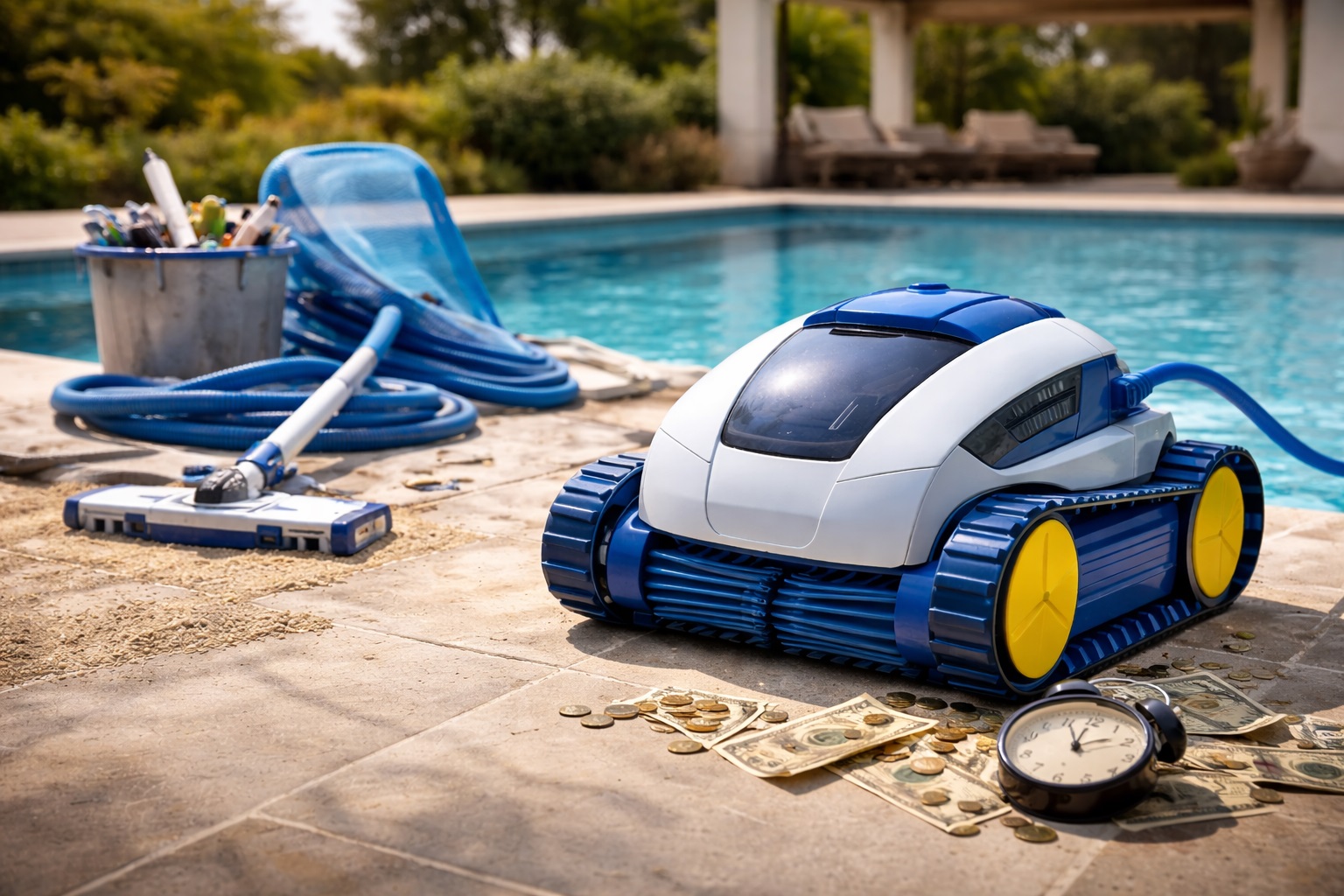
Why “Doing It the Old Way” Is Becoming a Business Risk
Pool cleaning has long been treated as a routine task—manual, repetitive, and rarely questioned. For many operators, facility managers, and equipment buyers, the assumption still holds: traditional cleaning is cheaper because it relies on basic tools.
In reality, traditional pool cleaning methods often waste far more than water and energy. They quietly consume time, labor capacity, and operational focus, turning maintenance into a long-term efficiency drain rather than a controlled process.
This article examines the real cost of traditional pool cleaning from a time-based and system-efficiency perspective, and explains why more professionals are shifting toward multi-functional, high-performance vacuum solutions.
⏱️ Time Is the Most Expensive Resource in Pool Maintenance
The real cost of pool cleaning is rarely visible on an invoice.
Repetitive Manual Labor
Traditional cleaning relies heavily on:
Manual brushing
Multiple cleaning passes
Constant supervision
Each step consumes time without improving long-term outcomes. In commercial or multi-site operations, these inefficiencies multiply quickly.
Low Cleaning Frequency by Design
Because manual cleaning is physically demanding and slow, it is often postponed. Lower frequency leads to:
Key Insight:
When cleaning takes too long, it gets delayed—and delayed cleaning always costs more later.
🧠 The False Economy of “Low-Cost” Tools
Basic tools appear economical at first glance, but fail under real operating conditions.
Traditional workflows often require:
This fragmented process increases setup time, tool switching, and operator fatigue. A multi-functional durable vacuum cleaner consolidates these steps into a single workflow, reducing wasted motion and operational complexity.
🧪 Case Snapshot: How Traditional Methods Waste Time
In a residential facility managing multiple pools, manual cleaning required frequent tool changes and repeated passes, averaging over two hours per pool. Despite the time investment, visible debris often returned within days.
After switching to a multi-functional wet and dry vacuum system, total cleaning time was reduced by nearly 40–50%, while cleaning frequency increased without adding labor. The improvement came not from working faster, but from eliminating redundant steps and tool switching.
🔌 Cordless Handheld Vacuum Cleaner: Convenience Without a System
A cordless handheld vacuum cleaner is often chosen for ease of use, but its role is limited.
Where It Adds Value
Where It Falls Short
Without system-level airflow control and filtration, handheld tools often create short-lived results that require frequent repetition.
💨 High Suction Vacuum Cleaner: Power Alone Is Not Efficiency
A high suction vacuum cleaner is effective only when suction is paired with stability and containment.
Without controlled airflow:
High power without system design often extends total cleaning time instead of reducing it.
🧪 HEPA Filter Vacuum Cleaner: Time Saved Through Containment
One hidden time cost of traditional cleaning is secondary contamination.
A HEPA filter vacuum cleaner prevents fine particles from escaping through exhaust airflow, reducing:
Containment is a direct time-saving mechanism, not just a hygiene feature.
💧 Wet and Dry Vacuum Cleaner: Eliminating Redundant Workflows
Traditional pool cleaning separates “wet” and “dry” tasks.
A wet and dry vacuum cleaner removes this inefficiency by:
Handling water, sludge, and debris in one pass
Reducing tool changes
Shortening total cleaning cycles
For operators and facility managers, this directly translates into fewer labor hours per week.
⚙️ The Compounding Cost of Traditional Methods
Over time, traditional pool cleaning creates cumulative losses:
More labor hours per task
Higher fatigue and error rates
Increased equipment wear
Greater reliance on chemicals
What appears inexpensive per session becomes expensive per month.
🧩 What a Time-Efficient Pool Cleaning System Looks Like
Professionals who successfully reduce cleaning time adopt a system-based approach:
Multi-functional durable vacuum cleaner for task consolidation
High suction vacuum cleaner with controlled airflow
HEPA filtration to prevent recontamination
Wet and dry vacuum cleaner capability for all conditions
Cordless handheld tools only as secondary support
This structure minimizes wasted effort and maximizes real cleaning impact.
📌 A Strategic Message for B2B Buyers and Facility Managers
If pool cleaning feels like it consumes more time every year, the issue is not discipline—it is methodology.
For distributors, OEM partners, and decision-makers, the real value lies in solutions that reduce time per task, not just upfront equipment cost.
Those who help customers reclaim time will earn long-term trust.
Hashtags
Pool Cleaning Efficiency, Traditional Pool Cleaning Methods, Time Cost of Pool Maintenance, Multi-Functional Durable Vacuum Cleaner, High Suction Vacuum Cleaner, Cordless Handheld Vacuum Cleaner, HEPA Filter Vacuum Cleaner, Wet and Dry Vacuum Cleaner, Commercial Pool Maintenance, Facility Management Solutions, Pool Maintenance Optimization, Labor Cost Reduction, Cleaning Workflow Optimization, Pool Cleaning Technology, B2B Cleaning Equipment, Professional Pool Services, Industrial Vacuum Cleaner, Pool Equipment Suppliers, Pool Maintenance Contractors, Sustainable Pool Maintenance, Equipment ROI Analysis, Pool Water Quality Management, Modern Pool Care Solutions, Cleaning System Design, Product Design Engineering, Vacuum Performance Optimization, Facility Operations Efficiency, Pool Cleaning Innovation, Commercial Facility Cleaning, Residential Pool Management, Dust Containment Technology, Airflow Engineering, Pool Maintenance Best Practices, Equipment Lifecycle Cost, Low Downtime Cleaning, Operational Efficiency Improvement, Pool Service Providers, EU Pool Maintenance, Middle East Pool Operations, Cleaning Industry Trends, Time Efficient Cleaning Systems, Pool Maintenance Strategy, Lanxstar











