Hi, message us with any questions.
We're happy to help!





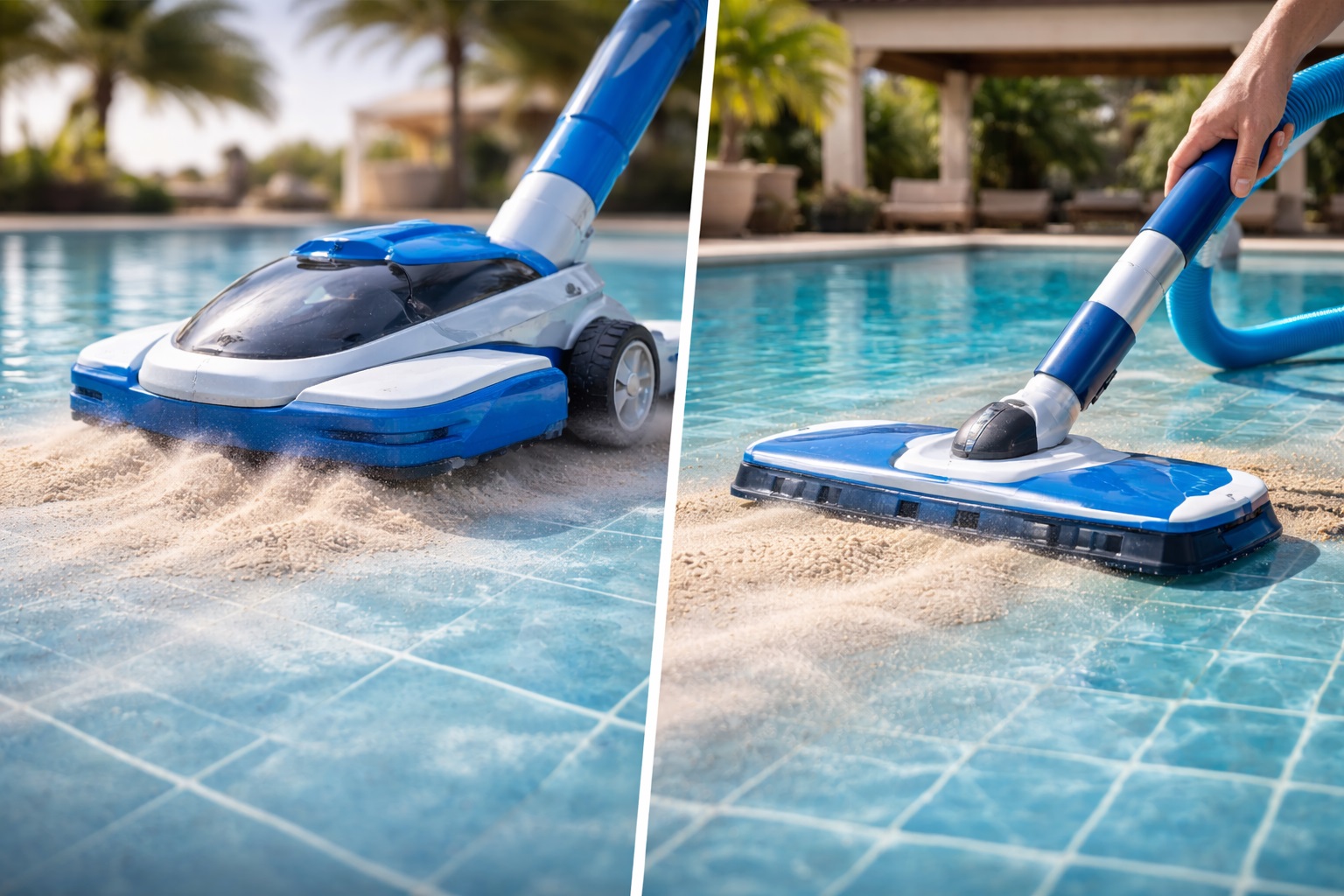
Why Pool Floors Look Clean—but Never Truly Are
Fine dust accumulating on pool floors is one of the most misunderstood problems in pool maintenance. On the surface, the pool may look clean. Water clarity appears normal. Yet hours or days after cleaning, a thin layer of dust quietly returns to the bottom.
For pool operators, distributors, and equipment buyers, this creates a frustrating contradiction:
“We cleaned it properly—so why does the dust keep coming back?”
The answer lies not in effort, but in particle physics, airflow behavior, and vacuum system design. This article explains the real reason fine dust is hard to remove from pool floors and what actually works—especially in commercial and high-frequency maintenance environments.
🌫️ Fine Dust Is Not “Small Dirt”—It Behaves Differently
Most cleaning tools are designed for visible debris. Fine dust is different.
Ultra-Fine Particle Suspension
Fine dust particles are light, smooth, and easily disturbed. When vacuumed improperly, they do not travel cleanly into the collection system. Instead, they:
Lift briefly
Spread laterally
Re-settle once suction stops
This creates the illusion of cleaning without true removal.
Electrostatic Adhesion to Pool Surfaces
Pool floors, especially tiled or coated surfaces, generate mild electrostatic attraction in water. Fine dust adheres lightly but consistently, making it harder to detach without controlled airflow.
Key Insight:
If airflow is unstable, fine dust will move—but not leave.
🧠 Why Standard Pool Vacuums Fail with Fine Dust
Most failures are design-related, not operational.
High Suction Without Control
Many systems emphasize strong suction but lack airflow stability. Turbulence at the suction head causes dust to scatter before it is captured.
This is why a wet and dry vacuum cleaner must be engineered for controlled extraction, not just peak power.
🧪 Field Observation: When More Power Makes Results Worse
In multiple commercial pool sites, operators attempted to solve fine dust issues by increasing suction power alone. The result was counterintuitive: stronger turbulence at the suction head caused fine dust to spread across a wider area of the pool floor.
Despite higher power consumption, visible dust reappeared within 24 hours. This confirmed that suction strength without airflow control increases dust redistribution rather than removal.
Small Tanks, Frequent Pressure Loss
Vacuum systems with limited capacity experience rapid internal pressure changes. As suction drops, fine dust escapes and resettles.
🧹 Wet and Dry Vacuum Cleaner: The Baseline for Fine Dust Removal
A properly designed wet and dry vacuum cleaner is the foundation for managing fine dust on pool floors.
What Actually Matters
Consistent airflow under wet load
Sealed internal pathways
Smooth suction head geometry
Compatibility with fine-particle filtration
Without these elements, dust removal remains temporary.
⚡ Fast Lightweight Vacuum Cleaner: Speed Reduces Re-Contamination
Fine dust is extremely sensitive to disturbance time.
A fast lightweight vacuum cleaner allows operators to:
Cover large floor areas quickly
Reduce agitation duration
Minimize secondary dust spread
Speed here is not about labor efficiency—it is about particle behavior control.
🛢️ Large-Capacity Wet Dry Vacuum Cleaner: Stability Over Time
Capacity directly affects cleaning consistency.
A large-capacity wet dry vacuum cleaner maintains:
Stable internal pressure
Constant suction performance
Fewer interruptions during cleaning
This is critical in commercial pools, where partial cleaning often leads to uneven dust redistribution.
🧪 Comparative Case: Same Pool, Different Outcomes
In a mid-size commercial pool with daily usage, standard vacuuming resulted in fine dust reappearing within 12–24 hours. Increasing cleaning frequency produced only marginal improvement.
After switching to a wet and dry vacuum cleaner system with stable airflow and larger collection capacity, operators observed a significant change. Cleaning time was reduced, and fine dust recurrence was delayed to more than 5–7 days under similar operating conditions.
The decisive factor was not higher suction, but airflow stability and containment during extraction.
🧳 Portable Vacuum for Travel: Precision, Not Sustained Removal
A portable vacuum for travel serves a specific role.
Effective for:
Spot-cleaning localized dust
Post-weather-event maintenance
Small or private pools
Not suitable for:
Full-floor fine dust removal
High-volume commercial environments
Portability offers control, not endurance.
🔁 Wet Dry Vacuum Cleaners vs Traditional Pool Tools
Traditional tools rely on:
Brushing
Manual agitation
Pool circulation systems
Modern wet dry vacuum cleaners focus on:
Direct extraction
Enclosed airflow
Minimal dust redistribution
This fundamental difference explains why outcomes vary dramatically.
⚙️ What Actually Removes Fine Dust from Pool Floors
Effective fine dust removal requires a system-level approach.
The most reliable setups share five characteristics:
Wet and dry vacuum cleaner with stable airflow
Fast lightweight design to reduce disturbance time
Large-capacity tank for pressure consistency
Sealed filtration for fine-particle containment
Structured cleaning patterns that minimize resuspension
This combination removes dust instead of relocating it.
📌 Strategic Insight for B2B Buyers and Engineers
Fine dust is not stubborn—it is mismanaged.
For distributors, OEM partners, and product engineers, the opportunity lies in designing and selecting vacuum systems that respect particle behavior rather than simply increasing power.
Those who solve fine dust at the system level will define the next standard in professional pool maintenance.
Hashtags
Fine Dust Pool Floors, Pool Dust Removal Solutions, Wet and Dry Vacuum Cleaner, Fast Lightweight Vacuum Cleaner, Large-Capacity Wet Dry Vacuum Cleaner, Portable Vacuum for Travel, Wet Dry Vacuum Cleaners, Pool Floor Cleaning Technology, Fine Particle Control, Commercial Pool Maintenance, Swimming Pool Cleaning Systems, Dust Containment Design, Vacuum Airflow Stability, Pool Cleaning Equipment, B2B Cleaning Equipment, Industrial Vacuum Cleaner, Pool Maintenance Solutions, Fine Dust Management, Water Environment Cleaning, Airflow Engineering, Vacuum Filtration Technology, Pool Water Quality Management, Commercial Facility Cleaning, Professional Pool Services, Cleaning Equipment Design, Product R&D Engineering, Pool Maintenance Innovation, Efficient Pool Cleaning Systems, Dust Redistribution Control, Pool Cleaning Best Practices, Industrial Cleaning Solutions, Facility Management Cleaning, High Frequency Cleaning Environments, Engineering Driven Cleaning, Vacuum Performance Optimization, Pool Equipment Suppliers, Cleaning Industry Trends, Pool Service Contractors, Fine Dust Control Technology, Performance Vacuum Systems, Pool Maintenance Strategy, EU Pool Maintenance, Middle East Pool Cleaning, Lanxstar



