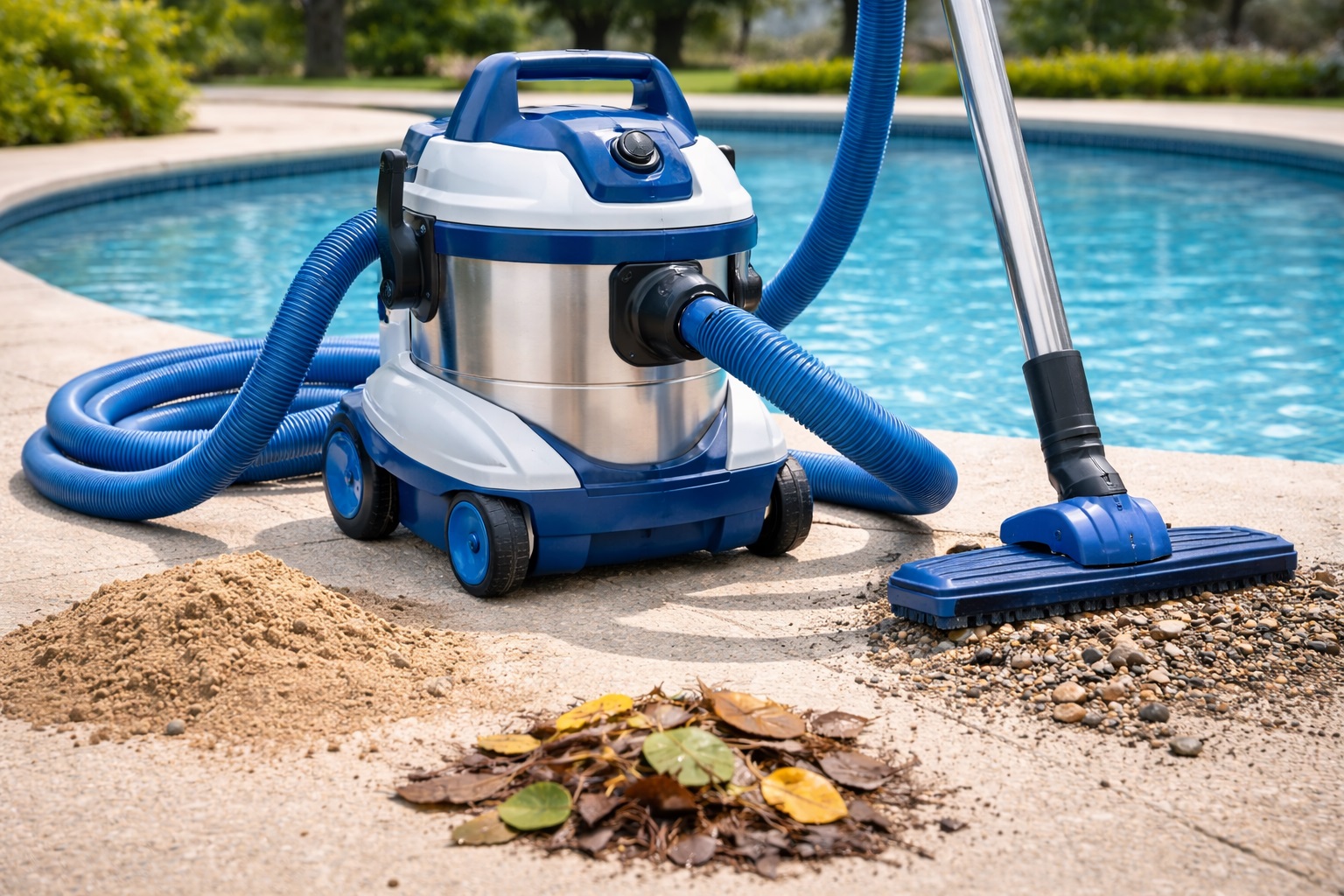
A Realistic Engineering and Usage Analysis
Pool environments create one of the most demanding cleaning scenarios for any vacuum cleaner. Unlike typical household cleaning, poolside debris is rarely uniform. It is a mixture of:
Water
Sand
Leaves
Fine dust
Organic residues
This leads to a common and very practical question from buyers, distributors, and even engineers:
Can one vacuum truly handle water, sand, and pool debris—reliably and over time?
The short answer is: Yes—but only if the vacuum is engineered for mixed-debris stress, not marketed for convenience alone.
This article explains why most vacuums fail, what design elements matter, and when a wet and dry vacuum cleaner becomes the only realistic solution.
🔍 1. Why Mixed Pool Debris Is a Worst-Case Scenario
Most vacuum cleaners are designed to handle one dominant material type:
Dry dust
Light debris
Occasional moisture
Poolside cleaning breaks that assumption.
Mixed debris creates three simultaneous stresses:
Hydraulic resistance from water
Abrasive wear from sand
Clogging risk from leaves and organic matter
Any vacuum that handles only one or two of these will fail prematurely.
⚠️ 2. Why Conventional Vacuums Fail So Quickly
Standard household or pool-only vacuums often fail for predictable reasons:
Sand erodes internal airflow channels
Water increases motor load
Fine particles bypass basic filtration
Wet debris sticks to hoses and tanks
This is why buyers frequently report:
These failures are structural, not user error.
🧠 3. The Engineering Logic Behind a True Wet and Dry Vacuum Cleaner
A wet and dry vacuum cleaner is not just a vacuum with “water tolerance.”
It is designed around material separation and airflow stability.
Key design principles include:
Independent wet and dry airflow paths
Reinforced internal surfaces resistant to abrasion
Float valves or sensors to prevent water overflow
Sealed motor chambers
Without these elements, “wet capability” is only theoretical.
🔄 4. Can One Machine Really Do It All?
The answer depends on how the machine is positioned and used.
A Multi-Functional Durable Vacuum Cleaner can realistically handle:
Pool water extraction
Sand and grit removal
Leaves and organic debris
Garage, terrace, and utility cleaning
But only if it is:
This is where many products claim versatility—but only some deliver it.
🚀 5. The Role of Portable Self-Cleaning Vacuum Cleaner Design
Self-cleaning features are increasingly promoted, but not all are meaningful.
A Portable Self-Cleaning Vacuum Cleaner becomes valuable when:
Internal filters can be rinsed without disassembly
Tanks are shaped to avoid residue buildup
Hose and intake paths reduce sand accumulation
In pool environments, self-cleaning is less about automation and more about hygiene and time savings.
🧪 Engineering Insight: Why Sand Is the Real Enemy
Water is manageable. Leaves are visible.
Sand is the silent killer.
Sand causes:
This is why Wet Dry Vacuum Cleaners intended for outdoor or pool use often feature:
Thicker internal coatings
Larger diameter airflow channels
Simplified internal geometry
These features rarely appear in lightweight household models.
🧳 6. Portability vs Performance: The Travel Use Question
Many buyers ask whether a Portable Vacuum for Travel can double as a poolside cleaner.
The reality:
Portability favors compact motors
Compact motors limit sustained suction
Small tanks struggle with wet debris volume
Portable vacuums are excellent for:
Short-term travel use
Spot cleaning
Dry debris
They are not replacements for a true wet and dry vacuum cleaner in pool scenarios.
📍 Usage Scenario: Residential Pool & Outdoor Area (Middle East)
In hot, sandy regions, residential pool owners face:
Users who relied on lightweight or portable vacuums reported:
Frequent clogging
Rapid filter wear
Those who transitioned to wet and dry vacuum cleaner systems experienced:
📊 7. Capability Comparison Overview
| Capability | Standard Vacuum | Portable Vacuum | Wet & Dry Vacuum Cleaner |
|---|
| Water Handling | No | Limited | Yes |
| Sand Resistance | Low | Low | High |
| Mixed Debris | No | No | Yes |
| Self-Cleaning Practicality | Low | Medium | High |
| Multi-Scenario Use | Low | Medium | High |
| Long-Term Durability | Low | Medium | High |
🧩 8. The Key Insight Buyers Often Miss
The real question is not:
“Can it clean water, sand, and debris once?”
The real question is:
“Can it do this repeatedly without losing performance?”
Only vacuums designed for mixed-debris stress cycles meet that requirement.
🎯 Final Answer
Yes—one vacuum can handle water, sand, and pool debris.
But that vacuum must be:
A true wet and dry vacuum cleaner
Engineered for abrasion, moisture, and airflow stability
Easy to clean internally
Durable enough for repeated exposure
Anything less is a compromise that shows up later as maintenance cost or early replacement.
📌 Suitable Audience
European & Middle Eastern vacuum cleaner buyers
Residential pool equipment retailers
Cleaning equipment distributors
Product engineers & sourcing teams
📌 Hashtags
wet and dry vacuum cleaner, Multi-Functional Durable Vacuum Cleaner, Portable Self-Cleaning Vacuum Cleaner, Wet Dry Vacuum Cleaners, Portable Vacuum for Travel, pool debris cleaning, water and sand vacuum, mixed debris cleaning, outdoor cleaning equipment, poolside cleaning solutions, residential pool maintenance, professional cleaning systems, wet dry suction technology, sand resistant vacuum, water extraction vacuum, multi scenario cleaning, durable vacuum systems, portable cleaning equipment, travel vacuum use cases, home and outdoor vacuum, suction stability vacuum, long lifespan vacuum cleaner, low maintenance vacuum, engineering grade vacuum, pool cleaning alternatives, garage wet vacuum, terrace cleaning vacuum, outdoor debris removal, vacuum cleaner durability, cleaning equipment ROI, smart cleaning design, abrasion resistant vacuum, self cleaning vacuum system, wet debris management, sand handling vacuum, pool maintenance tools, residential cleaning solutions, B2B vacuum cleaner, vacuum cleaner distribution, OEM vacuum cleaner, private label vacuum, industrial design cleaning, performance vacuum cleaner, long term value vacuum, Lanxstar