Hi, message us with any questions.
We're happy to help!





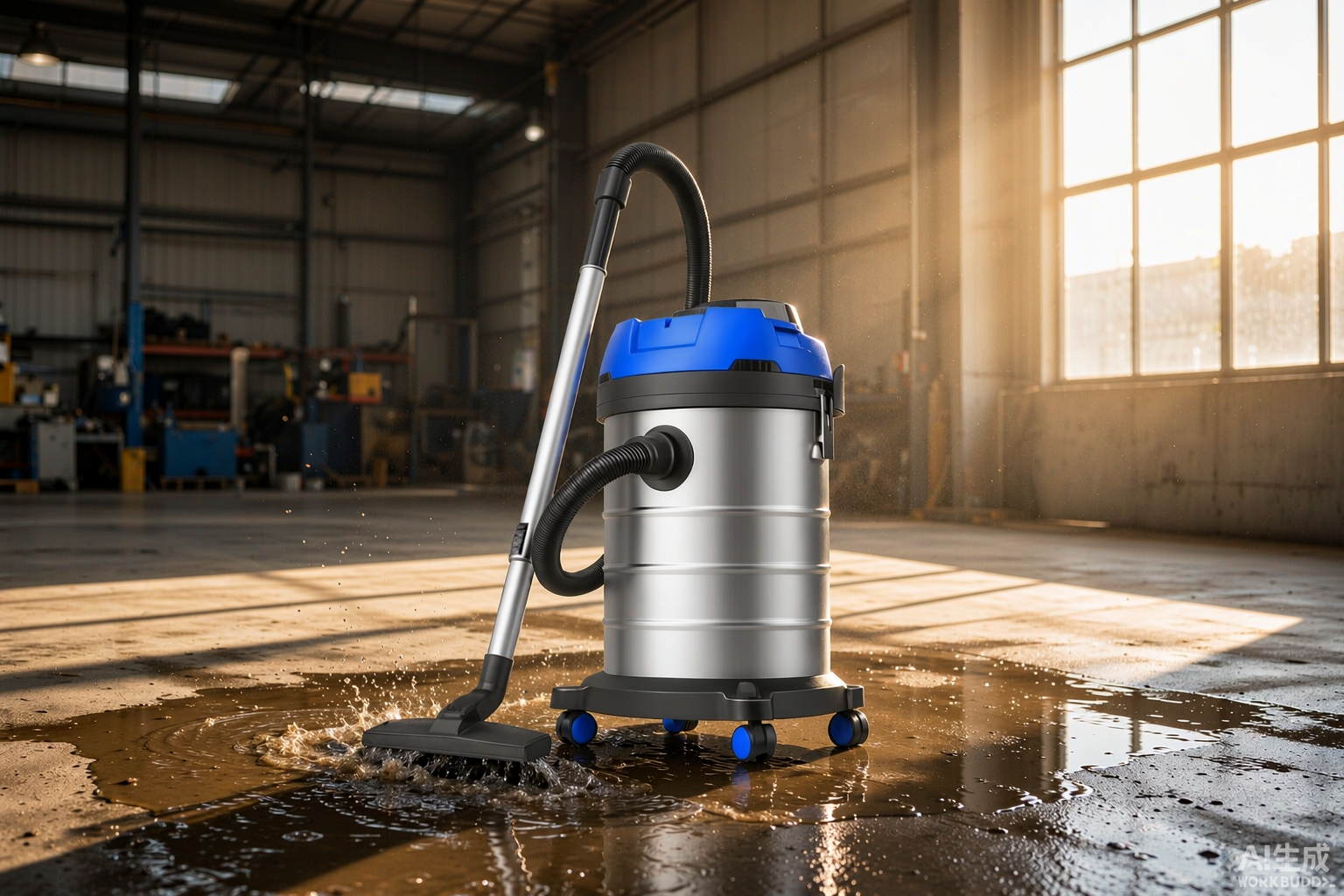
A commercial vacuum with a 20-liter tank rarely fails because it cannot suck. It fails because the operator empties it eleven times a shift, the float valve clogs on the first wet event, and the filter costs more per year than the machine cost at purchase. Capacity is not a number on a brochure — it is a system decision that determines whether cleaning gets done or gets deferred.
This guide addresses the selection problem specifically for large capacity vacuum cleaners in commercial settings: what “large” actually means per facility type, how to size tank and motor configuration against real workload, and how to compare machines on five-year cost rather than quote price.
1. What “Large Capacity” Actually Means for Commercial Facilities 📏
Domestic vacuums top out around 10–15 liters. Commercial “large capacity” begins where a single operator can work a meaningful shift segment without stopping to empty. The threshold varies by debris type:
| Facility Type | Debris Profile | Practical Minimum | Why This Threshold |
|---|---|---|---|
| Warehouse/DC | Fine dust, shrink-wrap, pallet splinters, dock water | 30–50 L | Emptying every 15–20 min at 30L for dusty floors; wet events demand usable capacity above nominal |
| Hotel/hospitality | Room debris, corridor dust, occasional liquid | 15–25 L | Transport weight matters more than absolute capacity; 25L wet becomes unwieldy in guest corridors |
| Industrial/factory | Metal chips, oil, coolant, heavy sludge | 50–80 L | High-density debris fills volume fast; drainage port mandatory for wet mode |
| Food service | Flour, sugar, crumbs, wet spillage | 30–50 L | Frequent wet/dry switching; filter access and tank wash-down design decisive |
The trap: nominal tank volume ≠ usable capacity. A 50L machine with a float valve that trips at 23L gives you 23 liters of wet work . Always ask for published usable wet capacity, not just tank size.
2. Tank Configuration: Stainless Steel vs. Plastic, Drainage, and Mobility 🔧
Material
For commercial duty with frequent wet use or corrosive debris, stainless steel tanks justify the weight and cost premium. Plastic tanks crack at mounting points under repeated emptying in cold environments or when dropped during transport. Steel tanks survive dock, factory, and outdoor perimeter duty .
For hotel and office interior use where wet events are rare, high-density polyethylene tanks are acceptable and save weight for multi-floor transport.
Drainage
A wide, tool-free drain port is the single most undervalued feature on a wet-capable commercial vacuum. Without it, emptying 40 liters of dock water means lifting the tank — which means the machine gets used for dry-only work and the wet mess becomes a mop problem.
Demand: drain hose or port diameter ≥40mm, positioned at the lowest tank point, operable without tools.
Mobility and Weight
A 60L machine filled with water weighs 75+ kg. Large castors (200mm minimum) and a balanced chassis determine whether the machine gets moved to the spill or the spill gets reported as “not my area.”
For multi-floor facilities: a separate 20–25L machine per floor beats one 60L machine on one floor and a mop on the other.
3. Motor and Suction: Configuration for Sustained Commercial Work ⚙️
Motor Count and Duty
Single-motor commercial vacuums (1000–1500W) suit hotel and office duty where cleaning windows are short and debris is light . Dual-motor configurations (2400–2800W) are the commercial warehouse and industrial standard: they maintain airflow under load as filters load up, and one motor can fail without total stoppage .
Continuous-duty rating matters more than peak wattage. A motor rated for 240+ minutes at sustained load with thermal protection is a commercial machine. A 1800W motor rated for 30-minute intervals is a domestic machine in a commercial housing.
Airflow vs. Vacuum
Brochure suction is measured at the hose end with a clean filter — a condition that exists for the first ten minutes of use. Ask for airflow-under-load data at typical filter loading. A machine rated 45 L/s clean may deliver 35 L/s at half filter load; the competitor rated 42 L/s clean may hold 38 L/s. The number that matters is the one after the dust starts accumulating.
For warehouse dock duty with standing water: suction (kPa) governs water lift rate; airflow governs dust capture. Wet/dry commercial machines need both, documented separately.
4. Filtration: HEPA Is Not Enough 🛡️
A vacuum that picks up dust but exhausts fine particles is a dust redistribution system. This matters commercially in three scenarios:
Food handling areas: flour, sugar, and allergen particles become airborne and settle on prep surfaces
Healthcare and aged care: airborne pathogens and allergens represent clinical exposure risk
Dust-sensitive manufacturing: combustible dust zones or cleanroom-adjacent areas
HEPA filter ≠ sealed HEPA system. The filter captures particles that reach it. Gaps around filter housings, tank seals, and motor mounts let unfiltered air bypass entirely. Demand documentation of sealed filtration design — all exhaust air passes through the filter element before exit .
For commercial facilities with mixed zones, a multi-stage system (cyclone or bag pre-filter + HEPA final) extends filter life dramatically in high-dust zones while maintaining filtration integrity where it matters.
5. The Five-Year Cost Comparison: What the Quote Doesn’t Show 💰
A commercial vacuum’s purchase price is typically 20–30% of five-year cost. The rest:
| Cost Layer | What Drives It | What to Demand |
|---|---|---|
| Consumables | Filter replacement frequency by zone; hose and seal wear | Per-unit filter pricing at contract; expected filter life per zone in writing |
| Energy | Motor efficiency × daily hours × facility rate | Published power draw at typical operating point |
| Labor | Emptying frequency, route coverage, cable management | Usable capacity; hose length; cable reach per stated voltage drop |
| Downtime | Mean time between failures; parts lead time | Spare parts SLA with committed lead times |
The commercial vacuum with the lowest quote often has the highest filter consumption and shortest hose reach — both of which convert directly into labor cost. A machine that eliminates one 15-minute emptying cycle per shift saves 60+ hours annually per operator.
6. Zone-Specific Configuration Matrix 🗺️
| Zone | Tank | Motor | Filtration | Key Feature |
|---|---|---|---|---|
| Docks/doors | 40–60L steel | Dual, continuous | Foam + HEPA option | Wide drain, float valve, rustproof |
| Wide aisles/racking | 30–50L | Single/dual | Multi-stage + HEPA | Wide floor tool, long hose |
| Pick faces/staging | 20–30L | Single | HEPA sealed | Lightweight, swivel castors, quiet |
| Battery rooms | 20–30L | Single, corrosion-rated | HEPA + acid-resistant | Stainless, sealed electronics |
| Food production | 30–50L | Dual or single | HEPA sealed + bag pre-filter | Tool-free filter access, washable tank |
7. Supplier Vetting for Commercial Fleet Programs 🤝
Commercial facility vacuums run in fleets. A single machine is a purchase; a fleet is infrastructure. Before standardizing:
Platform consistency: Can the supplier deliver dock, aisle, and specialty machines on shared consumables and accessories? Three incompatible fleets triple spares inventory.
Documentation culture: Send your spec. The completeness of the written response — duty ratings, filtration test data, spare part numbers — previews the after-sales relationship.
Sample trial in the worst zone: Two weeks at the docks in rain season tells you more about float valve reliability than any datasheet.
Parts SLA in the contract: Not a promise. A committed lead time with a remedy clause.
The Selection Checklist ✅
Zone audit completed before any machine comparison ☐
Usable wet capacity verified (not nominal tank size) ☐
Motor duty rating documented for sustained load ☐
Filtration sealed-system design confirmed in writing ☐
Five-year TCO table built with consumables and labor ☐
Drain port diameter and position verified for wet zones ☐
Mobility tested at loaded weight on your floor surfaces ☐
Spare parts SLA and per-unit consumable pricing in contract ☐
The Bottom Line 🎯
Large capacity commercial vacuums are not interchangeable containers with motors. The tank size, usable wet volume, drainage design, motor duty rating, and filtration sealing together determine whether the machine reduces cleaning labor or becomes a maintenance obligation. Audit your zones, size against actual debris and wet-event frequency, demand documentation on every performance claim, and compare on five-year cost — not quote price.
If you are interested, please feel free to contact us anytime. And when you are ready to build a commercial fleet program with documented specifications, explore the range at www.lxvacuum.com
50 Related Keywords
large capacity vacuum cleaner, commercial vacuum cleaner, industrial vacuum cleaner, wet dry vacuum cleaner, warehouse vacuum cleaner, heavy duty vacuum cleaner, stainless steel vacuum cleaner, dual motor vacuum cleaner, HEPA vacuum cleaner, commercial cleaning equipment, industrial cleaning equipment, large tank vacuum cleaner, 50L vacuum cleaner, 60L vacuum cleaner, 80L vacuum cleaner, wet and dry vacuum, commercial canister vacuum, industrial canister vacuum, factory vacuum cleaner, hotel vacuum cleaner, healthcare vacuum cleaner, food service vacuum cleaner, dock cleaning equipment, spill cleanup vacuum, sludge vacuum, fine dust vacuum, sealed HEPA vacuum, commercial grade vacuum, continuous duty vacuum, energy efficient vacuum cleaner, low noise vacuum cleaner, vacuum cleaner supplier, vacuum cleaner manufacturer, vacuum cleaner manufacturer in China, vacuum cleaner factory, industrial vacuum supplier, commercial vacuum supplier, cleaning equipment supplier, industrial equipment supplier, wholesale vacuum cleaner, bulk vacuum purchase, fleet vacuum program, commercial fleet standardization, factory direct vacuum cleaner, OEM vacuum cleaner, ODM vacuum cleaner, private label vacuum cleaner, import vacuum cleaner from China, vacuum cleaner distributor, commercial facility cleaning solution