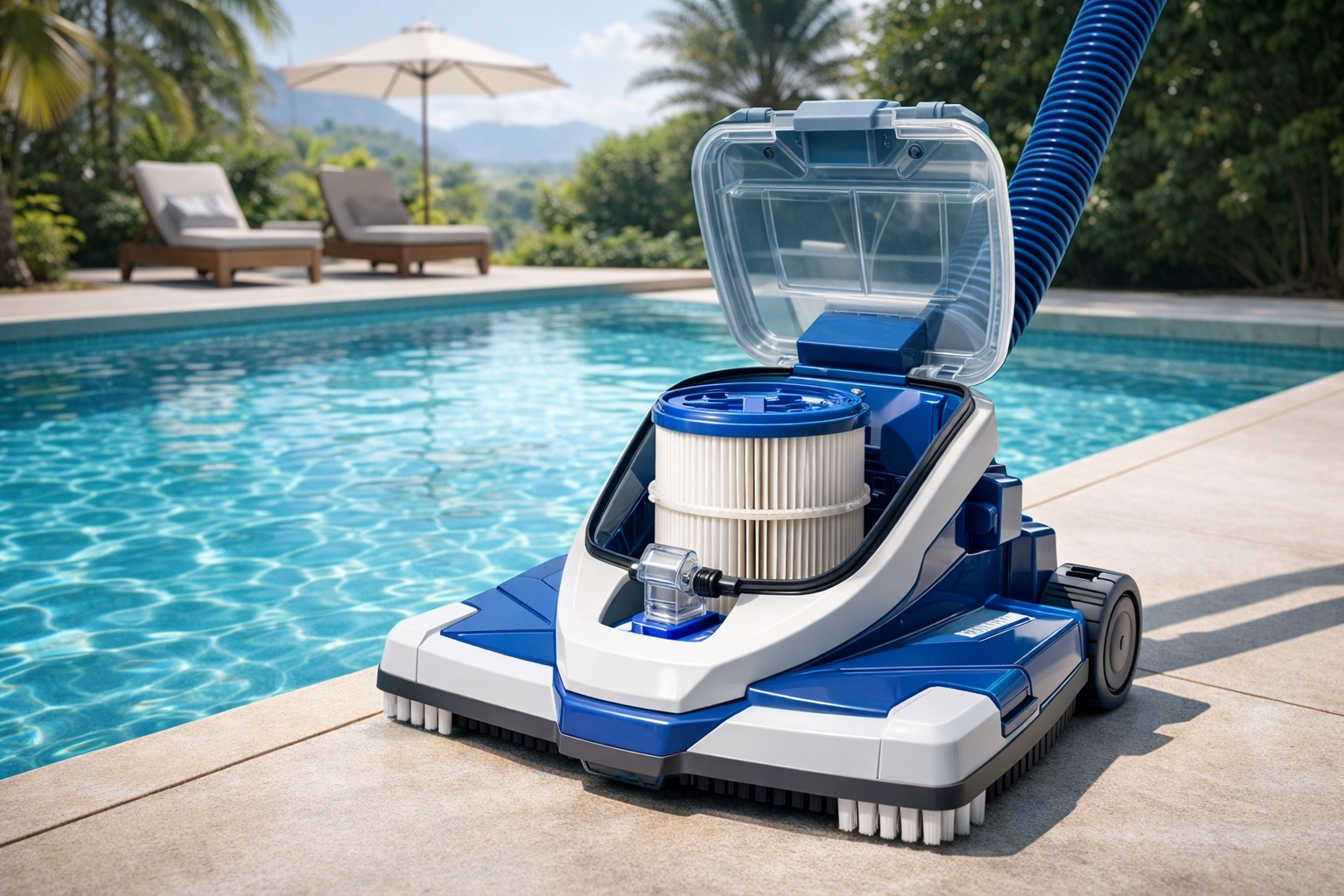
Selecting the right filter system for your pool vacuum is not just about trapping debris — it directly impacts suction performance, maintenance frequency, operational cost, and hygiene standards.
In Europe and the Middle East, where pool environments vary from sand-heavy outdoor resorts to enclosed spa facilities, filtration strategy must be adapted to the specific use case.
This guide explains how to choose the right filter system based on pool size, debris type, operational frequency, and environmental conditions.
🧪 ① Understand the Types of Pool Vacuum Filters
Different filter systems serve different purposes.
🔹 Cartridge Filters
Best for:
Light-to-medium use environments.
🔹 Foam or Fabric Filters
Capture fine sediment
Washable and reusable
Lower replacement cost
Ideal for:
Frequent maintenance schedules.
🔹 HEPA-Level Filtration (External Support Systems)
While pool water filtration handles water clarity, surrounding environments — especially indoor pools — benefit from vacuum systems with HEPA capability.
A Vacuum Cleaner for Allergies with high-efficiency filtration can capture fine dust particles down to 0.3 microns.
This is particularly relevant for:
📏 ② Match Filtration Precision to Debris Type
Choosing the wrong filtration precision leads to clogging or poor performance.
| Debris Type | Recommended Filter Type |
|---|
| Leaves & Large Debris | Standard cartridge |
| Fine Sand | Multi-layer cartridge |
| Algae Dust | Fine fabric filter |
| Renovation Dust | HEPA-supported system |
For sand-heavy regions in the Middle East, higher-density filtration is recommended.
💨 ③ Filtration & Suction Balance
High filtration precision can increase airflow resistance.
Therefore, pairing advanced filters with a Multi-Functional Durable Vacuum Cleaner ensures:
Strong suction compensates for filtration density.
A balanced system prevents performance drop during extended cleaning cycles.
🔇 ④ Noise Consideration in Filter Design
Filter density affects airflow resistance — and airflow resistance affects motor noise.
A properly engineered Quiet Vacuum Cleaner integrates:
In hospitality environments, quiet filtration systems protect guest experience.
🔄 ⑤ Self-Cleaning Filter Technology
Modern innovation introduces the Portable Self-Cleaning Vacuum Cleaner concept.
Self-cleaning filter systems:
Automatically shake or flush debris
Reduce manual cleaning frequency
Maintain suction efficiency
Extend filter lifespan
In high-frequency commercial settings, self-cleaning mechanisms reduce downtime significantly.
💧 ⑥ Integrating Wet & Dry Capability
Many commercial facilities require cleaning beyond underwater debris.
A professional wet and dry vacuum cleaner supports:
Pool deck spills
Pump room dust
Equipment room cleaning
When selecting filtration systems for wet & dry use, ensure:
Moisture-resistant filter materials
Separate wet/dry chambers
Easy-access maintenance design
Improper filter selection for wet applications can reduce lifespan.
🏢 ⑦ Multi-Surface & Facility-Wide Application
If your cleaning team handles both:
Pool interiors
Pool decks
Changing rooms
Equipment rooms
A Vacuum for Multi-Surface use ensures adaptability.
Multi-surface compatibility requires:
One adaptable system reduces equipment redundancy.
📊 ⑧ Maintenance Cost Evaluation Model
To assess long-term cost:
Annual Filter Cost =
(Filter Replacement Cost × Replacement Frequency) + Maintenance Labor Cost
Example:
€25 per cartridge × 8 replacements per year
= €200 annually
Switching to washable or self-cleaning systems may reduce replacement frequency by 40–60%.
Lifecycle cost analysis is critical in commercial procurement.
🌍 Europe vs Middle East Filter Strategy
Europe
Higher indoor pool prevalence
Allergy sensitivity concerns
Stronger hygiene standards
HEPA-supported systems and fine filtration are often preferred.
Middle East
Outdoor pools
Sand infiltration
Heavy dust environment
Durable, high-density, washable filters perform better in high-debris settings.
🔮 ⑨ Future Filtration Trends (2027 and Beyond)
The next generation of pool vacuum filtration may include:
Advanced systems will focus on maintaining suction stability while reducing environmental impact.
❓ FAQ
Q1: How often should pool vacuum filters be replaced?
Depends on usage frequency and debris type. Commercial pools may require more frequent maintenance.
Q2: Is HEPA filtration necessary for outdoor pools?
Primarily beneficial for indoor or surrounding facility areas.
Q3: Do finer filters reduce suction power?
They can increase airflow resistance if not paired with strong suction systems.
Q4: Are self-cleaning filters worth the investment?
Yes, especially in high-frequency commercial operations.
✅ Conclusion
Choosing the right filter system for your pool vacuum requires evaluating:
Combining a durable vacuum platform with properly selected filtration — including support from a wet and dry vacuum cleaner or Portable Self-Cleaning Vacuum Cleaner — ensures long-term efficiency and operational stability.
Effective filtration is not just about trapping debris — it is about protecting performance, reducing cost, and maintaining hygiene standards.
📌 Suitable Readers
Pool equipment distributors
Commercial pool contractors
Hospitality maintenance managers
Facility procurement directors
Residential pool service providers
📌 Hashtags
Lanxstar, wet and dry vacuum cleaner, Multi-Functional Durable Vacuum Cleaner, Portable Self-Cleaning Vacuum Cleaner, Quiet Vacuum Cleaner, Vacuum Cleaner for Allergies, Vacuum for Multi-Surface, commercial pool filtration system, HEPA filtration vacuum, sand resistant pool vacuum, durable cleaning machine, lithium battery pool vacuum, professional suction cleaner, energy efficient cleaning system, B2B pool equipment supplier, Europe pool distributor, Middle East maintenance tools, advanced filtration vacuum system, facility management tools, high efficiency motor technology, intelligent cleaning system, self cleaning filter vacuum, sustainable filter technology