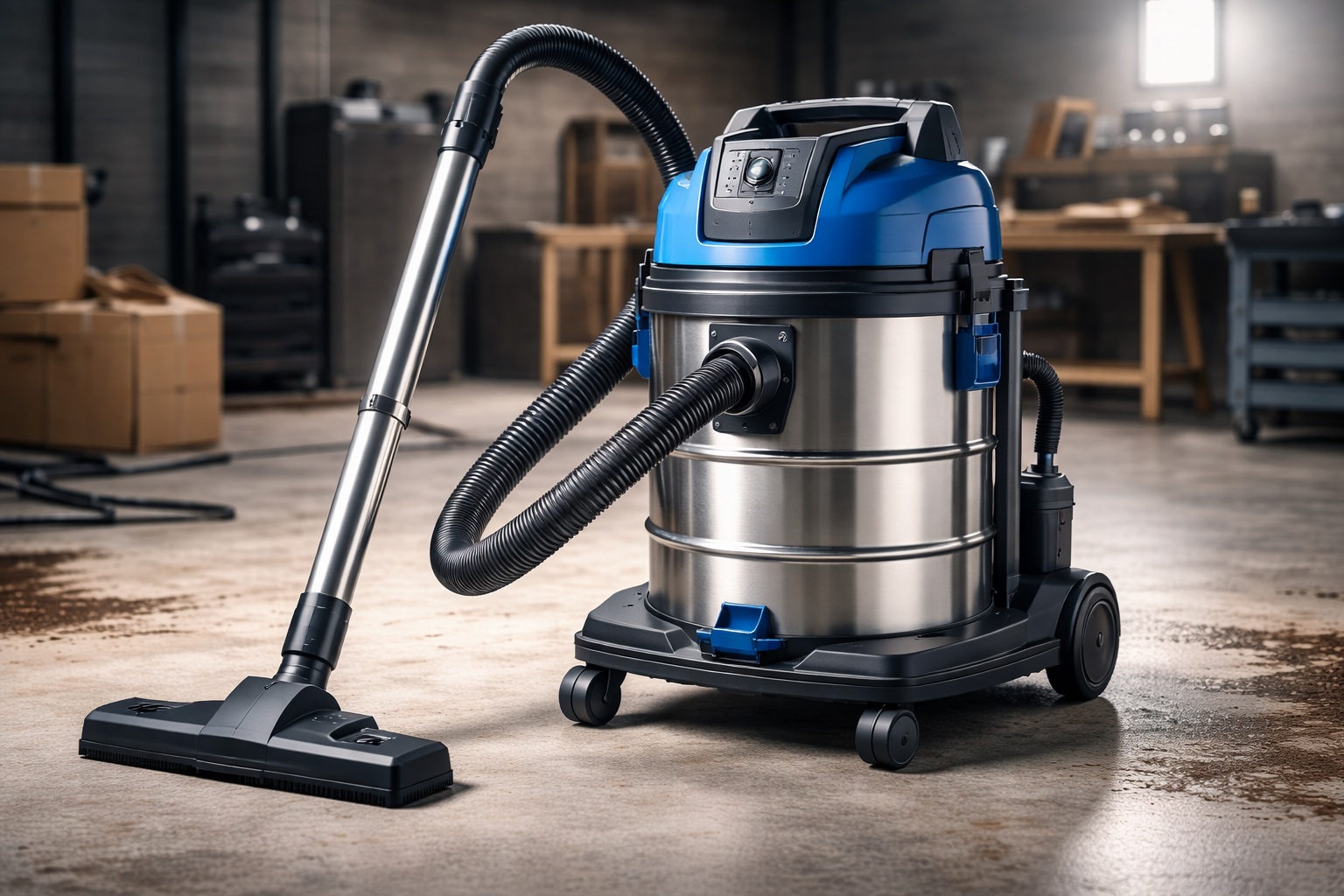
When choosing commercial cleaning equipment, many buyers still default to traditional upright or compact vacuums.
However, as commercial spaces become larger and operational efficiency becomes more critical, barrel vacuums are increasingly outperforming traditional designs.
Across Europe and the Middle East, distributors and facility managers are shifting toward barrel systems for structural, economic, and functional reasons.
This guide breaks down the key differences and explains why barrel vacuums are often the smarter long-term investment.
🛢️ ① Structural Design: Capacity & Stability
Traditional Vacuums:
Barrel Vacuums:
A Large-Capacity Wet Dry Vacuum Cleaner reduces emptying frequency, which improves cleaning productivity in large facilities.
For warehouses, malls, and industrial sites, capacity directly affects labor efficiency.
💧 ② Wet & Dry Versatility
Most traditional vacuums are designed for dry cleaning only.
In contrast, a professional wet and dry vacuum cleaner handles:
Dry dust
Liquid spills
Mud
Renovation debris
Commercial facilities frequently experience both dry and wet messes.
Using one machine for multiple scenarios reduces equipment redundancy and storage needs.
Versatility = lower operational complexity.
⚙️ ③ Durability & Lifecycle Cost
Traditional consumer-grade vacuums are not engineered for continuous commercial use.
A Multi-Functional Durable Vacuum Cleaner typically includes:
Durability directly impacts total cost of ownership.
If a traditional unit lasts 12–18 months under heavy use, while a barrel system operates for 2–3 years, lifecycle savings become significant.
Longer lifespan = better ROI.
⚡ ④ Energy Efficiency & Performance Balance
Modern barrel systems are not just powerful — they are optimized.
An Energy-Saving Efficient Powerful Vacuum Cleaner improves airflow-to-power ratio, delivering:
Example scenario:
If energy consumption drops by 350W during daily 3-hour operation:
350W × 3h × 300 days
= 315 kWh annual savings per unit
Efficiency matters, especially in large commercial contracts.
🏢 ⑤ Multi-Surface Adaptability
Traditional vacuums are often designed for specific surfaces, such as carpet-only or hard floor-only use.
Barrel systems can function as a Vacuum for Multi-Surface, suitable for:
Concrete floors
Tile
Carpets
Outdoor decks
Industrial workshops
Additionally, models optimized as a Vacuum Cleaner for Hardwood Floors provide adjustable suction and soft-brush compatibility to protect delicate surfaces.
Multi-surface adaptability expands application range.
📊 Side-by-Side Comparison
| Feature | Traditional Vacuum | Barrel Vacuum |
|---|
| Tank Capacity | Small | Large |
| Wet Capability | Rare | Standard |
| Durability | Moderate | High |
| Multi-Surface Use | Limited | Broad |
| Commercial Suitability | Low–Medium | High |
| Energy Optimization | Basic | Advanced |
| Lifecycle Cost | Higher | Lower over time |
Barrel systems offer greater operational flexibility.
💰 ⑥ Labor & Productivity Impact
Frequent emptying and weaker suction increase cleaning time.
Example:
Traditional vacuum:
2-hour cleaning cycle
Multiple interruptions
Barrel system:
1.5-hour cycle
Fewer interruptions
If labor cost = €18/hour
0.5-hour saved × 300 days
= €2,700 annual savings per location
Productivity gains justify the investment.
🌍 Europe vs Middle East Adoption Factors
Europe
Barrel systems positioned as energy-efficient and durable solutions.
Middle East
Durability and suction stability are key advantages of barrel systems.
🔮 Future Outlook
Cleaning standards are rising.
Procurement decisions increasingly consider:
Energy efficiency
Versatility
Long-term ROI
Sustainability
Barrel vacuums are structurally adaptable for future upgrades, including improved filtration and smart monitoring systems.
Traditional compact vacuums struggle to scale with these demands.
❓ FAQ
Q1: Are barrel vacuums too large for everyday use?
Not necessarily. Compact barrel models are available for light commercial environments.
Q2: Do barrel vacuums consume more electricity?
Modern Energy-Saving Efficient Powerful Vacuum Cleaner systems optimize performance without excessive power use.
Q3: Are they safe for hardwood floors?
Yes, when used with adjustable suction and appropriate brush attachments.
Q4: Why are distributors favoring barrel systems?
Because they offer higher durability, broader application, and stronger margin potential.
✅ Conclusion
Barrel vacuums are becoming the smarter choice because they deliver:
For distributors and commercial buyers across Europe and the Middle East, barrel systems represent a scalable, future-ready cleaning solution that outperforms traditional vacuum designs in demanding environments.
Choosing smarter equipment today means lower operational cost tomorrow.
📌 Suitable Readers
Cleaning equipment distributors
Commercial procurement managers
Property management companies
Facility maintenance teams
Hospitality operators
📌 Hashtags
Lanxstar, wet and dry vacuum cleaner, Multi-Functional Durable Vacuum Cleaner, Large-Capacity Wet Dry Vacuum Cleaner, Energy-Saving Efficient Powerful Vacuum Cleaner, Vacuum Cleaner for Hardwood Floors, Vacuum for Multi-Surface, industrial barrel vacuum, commercial cleaning equipment, sustainable cleaning equipment, B2B vacuum distributor, Europe cleaning equipment supplier, Middle East facility maintenance tools, dual motor vacuum cleaner, high airflow vacuum system, durable cleaning machine, property management cleaning tools, commercial sanitation equipment, low noise vacuum system, professional dust extraction machine, high efficiency motor technology, modern vacuum design innovation