Hi, message us with any questions.
We're happy to help!





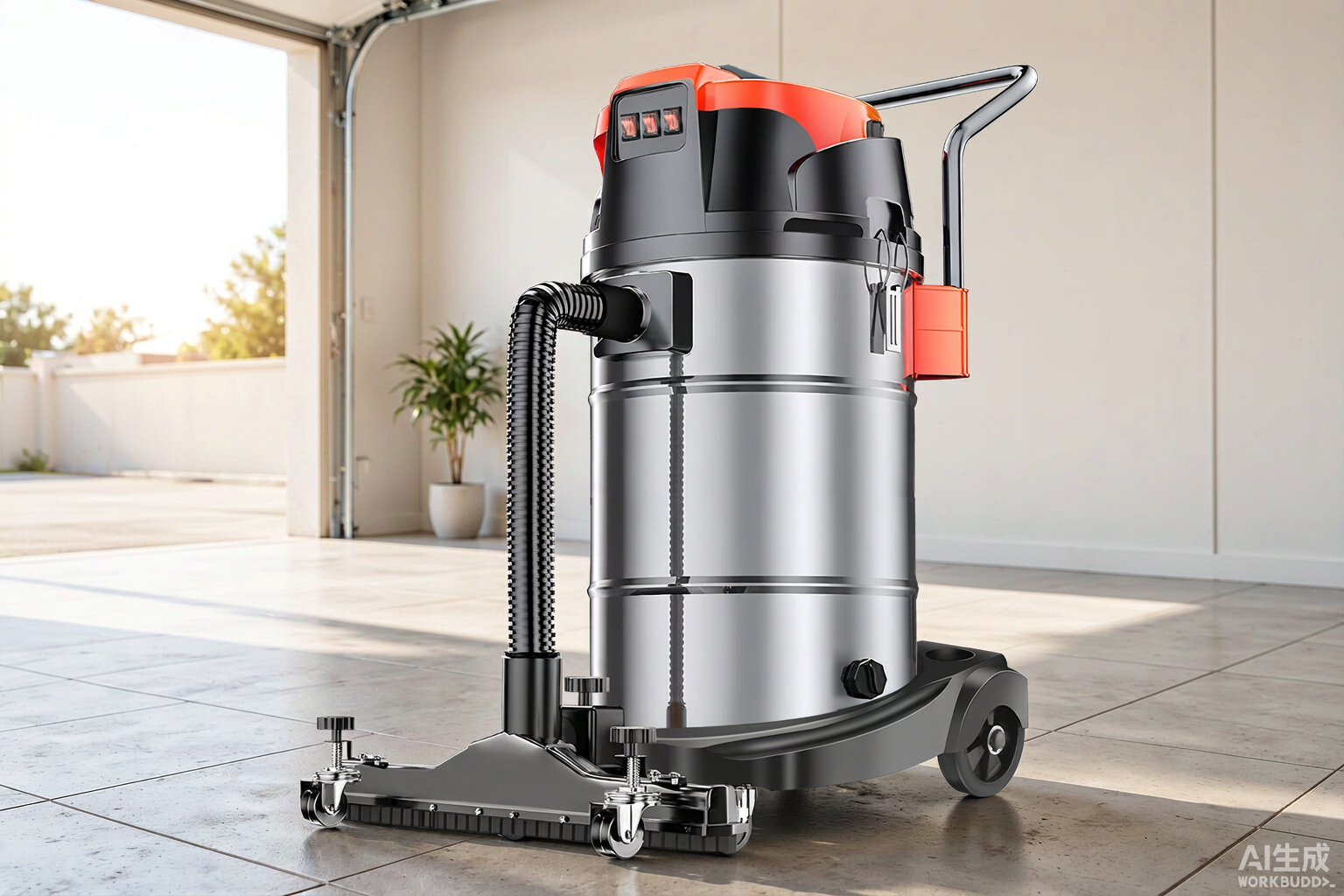
Walk into any tool expo and you will find two categories of machine in adjacent booths: the construction dust extractor, priced like precision equipment, and the wet dry vacuum cleaner, priced like versatile muscle. Both have tanks, both have motors, both have hoses — and a contractor staring at the two could be forgiven for thinking the premium one is simply the same machine with a certification sticker.
It isn't. These two categories were engineered against different enemies, and buying the wrong one means either failed compliance or a dead machine. This guide draws the line precisely, so you buy the category your tasks demand — and know when one hybrid machine can honestly do both. ⚖️
1. Two Machines, Two Jobs 📋
Strip away the marketing and each category exists for one core mission:
Dust extractor: capture fine, regulated dust at the point of generation — the shroud of a grinder, the guard of a circular saw, the connection point of a wall chaser. Its engineering is optimized for continuous, tool-mounted, low-debris, high-fines operation.
Wet dry vacuum cleaner: clean the general site — slurry spills, rainwater, plasterboard shards, gravel, and everything a working floor collects. Its engineering is optimized for liquid tolerance, debris capacity and physical survivability.
The confusion is understandable because the physical machines are converging — many wet-dry machines now carry M-class filters, and many dust extractors now accept water. But the design priority stack is different, and that stack decides how each machine behaves on hour six of a grinding shift. 🎯
2. What Defines a Construction Dust Extractor 🫁
A genuine dust extractor is defined by four features, all in service of fine dust:
Certified dust class — M-class (≤0.1% leakage) or H-class (≤0.005%) under EN 60335-2-69, or sealed HEPA documentation meeting OSHA Table 1 expectations. This is the machine's legal passport for silica work.
Automatic filter cleaning — timed or sensor-driven pulse blasts that keep the filter cake thin during continuous operation. Without this, fine dust halves airflow within an hour and the extraction at the tool stops meeting the capture velocity it was engineered for.
Tool-triggered operation — a power take-off socket runs the extractor automatically with the grinder or saw. Extraction becomes a property of the tool, not a behavior of the crew.
Airflow management for tools — high airflow (l/s) at partial vacuum, tuned for capturing dust from a shroud rather than lifting nails. Dust extractors live and die by maintained airflow, not peak suction.
The tell that separates real extractors from imposters: the datasheet shows an airflow curve across filter loading, not a single peak figure. If the seller can't produce it, you are looking at a wet-dry machine with a certificate-shaped sticker. ❗
3. What Defines a Wet Dry Vacuum Cleaner 💧
A wet dry vacuum earns its name through a different feature stack:
Float valve — an automatic shutoff that seals the air path as the tank fills with liquid, protecting the motor. Without it, "wet capable" is a euphemism.
Honest wet capacity — the usable wet volume is typically 50–70% of nominal tank size; serious manufacturers publish the real figure.
Debris-proof materials — a stainless steel vacuum tank (0.6–0.8mm, documented grade), crushproof anti-static hose with metal cuffs, and castors that survive cable runs and rubble.
Drain engineering — a wide, tool-free drain port, non-negotiable for any machine that will touch concrete slurry. Slurry sets overnight; a poor drain turns a $400 tank into a 40kg ingot.
Capacity range — from 20–30L interior renovation machines up to 60–100L large-capacity wet dry vacuum cleaner models for continuous slurry and floor-wash removal.
Most industrial-grade wet-dry machines offer bypass motors and continuous-duty ratings — so far, the categories overlap. The divergence appears in what each optimizes when conditions get difficult, which is exactly what the next section measures.
4. Head-to-Head: The Nine-Row Comparison 📊
Dimension | Construction Dust Extractor | Wet Dry Vacuum Cleaner |
Core mission | Fine dust at the tool | General site cleanup, wet and dry |
Dust class | M or H certified, documented leakage | L to M common; H available on top models |
Filter cleaning | Automatic pulse standard | Manual shaker common; pulse on premium units |
Airflow character | High sustained airflow for shrouds | High static suction for dense debris |
Wet pickup | Limited or rated separately | Core function, float-valve protected |
Tank priorities | Sealed path, bag compatibility | Stainless durability, capacity, drain port |
Tool integration | Power take-off, antistatic hoses | Blower ports, accessory range |
Debris tolerance | Low — debris shortens filter life | High — engineered for shards and slurry |
Typical buyer | Silica-regulated trades, floor prep | General contractors, renovation, facility crews |
Read the table as a routing question, not a ranking. A row doesn't say one machine is better — it says which task belongs to which machine. 🧭
5. Which Machine Each Site Task Demands 🎯
Route your task list through these rules of thumb:
Grinding, cutting, chasing concrete → dust extractor. Regulated fine dust at the tool, continuous operation, compliance file. A wet-dry machine without automatic filter cleaning will lose capture velocity mid-shift and quietly put your silica documentation out of sync with reality.
Slurry from wet cutting, hydro-demolition, floor washing → wet dry vacuum. Dust extractors rated for light moisture are not slurry machines; alkaline slurry attacks components never designed for it.
Daily site cleanup, mixed debris, rainwater → wet dry vacuum. Debris tolerance and tank durability decide survival here, and extractors are the wrong tool for screws and plasterboard.
Interior renovation in occupied buildings → both, or a hybrid. You need M-class capture at the sander and water pickup when pipes are cut.
Silica compliance documentation → dust extractor (or hybrid with class certificate). The certificate must match the machine actually connected to the tool.
The last two rows explain why the market is converging: an M-class wet dry vacuum cleaner with automatic filter cleaning and a stainless tank is genuinely both machines — provided the certificate covers the full wet-dry configuration, not just the dry mode. Ask that question exactly; the answer sorts honest hybrids from sticker engineering.
6. Four Buying Mistakes That Repeat Every Year ⚠️
Buying an extractor to do site cleanup. Debris kills its filter economics; crews resent it; it ends up in the office trailer doing carpets.
Buying a wet-dry machine for regulated silica tasks without class documentation. It may filter well today, but without a certificate the compliance file fails the inspection regardless of performance.
Equating peak watts with extraction performance. A 1400W extractor with pulse cleaning outperforms a 2000W machine whose filter loaded at 09:40. Demand airflow-under-load data.
Ignoring filter running cost. Filters are the toner cartridges of this category. The cheaper machine with expensive, short-life filters is the expensive machine over a project.
Real Project Cases 📊
Case 1 — Flooring contractor, Toronto, Canada 🇨🇦: A crew bought one M-class dust extractor for concrete grinding and used their old wet-dry machine for everything else. Mid-project, the wet-dry machine was handed a six-hour grinding shift while the extractor was in service — its airflow collapsed by mid-morning and the site failed a spot inspection. The fix was not a better wet-dry machine; it was a second extractor. Categories exist because tasks differ.
Case 2 — Renovation firm, Vienna, Austria 🇦🇹: Working in an occupied hospital wing, a firm ran a hybrid fleet: two M-class wet-dry machines with automatic filter cleaning for sanders and channel-cutting, plus one 60L stainless machine for water and debris. The inspector accepted the class certificates covering both operating modes. The combination delivered compliance and survivability without a duplicate fleet — the exact convergence this guide describes.
Case 3 — Infrastructure contractor, Dubai, UAE 🇦🇪: A tunnel retrofit crew learned the drain lesson at scale: three imported wet-dry machines with narrow garden-style taps effectively died overnight when slurry set in the tanks. Replacement machines were specified with 50mm tool-free drains and stainless tanks; two years later the same fleet is still running, and the specification clause now reads "wide drain, tool-free, alkaline-resistant" verbatim. 💡
Case 4 — Equipment rental chain, Auckland, New Zealand 🇳🇿: A rental company split its catalog, labeling machines "For regulated dust — M class" and "For site cleanup — wet/dry" with a one-page routing card in each case. Damage claims dropped by a third, filter sales became a clean revenue line, and the routing card itself became the most-quoted page in their catalog — customers appreciated being told which machine not to rent.
How to Decide in Five Minutes 🤝
Answer three questions:
Does any task involve regulated silica dust at a powered tool? Yes → you need a dust extractor or documented hybrid, regardless of what else you buy.
Does any task involve liquids or slurry? Yes → you need a wet dry machine (or hybrid) with float valve, drain port and honest wet rating.
Is your volume a fleet or a single project? Single project → rent the missing category rather than compromise; fleet → standardize on one platform across both roles and negotiate filter supply with the machine contract.
For fleets, rental companies and private-label buyers, an industrial vacuum cleaner factory can build both categories on shared components — same motors, same chassis family, different filter and tank stacks — which simplifies your spare-parts inventory while keeping the certifications honest. A vacuum cleaner manufacturer in China with vertical integration will show you the certification files for both configurations and supply samples for your own worst-case testing; that transparency is the shortest possible due-diligence process.
The Bottom Line 🎯
A construction dust extractor is a compliance instrument: certified, self-cleaning, tool-triggered, optimized for fine dust capture at the source. A wet dry vacuum cleaner is a survival instrument: float-protected, steel-tanked, drain-equipped, optimized for whatever the site floor serves up. The overlap is real — and a documented hybrid can honestly be both — but the decision discipline is simple: match the machine to the enemy, and demand certificates that match the machine actually on site.
If you are interested, please feel free to contact us anytime. And when you are ready to compare machines documented for both sides of this question, explore the range at www.lxvacuum.com
50 Related Keywords
wet dry vacuum cleaner, wet and dry vacuum cleaner, construction dust extractor, industrial dust extractor, dust extractor vs wet dry vacuum, M-class vacuum, silica dust extraction, HEPA filter vacuum cleaner, concrete dust vacuum, construction site cleaning equipment, industrial vacuum cleaner, commercial vacuum cleaner, heavy duty vacuum cleaner, dual motor vacuum cleaner, stainless steel vacuum tank, large-capacity wet dry vacuum cleaner, wet and dry suction system, concrete slurry vacuum, low noise vacuum cleaner, energy efficient vacuum cleaner, high suction power vacuum cleaner, commercial grade vacuum cleaner, industrial cleaning equipment, commercial cleaning equipment, workshop vacuum cleaner, warehouse cleaning solution, factory floor cleaning, hotel cleaning equipment, hospital cleaning equipment, facility management cleaning equipment, retail cleaning equipment, best budget vacuum, best vacuum on a budget, good budget vacuum cleaner, vacuum cleaner supplier, vacuum cleaner manufacturer, vacuum cleaner manufacturer in China, vacuum cleaner maker, vacuum manufacturer, industrial vacuum cleaner supplier, industrial vacuum cleaner factory, cleaning equipment supplier, industrial equipment supplier, wholesale vacuum cleaner, bulk vacuum cleaner purchase, bulk order vacuum cleaner, factory direct vacuum cleaner, OEM vacuum cleaner, ODM vacuum cleaner, Lanxstar