Hi, message us with any questions.
We're happy to help!





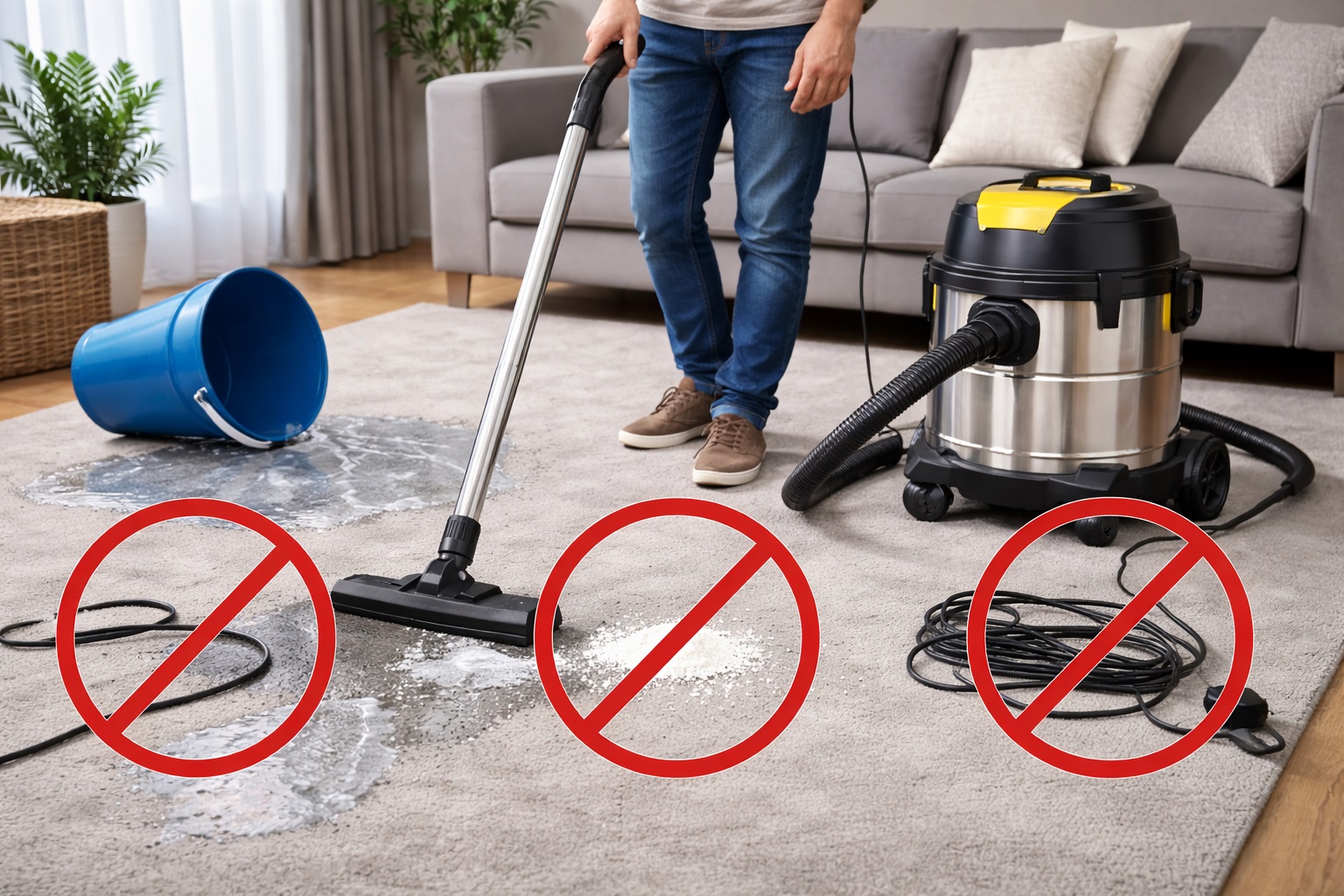
A barrel vacuum is built for power and durability.
But even a high-performance wet and dry vacuum cleaner can fail prematurely if operated incorrectly.
Across Europe and the Middle East, distributors report that a large percentage of warranty claims are not caused by product defects — but by operational mistakes.
Understanding these common errors can:
Extend motor lifespan
Reduce maintenance cost
Improve suction stability
Lower energy consumption
Protect brand reputation
This guide explains the most frequent mistakes when using a barrel vacuum — and how to avoid them.
🚫 ① Running at Maximum Suction All the Time
Many operators believe that a High Suction Vacuum Cleaner should always operate at full power.
This is a misconception.
Operating continuously at maximum suction:
Increases motor temperature
Accelerates carbon brush wear
Raises energy consumption
Increases noise output
Best Practice:
Adjust suction according to debris type
Use moderate suction for light dust
Increase only when lifting heavy debris
Even a Multi-Functional Durable Vacuum Cleaner benefits from calibrated power control rather than constant overload.
🛢️ ② Overfilling the Tank
One of the most common mistakes is waiting until the tank is completely full.
Overfilling leads to:
Airflow restriction
Reduced suction efficiency
Dust reaching motor housing
Liquid overflow in wet mode
For operators upgrading from an Apartment Vacuum Cleaner, this mistake is especially common because residential units have smaller debris capacity expectations.
Rule of thumb:
Empty the tank at 70–80% capacity.
Maintaining airflow is critical to motor protection.
🌬️ ③ Ignoring Filter Maintenance
Filter neglect is a primary cause of suction loss.
This is particularly critical in a HEPA Filter Vacuum Cleaner, where fine particle capture increases filter load.
Common filter mistakes:
Not cleaning after heavy debris sessions
Using wet filter in dry mode
Delaying replacement beyond airflow drop
When airflow decreases:
Motor current increases
Heat builds up
Energy efficiency drops
Regular inspection ensures your wet and dry vacuum cleaner maintains optimal performance.
🔌 ④ Blocking Cooling Airflow Vents
Barrel vacuums rely on motor cooling airflow.
Blocking ventilation ports — often due to dust accumulation — causes overheating.
Signs of cooling blockage:
Sudden noise increase
Frequent automatic shutdown
Excessively hot exhaust air
Even a Fast Lightweight Vacuum Cleaner with compact design requires proper ventilation clearance.
Maintenance tip:
Inspect air vents weekly in heavy-use environments
Remove debris around cooling channels
Ensure adequate spacing during operation
Cooling integrity directly impacts lifespan.
⚠️ ⑤ Using the Wrong Mode (Wet vs Dry)
Switching between wet and dry modes without preparation damages internal components.
Common errors:
Using dry filter during liquid suction
Failing to remove dust bag before wet cleaning
Not drying tank interior before dry operation
A professional Multi-Functional Durable Vacuum Cleaner supports dual-mode cleaning — but requires correct configuration.
Improper mode switching increases:
Filter clogging
Motor moisture exposure
Internal corrosion
🧰 ⑥ Using Excessive Hose Length
Long hoses reduce effective suction due to airflow resistance.
Consequences:
Reduced debris transport efficiency
Increased motor workload
Higher energy consumption
For high-demand environments, ensure hose length matches manufacturer recommendation — especially when using a High Suction Vacuum Cleaner designed for stable airflow.
📊 ⑦ Confusing Residential and Industrial Usage Expectations
Many failures occur when a residential-grade Apartment Vacuum Cleaner is used in semi-industrial conditions.
Differences include:
| Feature | Apartment Vacuum Cleaner | Barrel Wet and Dry Vacuum Cleaner |
|---|---|---|
| Duty Cycle | Short | Extended |
| Tank Size | Small | Large |
| Motor Cooling | Basic | Reinforced |
| Debris Volume | Light | Heavy |
Using the wrong category for the environment leads to premature burnout.
🔇 ⑧ Ignoring Noise Changes
An increase in noise level is often the first warning sign.
Even a well-designed Fast Lightweight Vacuum Cleaner or HEPA Filter Vacuum Cleaner will produce abnormal sound if:
Bearings are worn
Airflow path is restricted
Internal debris accumulates
Noise diagnostics help prevent major failure.
❓ FAQ: Preventing Barrel Vacuum Mistakes
Q1: Is high suction always better?
No. Excessive suction increases heat and motor wear. Adjust power based on debris type.
Q2: How often should I clean HEPA filters?
In heavy-use environments, inspect every 2–3 operating hours. Replace when airflow noticeably drops.
Q3: Can a wet and dry vacuum cleaner handle all debris types?
Yes, if properly configured. Always match filter and mode to debris type.
Q4: Does lightweight design reduce durability?
Not necessarily. A well-engineered Fast Lightweight Vacuum Cleaner can combine portability and structural strength if airflow and motor protection are optimized.
Strategic Conclusion
Avoiding common mistakes when using a barrel vacuum protects:
Motor lifespan
Suction performance
Energy efficiency
Operational continuity
Warranty stability
Whether operating a HEPA Filter Vacuum Cleaner, a High Suction Vacuum Cleaner, or a Multi-Functional Durable Vacuum Cleaner, long-term performance depends as much on user behavior as engineering design.
A vacuum’s durability is not determined by power alone.
It is determined by airflow stability, thermal protection, and disciplined operation.
Suitable Audience
European and Middle East vacuum distributors
Industrial maintenance supervisors
B2B cleaning equipment buyers
After-sales service teams
Commercial cleaning contractors
Hashtags
Lanxstar, wet and dry vacuum cleaner, Multi-Functional Durable Vacuum Cleaner, Fast Lightweight Vacuum Cleaner, High Suction Vacuum Cleaner, Apartment Vacuum Cleaner, HEPA Filter Vacuum Cleaner, barrel vacuum maintenance guide, industrial vacuum usage mistakes, commercial cleaning equipment operation, vacuum motor protection strategy, airflow retention optimization, energy efficient vacuum system, heavy duty suction equipment, continuous duty vacuum cleaner, thermal overload protection vacuum, factory cleaning equipment support, warehouse vacuum maintenance, vacuum filter care tips, commercial vacuum durability guide, vacuum suction stability solution, tank capacity management, industrial cleaning system efficiency, B2B vacuum distributor Europe, Middle East vacuum supplier, OEM vacuum cleaner factory, CE certified vacuum manufacturer, professional cleaning tools supplier, industrial maintenance equipment guide, vacuum cooling system design, industrial airflow engineering, export vacuum cleaner supplier, bulk vacuum cleaner buyer, durable barrel vacuum system, facility management cleaning equipment, smart suction vacuum technology, heavy debris vacuum solution, washable cartridge filter vacuum, industrial HEPA vacuum system, commercial janitorial equipment supplier, industrial cleaning efficiency strategy, long life vacuum motor design, vacuum gasket inspection guide, airflow optimized vacuum cleaner, factory dust extraction machine, warehouse cleaning solution provider, professional vacuum servicing guide, industrial suction equipment durability, maintenance cost reduction strategy



