Hi, message us with any questions.
We're happy to help!





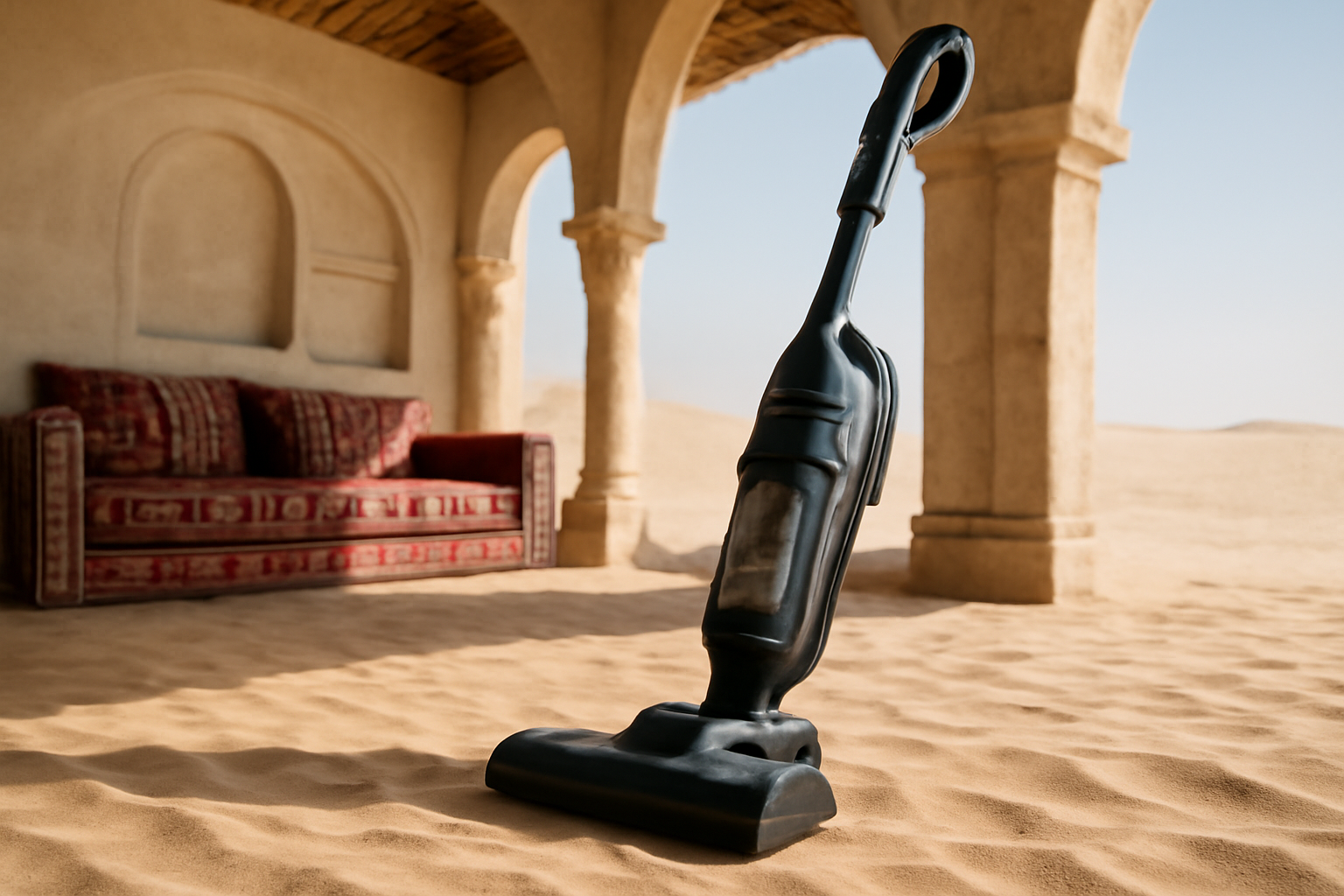
🏜️💥 1. Ultra-Fine Desert Sand — The Silent, Engineered-For-Destruction Dust
What most Western buyers don’t realize is that Middle Eastern dust is a completely different substance than European or American house dust.
This isn’t the typical dust from carpets or fabrics.
It’s microscopic PM0.3-level desert sand — one of the most destructive materials for a vacuum cleaner’s internal system.
Why this sand destroys vacuums:
It is extremely fine, so it bypasses normal filters
It clogs HEPA layers 3–5× faster
It enters the motor housing through microscopic gaps
It accumulates in the airflow path, reducing suction
It causes overheating and early motor death
In many cases, even a high-performance Cordless Handheld High Suction Vacuum Cleaner designed for Europe loses up to 30–50% suction within months in Middle Eastern environments.
Engineering Consequences
Motor thermal load increases sharply
Filters get blocked prematurely
Suction degrades far faster
Noise increases due to airflow blockage
Technical Solutions
High-capacity multi-stage filtration
Enlarged airflow channels
Heat-resistant motors
Easy-wash filter design
Reinforced dust seals
For harsh sand conditions, a Large-Capacity Wet Dry Vacuum Cleaner is far more suitable than a conventional upright.
🔥🌡️ 2. Extreme Heat Accelerates Battery Decay & Motor Degradation
Summer temperatures in the Middle East can reach 45–55°C, and indoor rooms often stay above 28–35°C even with AC.
For vacuum cleaners, this is catastrophic.
Effects of high heat:
⚠ Battery Chemistry Breakdown
Cordless vacuums suffer most.
Lithium battery life shortens significantly in hot regions.
⚠ Motor Overheating
Hot intake air reduces cooling efficiency, causing:
Higher RPM load
Faster bearing wear
Burning smell
Motor failure
⚠ Plastic Housing Aging
Long exposure to heat weakens structural components.
Engineering Recommendations
To survive Middle Eastern temperatures:
Use high-temperature lithium cells
Upgrade motor insulation (120–155°C rating)
Improve heat dissipation channels
Use UV- and heat-resistant plastics
A Fast Lightweight Vacuum Cleaner can work well if its cooling structure is upgraded for hot climates.
🧹🏠 3. Middle Eastern Homes Produce More Dust — 3× to 12× More
Based on field surveys from UAE, KSA, and Qatar:
Middle Eastern homes gather significantly more dust because:
Desert dust enters through windows and gaps
AC airflow redistributes dust
Large open floorplans accumulate more debris
Tiled and marble floors do not “trap” dust
More households keep pets
Larger door openings allow sand in
Dust accumulation speed:
Europe: slow
USA: moderate
Middle East: extremely fast
This means vacuums are used:
Europe — 2–4 times/week
USA — 1–3 times/week
Middle East — 1–3 times/day
Daily use destroys motor brushes, filters, and seals far faster than expected.
🕌🏠 4. Middle Eastern Homes Are Much Larger — Resulting in Heavy Duty Cleaning Cycles
Average home sizes:
Europe: 80–110 m²
USA: 150–180 m²
Middle East: 250–500+ m²
Large houses = long continuous cleaning sessions.
Consequences:
Small dust cups fill quickly
Motors run hot
Batteries drain fast
Users push vacuums beyond intended runtime
To handle large villas and majlis areas, distributors prefer:
Large-Capacity Wet Dry Vacuum Cleaner
Wet and Dry Vacuum Cleaner units
Vacuums with bigger dust tanks
Double-battery cordless systems
🐕🧵 5. High Pet Ownership + Thick Carpets = Rapid Wear & Tear
Middle Eastern families often keep:
Persian cats
Long-hair dogs
Huskies
Shepherd breeds
Pair this with:
Thick oriental rugs
Deep pile carpets
Wool carpets
This combination is brutal for vacuum cleaners:
Effects:
Brushroll hair wrapping
Increased load on the motor
HEPA clogging
Dust cup filling faster
Thermal protection triggering frequently
A standard upright may last 2–3 years in Europe —
but just 6–12 months in Middle Eastern homes without proper design.
🧽🚫 6. Low Maintenance Culture — Users Rarely Clean Filters
A major reason vacuums fail fast in the Middle East:
Many users do NOT perform basic maintenance.
This includes:
Not washing filters
Not replacing HEPA filters
Not cleaning brushrolls
Not emptying dust tanks
Not checking water tanks for Wet and Dry models
This leads to:
Clogged airflow
Motor overheating
PCB exposure to dust
Complete loss of suction
This is why vacuums designed for the Middle East must have:
Easy-wash parts
Big filters
Anti-clog pathways
Large-capacity dust cups
Strong brushroll anti-hair systems
⚡🔌 7. Voltage Instability in Some Regions Damages Motors & PCB Boards
Not all Middle Eastern homes have stable voltage supply.
Common issues:
Sudden voltage spikes
Weak grounding
Old building wiring
Sandstorms affecting outdoor power grids
Use of cheap extension cords
These issues cause:
Motor surges
PCB burnout
Battery charge instability
Power cutoff during operation
Engineering Requirements
Vacuum cleaners for this region must include:
Overcurrent protection
Surge protection
Temperature cutoff
PCB reinforcement
🛠🔍 8. The Biggest Misconception: “The Middle East is a Normal Market”
No — it is the harshest vacuum cleaner environment in the world.
Selling a vacuum designed for Europe into the GCC is a guaranteed disaster.
To survive Middle Eastern conditions, vacuums must be:
More heat-resistant
More sand-resistant
Easier to clean
Larger in capacity
Built with stronger motors
Designed with anti-blockage airflow
Optimized for long cleaning sessions
Compatible with voltage fluctuations
🧩✨ 9. Engineering-Level Checklist for Middle East–Ready Vacuums
If you're designing or selecting products for the Middle East, apply this checklist:
✔ High-temperature motor
✔ Oversized dust cup
✔ Washable pre-filter
✔ Large HEPA surface area
✔ Thick airflow channels
✔ Heat-resistant battery
✔ Anti-hair brushroll
✔ Strong cooling airflow path
✔ Reinforced cyclonic structure
✔ Durable PCBA with surge protection
✔ High-capacity tank (for Large-Capacity Wet Dry Vacuum Cleaner)
✔ Water-washable system (for Wet and Dry Vacuum Cleaner lines)
This is exactly how premium brands drastically reduce failure and return rates in the Middle East.
🧠🏆 10. What Top Middle East Distributors Do Differently
Successful GCC distributors follow a proven model:
✔ 1. They do NOT import European household vacuums
These aren’t built for sand or heat.
✔ 2. They request Middle East–specific design modifications
Factories upgrade motor cooling, dust seals, battery chemistry, and filter architecture.
✔ 3. They provide customers with clear maintenance videos
This reduces warranty claims by up to 35%.
✔ 4. They import models with large dust capacity
A must-have for sandy environments.
✔ 5. They prefer durable Wet and Dry models
Because they survive extreme usage conditions.
If you follow this model, you dominate the region.
🎯 Suitable for
GCC vacuum distributors
European/US exporters targeting the Middle East
Product engineers
R&D teams
Cleaning industry entrepreneurs
Procurement managers
Household appliance strategists
🏷 Hashtags
#lanxstar #vacuumcleaner #middleeastcleaning #sandproofvacuum #hepa #wetdryvacuum #cordlessvacuum #highsuctionvacuum #b2bcleaning #vacuumdistribution #homeappliances #cleaningtech #vacuumfactory #supplychain #durablevacuum #petvacuum #desertsandcleaning #uaemarket #ksamarket #qatarbusiness #kuwaitmarket #omanmarket #bahrainmarket #vacuumsupplier #productdevelopment #rdinnovation #chinavacuum #chinamanufacturing #importexport #globaltrade #retailbuyers #logisticsmanagement #cleaningdevices #handheldvacuum #affordablevacuum #valuevacuum #budgetvacuum #vacuumstartup #buyersguide #industrytrends #desertsand #suctionpower #quietvacuum #powercleaning #cleanhome #smartcleaning #innovation2025 #vacuumengineering #qcmanagement #homecaretechnology



