Hi, message us with any questions.
We're happy to help!





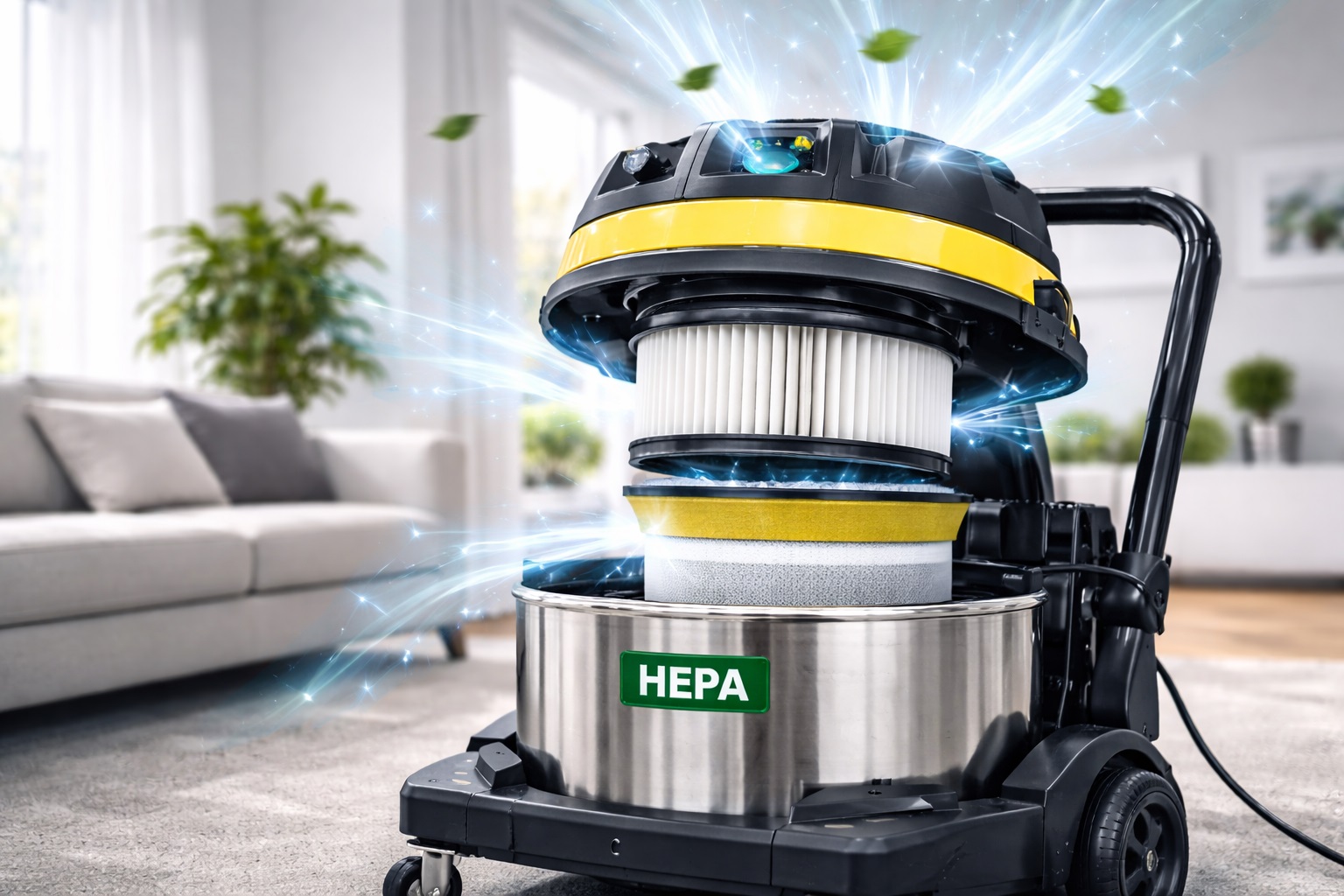
A Filtration-Centered Guide for Health-Conscious Facility & Business Buyers
Indoor air quality (IAQ) has become a critical health, productivity, and compliance issue across residential, commercial, and institutional environments. Dust, allergens, pet hair, fine particles, and micro-debris do not disappear when surfaces look clean—they often re-enter the air.
For facility managers, small business owners, cleaning contractors, and B2B buyers in Europe, the US, and the Middle East, vacuum cleaner selection plays a direct and measurable role in indoor air quality outcomes.
This article explains how advanced vacuum filtration improves indoor air quality, what filtration mistakes silently worsen air pollution, and how to select vacuum systems that truly support healthier indoor environments.
🧠 Why Cleaning Alone Does Not Improve Air Quality
Many people assume that frequent cleaning automatically improves indoor air quality.
In reality, poorly filtered vacuums can make air quality worse.
Common problems include:
Re-aerosolization of fine dust
Leakage from unsealed airflow paths
Inadequate filtration for micro-particles
Exhaust air carrying allergens back into rooms
Key insight:
A vacuum cleaner without advanced filtration is not an air-cleaning tool—it is an air circulation device.
🌬️ Filtration, Not Suction, Determines Air Quality
Suction removes debris from surfaces.
Filtration determines what goes back into the air.
A Multi-Functional Durable Vacuum Cleaner designed for air-quality improvement focuses on:
Sealed airflow systems
Multi-stage filtration
Consistent performance under load
High suction without proper filtration simply moves pollutants from the floor into the breathing zone.
🧹 HEPA-Level Filtration: The IAQ Baseline
High-efficiency filtration is essential for improving indoor air quality.
Advanced systems capture:
Fine dust
Allergens
Pet dander
Micro-particles released from carpets and upholstery
A HEPA-capable filtration system ensures that collected particles remain contained instead of being redistributed.
This is particularly important in:
Apartments
Offices
Clinics
Hospitality environments
🐾 Pet Hair & Allergens: A Hidden Air Quality Risk
Pet hair is often treated as a surface issue.
In reality, it is a major airborne allergen source.
A Vacuum Cleaner for Pet Hair that improves IAQ must:
Capture hair without shredding it into finer particles
Prevent hair from clogging airflow
Maintain filtration efficiency as debris accumulates
Without proper filtration, pet hair cleaning increases allergen concentration in indoor air.
💧 Wet & Dry Cleaning: Filtration Risks Few Buyers Consider
A wet and dry vacuum cleaner adds complexity to filtration design.
Key air-quality risks include:
Moisture-damaged filters
Microbial growth inside tanks
Air leakage after wet pickup
Advanced wet/dry systems improve IAQ by:
Separating wet and dry airflow paths
Protecting filtration media from moisture
Allowing easy tank sanitation
Poor wet/dry design creates hidden contamination sources.
🔄 Self-Cleaning Systems: Hygiene Without Air Pollution
Manual filter cleaning often releases trapped dust back into the air.
A Portable Self-Cleaning Vacuum Cleaner improves indoor air quality by:
Reducing direct contact with contaminated filters
Preventing dust release during maintenance
Maintaining consistent filtration efficiency
For small businesses and apartments, self-cleaning systems reduce both maintenance burden and air quality risk.
⚡ Energy Efficiency & Filtration Can Coexist
A common misconception is that high filtration always means higher energy use.
An Energy-Saving Efficient Powerful Vacuum Cleaner achieves both by:
Optimizing airflow paths
Reducing suction losses
Maintaining filtration efficiency without excessive power
Efficient filtration reduces the need for repeated cleaning, indirectly lowering energy consumption.
🏢 Apartment & Small Commercial Spaces: IAQ Sensitivity Is Higher
In compact environments:
Pollutants concentrate faster
Ventilation is limited
Occupants are closer to cleaning activity
An Apartment Vacuum Cleaner designed with advanced filtration:
Minimizes airborne dust during cleaning
Supports allergy-sensitive occupants
Improves daily living comfort
In small spaces, filtration quality matters more than raw power.
📉 Failure Scenario: When Cleaning Makes Air Worse
Consider this common situation:
Strong suction vacuum
Basic filtration
Visible dust removed
But:
Fine particles escape exhaust
Allergens circulate
Occupants experience irritation
Result:
The space looks clean, but air quality declines.
Advanced filtration prevents this invisible failure.
🌍 Regional Air Quality Considerations
Europe
Strong focus on health, sustainability, and IAQ
Filtration performance influences purchasing decisions
Middle East
High dust environments increase filtration load
Sealed systems are essential
United States
Allergy and pet-related concerns are major drivers
Consistent filtration performance builds trust
Vacuum filtration strategy should align with regional IAQ priorities.
📊 Indoor Air Quality & Total Cost of Ownership
Improved IAQ delivers long-term value:
Fewer complaints
Better occupant comfort
Reduced allergy-related issues
Less re-cleaning
Buyers who invest in advanced filtration often see lower indirect costs and higher satisfaction over time.
🧭 A Practical IAQ-Focused Vacuum Selection Framework
| IAQ Risk | Filtration Feature That Solves It |
|---|---|
| Fine dust re-release | Sealed multi-stage filtration |
| Pet allergens | High-efficiency capture systems |
| Wet cleaning contamination | Protected wet/dry filtration |
| Maintenance dust exposure | Self-cleaning filtration |
| Energy waste | Optimized airflow efficiency |
🧠 Final Insight for Health-Conscious Buyers
Improving indoor air quality does not start with air purifiers—it starts with how you clean.
Vacuum cleaners equipped with advanced filtration systems transform cleaning from a surface-level task into a health-supporting process, protecting occupants, improving comfort, and elevating long-term indoor environmental quality.
👥 Suitable Readers
Facility & operations managers
Small business owners
Cleaning service providers
Property managers
Health- and air-quality-conscious buyers
🔖 Hashtags
wet and dry vacuum cleaner, Multi-Functional Durable Vacuum Cleaner, Portable Self-Cleaning Vacuum Cleaner, Energy-Saving Efficient Powerful Vacuum Cleaner, Apartment Vacuum Cleaner, Vacuum Cleaner for Pet Hair, indoor air quality, advanced vacuum filtration, HEPA filtration systems, air quality improvement tools, professional cleaning equipment, allergy control solutions, dust control technology, sealed vacuum systems, air hygiene equipment, commercial air quality solutions, residential air quality tools, pet allergen control, sustainable cleaning equipment, energy efficient vacuum systems, cleaning equipment TCO, IAQ compliance tools, small business cleaning solutions, apartment air quality improvement, facility hygiene management, filtration technology innovation, commercial vacuum filtration, indoor pollution control, health focused cleaning, B2B cleaning solutions, cleaning industry innovation, European air quality standards, Middle East dust control, US indoor air quality, professional janitorial tools, air hygiene strategy, cleaning system design, filtration performance optimization, durable vacuum cleaner, smart cleaning technology, vacuum maintenance reduction, healthy indoor environments, cleaning equipment selection, indoor environmental quality, Lanxstar



