Pool maintenance is seasonal — but equipment stress is cumulative.
From spring reopening to peak summer operation, pool vacuums often run:
Daily in commercial facilities
3–5 times weekly in residential pools
Extended cycles in resorts and hospitality environments
Without structured maintenance, performance gradually declines:
This guide explains how to maintain your pool vacuum for consistent, high-level performance throughout the entire season.
🌡️ ① Understand Seasonal Stress Factors
Seasonal pressure varies by region:
Europe
Spring pollen
Organic debris
Indoor humidity
Middle East
Environmental stress affects filtration load and motor cooling efficiency.
Understanding your regional risk helps plan preventive maintenance.
🗓️ ② Create a Seasonal Maintenance Schedule
Consistency matters more than intensity.
Pre-Season Inspection
Inspect hose integrity
Check seals and gaskets
Test suction stability
Clean or replace filters
Peak Season Routine (Weekly)
Mid-Season Deep Maintenance
Inspect motor ventilation
Check electrical connections
Lubricate moving parts if applicable
A Multi-Functional Durable Vacuum Cleaner performs best when preventive care is structured, not reactive.
💨 ③ Protect Suction Stability
Loss of suction is often gradual.
Common causes:
An Energy-Saving Efficient Powerful Vacuum Cleaner relies on balanced airflow to maintain motor efficiency.
To preserve suction:
Never operate with clogged filters
Allow cooling breaks during heavy operation
Avoid continuous maximum power when unnecessary
Stable airflow = stable performance.
🧪 ④ Filter Management & Hygiene Control
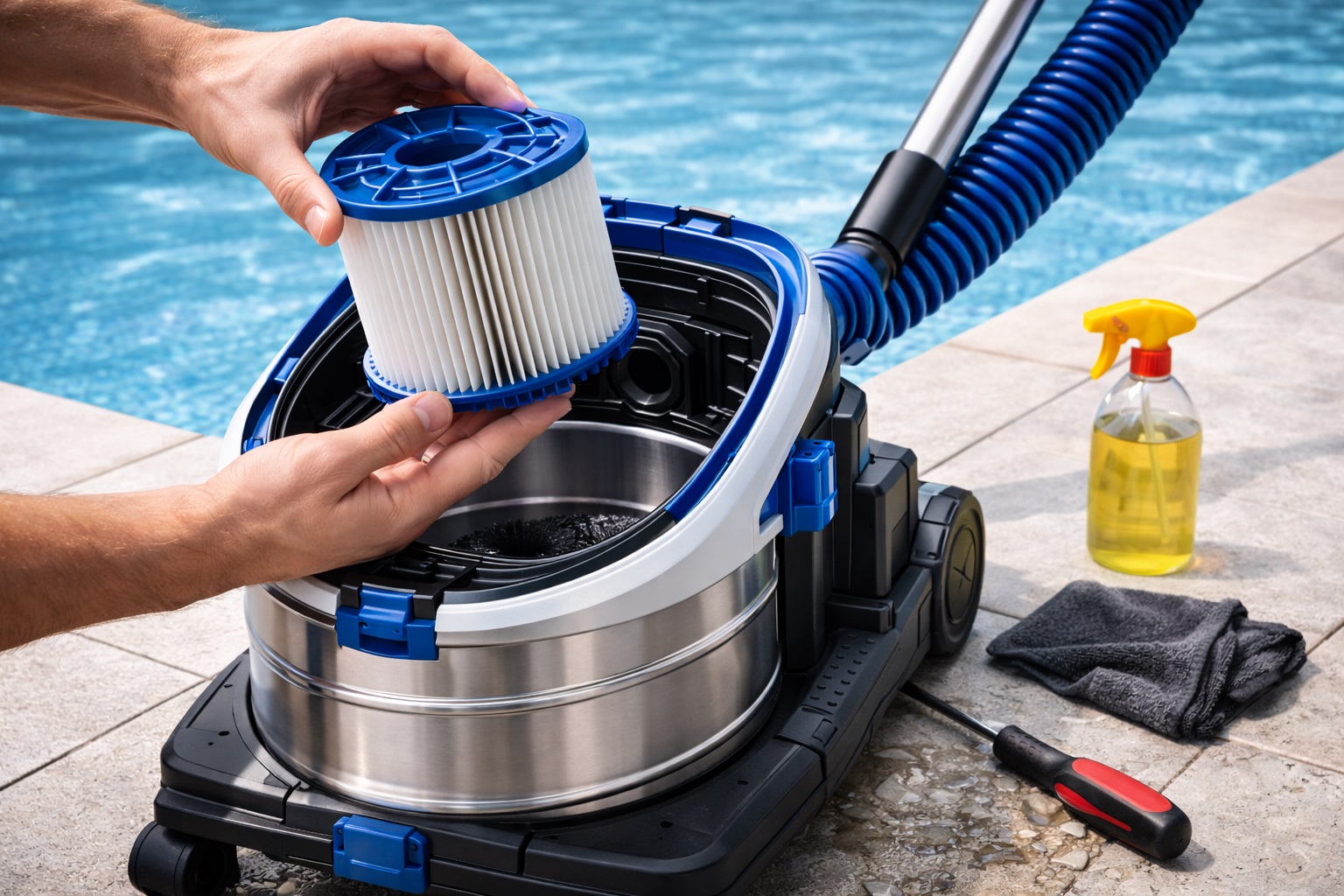
Filters are the most critical seasonal maintenance component.
In high-debris environments:
Rinse cartridge filters after every heavy cleaning
Replace disposable filters as recommended
Inspect sealing integrity
For facilities concerned with fine dust control, especially indoor spas, systems functioning similarly to a Vacuum Cleaner for Allergies require higher filtration integrity.
Compromised filters reduce hygiene standards and strain the motor.
💧 ⑤ Wet Use & Moisture Control
If operating as a wet and dry vacuum cleaner, moisture management is essential.
After wet cleaning:
Empty liquid immediately
Dry tank interior
Leave lid open to ventilate
Failure to dry internal components leads to:
Odor formation
Mold risk
Electrical corrosion
Seasonal humidity amplifies this risk.
🔄 ⑥ Self-Cleaning Systems: Reduce Downtime
If equipped as a Portable Self-Cleaning Vacuum Cleaner, activate automatic filter cleaning regularly.
Self-cleaning systems:
Maintain airflow efficiency
Reduce manual maintenance
Lower labor time
Improve consistency during peak season
Even self-cleaning systems require periodic inspection for residue buildup.
🔋 ⑦ Battery Care for Cordless Units
In hot climates:
Avoid charging under direct sunlight
Store batteries at moderate temperature
Avoid full discharge cycles frequently
Heat accelerates battery degradation.
Portable systems, including a Portable Vacuum for Travel, require careful battery handling to ensure stable runtime throughout the season.
🛢️ ⑧ Tank & Structural Integrity Checks
Heavy seasonal usage stresses:
Tank walls
Wheel assemblies
Hose connectors
Inspect for:
Micro cracks
Loose fasteners
Wheel resistance
Early detection prevents mid-season breakdowns.
📊 Performance Monitoring Checklist
| Indicator | Normal | Warning Sign |
|---|
| Suction | Stable | Gradual decrease |
| Noise | Consistent | High-pitched strain |
| Heat | Warm | Excessively hot casing |
| Debris Flow | Smooth | Blockage signs |
Monitoring small changes prevents large failures.
🌍 Regional Seasonal Strategy
Europe
Middle East
Adjusting maintenance frequency to climate conditions ensures reliability.
🔮 ⑨ End-of-Season Shutdown Protocol
At season close:
Deep clean all components
Replace worn filters
Drain moisture completely
Store in dry environment
Disconnect batteries if applicable
Proper shutdown prevents corrosion and performance decline next season.
❓ FAQ
Q1: How often should filters be replaced during peak season?
Depends on debris load. High-use commercial pools may require monthly replacement.
Q2: Why does suction drop mid-season?
Usually filter saturation or airflow restriction.
Q3: Can high temperature damage the motor?
Yes. Overheating shortens lifespan significantly.
Q4: Are self-cleaning vacuums maintenance-free?
No. They reduce manual effort but still require inspection.
✅ Conclusion
Maintaining consistent performance throughout the season requires:
Whether using a wet and dry vacuum cleaner, a Multi-Functional Durable Vacuum Cleaner, or a Portable Self-Cleaning Vacuum Cleaner, proactive maintenance ensures reliable suction, lower repair costs, and stable operation during peak demand.
Consistency in maintenance equals consistency in performance.
📌 Suitable Readers
Commercial pool maintenance contractors
Resort facility managers
Professional pool service teams
Equipment distributors
Property maintenance companies
📌 Hashtags
Lanxstar, wet and dry vacuum cleaner, Multi-Functional Durable Vacuum Cleaner, Portable Self-Cleaning Vacuum Cleaner, Energy-Saving Efficient Powerful Vacuum Cleaner, Vacuum Cleaner for Allergies, Portable Vacuum for Travel, seasonal pool vacuum maintenance, commercial pool cleaning equipment, sand resistant pool vacuum, professional suction cleaner, durable cleaning machine, energy efficient pool cleaner, B2B pool equipment supplier, Europe pool distributor, Middle East resort maintenance tools, advanced filtration vacuum system, facility management tools, heavy duty pool vacuum machine