Hi, message us with any questions.
We're happy to help!





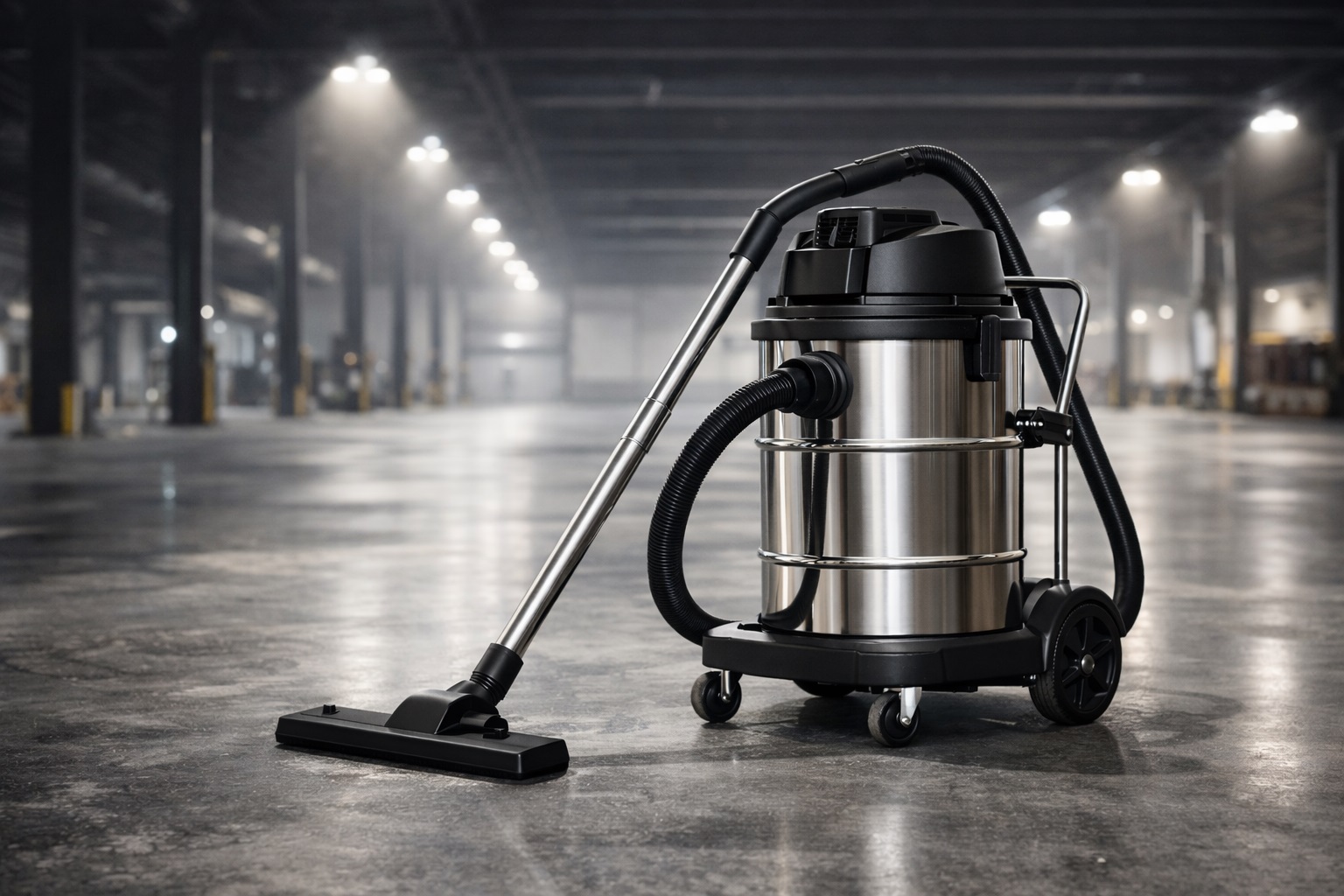
🎯 Who This Is For
This financial-focused guide is written for:
Large facility directors
FM company CEOs
Operations managers responsible for 5,000–50,000 m² facilities
Procurement and finance decision-makers
If cleaning cost exceeds six figures annually, equipment efficiency becomes a financial strategy — not just an operational choice.
📉 The Real Problem: Large Facilities Scale Inefficiency
In large facilities, small inefficiencies multiply rapidly.
Typical cost breakdown:
60–70% labor
15–25% equipment & maintenance
10–15% energy
Indirect costs (downtime, complaints, overtime)
Most cost-reduction strategies focus on labor cuts.
But cutting labor without improving productivity increases risk and turnover.
The smarter solution is:
Increase output per labor hour.
High-capacity drum systems enable this shift.
🛢️ Capacity = Time = Money
Small 20–30L units require frequent emptying.
In a 15,000 m² logistics center, technicians may empty tanks 5–7 times per shift.
A large-capacity wet dry vacuum cleaner (80–100L) reduces this to 1–2 times.
Time Saved Per Technician:
~25 minutes per shift
If you operate:
20 technicians
2 shifts per day
25 min × 20 × 2
= 1,000 minutes daily
= 16.6 labor hours saved per day
Over 26 working days:
≈ 431 labor hours saved per month
This is not marginal.
This is structural.
📊 3-Year ROI Model (Illustrative Example)
Facility:
20,000 m² distribution center
Current Setup:
8 small wet and dry vacuum cleaner units
16 technicians
Average cleaning time per day: 5 hours
Upgrade Investment:
Replace with 6 large-capacity wet dry vacuum cleaner systems
Higher upfront CAPEX
Estimated Productivity Gain:
12–18% efficiency improvement
Assume conservative 12%:
If annual cleaning labor cost = $400,000
12% improvement = $48,000 saved per year
Over 3 years:
$144,000 labor savings
Even if equipment upgrade costs $40,000–$60,000 more initially:
Payback period: ~10–15 months
After that, savings are pure margin protection.
⚖️ CAPEX vs OPEX Perspective
Low-cost machines reduce CAPEX.
High-capacity engineered systems reduce OPEX.
In large facilities:
OPEX dominates long-term financial impact.
Choosing a cheaper small wet and dry vacuum cleaner for large-scale cleaning is equivalent to operating half-capacity trucks in logistics — fuel and labor waste accumulate.
Facility strategy should optimize total cost of ownership, not purchase price.
⚡ Energy Efficiency Impact
An energy-saving efficient powerful vacuum cleaner:
Optimizes airflow-to-watt ratio
Reduces generator strain
Lowers long-term electricity expense
If 6 machines run 4 hours daily:
Even a modest 300W per unit energy saving:
300W × 6 × 4h × 26 days
≈ 187 kWh per month saved
Over multiple facilities, this compounds.
Energy efficiency also reduces internal heat stress, extending equipment life.
👥 Human Efficiency Compression Model
A 10% productivity improvement in a 25-person cleaning team:
= Equivalent to 2–3 full-time staff cost exposure reduction
This does not mean layoffs — it means:
Reduced overtime
Higher cleaning coverage
Capacity to take additional contracts
Reduced burnout and turnover
High-capacity drum systems improve human efficiency sustainably.
🌀 Multi-Surface Flexibility Reduces Redundancy
Large facilities often combine:
Concrete warehouse floors
Epoxy loading areas
Ceramic offices
Hardwood executive zones
A professional vacuum for multi-surface cleaning eliminates equipment duplication.
Even premium zones can be handled with a vacuum cleaner for hardwood floors integrated into the drum system through adjustable suction and floor-specific tools.
Standardization simplifies:
Training
Maintenance
Spare parts inventory
🛠 Durability & Replacement Cycle Impact
A multi-functional durable vacuum cleaner with:
Reinforced steel drum
Continuous-duty motor
Thermal protection
can operate 3–5 years in heavy use.
Small plastic units often require replacement within 18–24 months in high-demand facilities.
Replacement cycles are hidden OPEX multipliers.
Durability stabilizes budgeting.
📈 Extreme Comparison: 3-Year Cost Snapshot
| Metric | Small Units | High-Capacity Drum System |
|---|---|---|
| Emptying Per Shift | 6x | 2x |
| Cleaning Speed | Baseline | +12–18% |
| 3-Year Labor Cost | Higher | Lower |
| Equipment Replacement | 1–2 Cycles | 1 Cycle |
| Energy Efficiency | Moderate | Optimized |
| ROI Period | — | 10–15 Months |
Large facilities do not suffer from expensive equipment.
They suffer from inefficient systems.
⚠️ Risk of Staying With Undersized Equipment
Continuing with underpowered systems results in:
Overtime creep
Staff fatigue
Higher turnover
Frequent breakdown
Reduced contract competitiveness
In large-scale operations, inefficiency compounds monthly.
🔮 2026 Strategic Cost-Control Recommendations
For facilities above 5,000 m²:
✔ Upgrade to large-capacity drum platforms
✔ Select energy-saving efficient powerful vacuum cleaner models
✔ Prioritize multi-surface adaptability
✔ Standardize equipment fleet
✔ Evaluate 3-year total cost, not purchase price
Cleaning cost optimization is not about cutting corners.
It is about engineering efficiency.
Final Insight
In large facilities, scale magnifies inefficiency — but it also magnifies smart decisions.
A properly engineered:
Wet and dry vacuum cleaner
Large-capacity wet dry vacuum cleaner
High suction vacuum cleaner
Energy-saving efficient powerful vacuum cleaner
Multi-functional durable vacuum cleaner
Vacuum for multi-surface applications
Vacuum cleaner for hardwood floors in premium areas
transforms cleaning from an operational burden into a controllable financial lever.
The question is not:
Can you afford to upgrade?
The question is:
Can you afford not to?
📌 Suitable Audience
Large facility directors
FM CEOs
Warehouse operators
Airport & mall operations managers
Industrial cleaning contractors
Procurement and finance managers
📌 Hashtags
Lanxstar, wet and dry vacuum cleaner, Multi-Functional Durable Vacuum Cleaner, Energy-Saving Efficient Powerful Vacuum Cleaner, Large-Capacity Wet Dry Vacuum Cleaner, Vacuum for Multi-Surface, Vacuum Cleaner for Hardwood Floors, industrial drum vacuum system, warehouse cleaning cost reduction, facility management ROI strategy, high capacity vacuum cleaner 100L, steel drum wet dry vacuum, energy efficient commercial vacuum, high suction industrial vacuum system, multi surface cleaning equipment commercial, hardwood floor cleaning vacuum commercial, large facility maintenance equipment, S1 motor industrial vacuum cleaner, durable commercial cleaning machine, B2B vacuum distributor GCC, UAE warehouse cleaning equipment supplier, Saudi Arabia industrial vacuum importer, facility management cost optimization equipment, industrial hygiene equipment Middle East, continuous duty vacuum cleaner commercial, heavy duty suction machine warehouse, energy saving industrial cleaning system, commercial floor cleaning vacuum system, multi functional vacuum platform industrial, cleaning equipment lifecycle cost analysis, logistics warehouse dust control solution, CE certified industrial vacuum cleaner GCC, professional cleaning equipment distributor Europe, generator friendly vacuum cleaner industrial, mall cleaning equipment solution, airport facility cleaning machine, steel tank drum vacuum cleaner, industrial maintenance equipment supplier, large scale cleaning cost reduction strategy, premium commercial vacuum cleaner system, sustainable cleaning equipment industrial, vacuum standardization strategy large facility, high efficiency suction system commercial, durable vacuum cleaner for heavy use, industrial equipment distributor Middle East, warehouse hygiene management solution, drum vacuum adoption GCC