Hi, message us with any questions.
We're happy to help!





1. What Is an OEM Wet Dry Vacuum Cleaner? 🏭
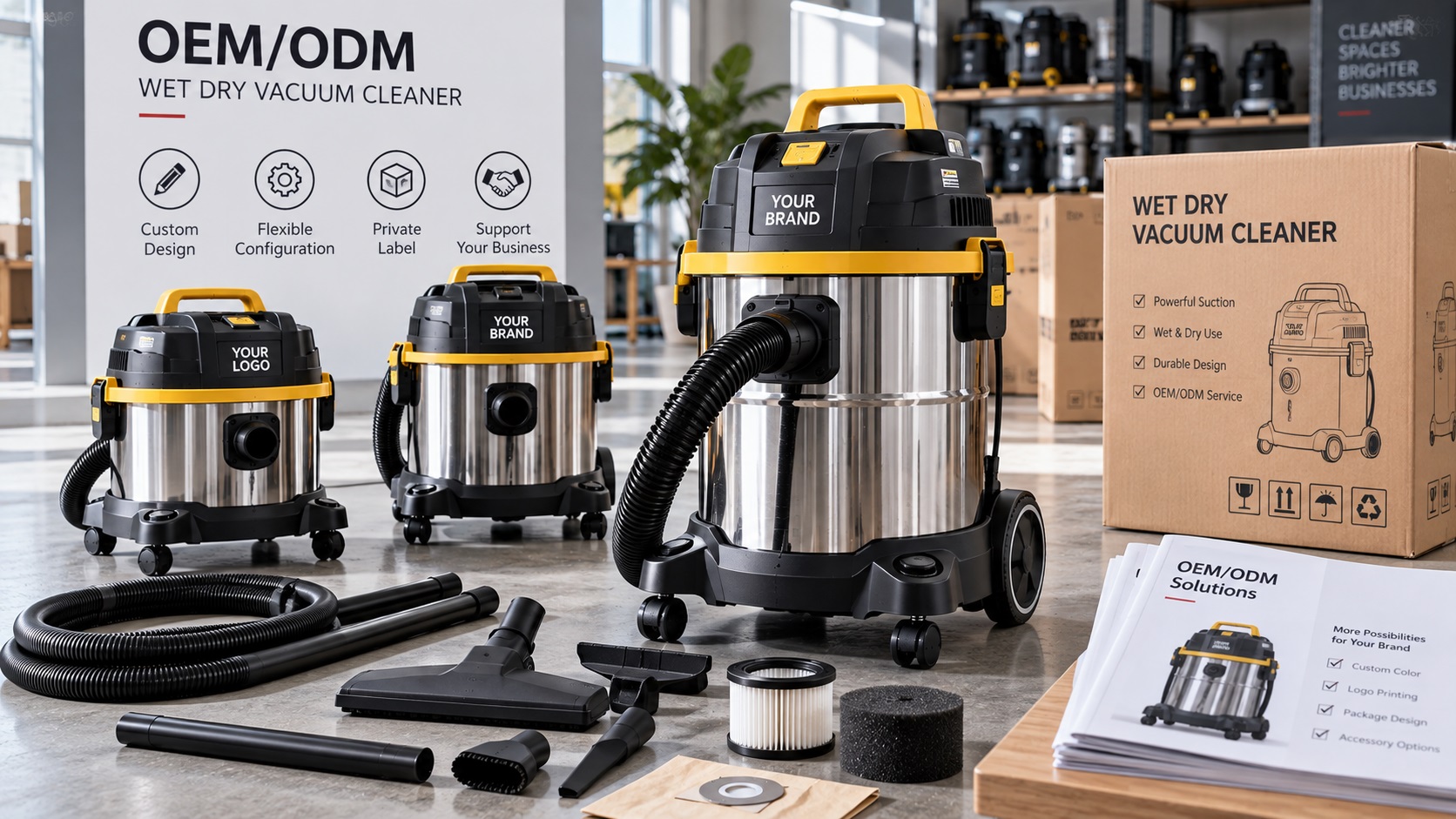
An OEM wet dry vacuum cleaner is a vacuum cleaner manufactured by one company and customized for another company's brand, market, or technical requirements.
OEM stands for Original Equipment Manufacturer.
In practical B2B sourcing, a distributor or brand may select an existing vacuum cleaner platform from a factory and customize selected elements such as:
Brand logo
Product color
Rating label
Packaging
Accessories
Filter configuration
Hose length
Power cord
Plug type
Tank design
Product manual
For many distributors, OEM manufacturing offers a faster and lower-risk route to market than developing an entirely new vacuum cleaner from the ground up.
A reliable vacuum cleaner manufacturer in China may already have proven production platforms for commercial, industrial, wet/dry, high-suction, lightweight or low-noise applications.
The buyer can then adapt that platform to match its own target market.
This model is particularly useful for companies that want to build a private label vacuum cleaner business without investing in their own manufacturing facility.
2. OEM vs ODM: What Is the Difference? 🔍
OEM and ODM are often used together, but they are not exactly the same.
OEM Vacuum Cleaner
In an OEM vacuum cleaner project, the factory usually manufactures a product based on an existing design or according to specifications provided by the buyer.
Customization may focus on branding, components, accessories and packaging.
ODM Vacuum Cleaner
An ODM vacuum cleaner project usually involves deeper product development.
The manufacturer may help develop:
New structural designs
New molds
Different airflow systems
New accessory combinations
Revised tanks
New filtration systems
Additional product functions
ODM projects typically require more development time, engineering resources and tooling investment.
For many distributors launching their first private-label range, OEM is often the more practical starting point.
Established brands with higher annual volumes may later move toward ODM projects to create greater product differentiation.
3. Why Do Distributors Choose OEM Wet Dry Vacuums? 🌍
The wet dry vacuum cleaner category serves a wide range of markets.
These machines can be used for dust, debris and liquid pickup, making them suitable for commercial, industrial and professional cleaning environments.
Typical applications include:
Warehouses
Workshops
Construction sites
Hotels
Retail stores
Automotive detailing
Factories
Facility-management companies
Professional cleaning services
A distributor may want different specifications for each market.
For example, a warehouse buyer may prefer a Large-Capacity Wet Dry Vacuum Cleaner, while a hotel distributor may focus more on mobility and low operating noise.
An OEM program allows the distributor to build product specifications around customer needs instead of selling a generic machine.
It can also help create stronger brand identity and reduce direct price comparison with competitors.
4. Start with the Target Application, Not the Logo 🎯
One of the most common mistakes in OEM sourcing is starting with branding before defining product requirements.
A logo does not make a good OEM product.
The first question should be:
Who will use this vacuum cleaner, and where will they use it?
For a wet dry vacuum cleaner for construction site applications, buyers may prioritize:
Robust wheels
Durable hose
Strong accessories
Large debris pickup
Wet suction capability
Easy tank emptying
For warehouse cleaning solution applications, the priority may be:
Large tank capacity
Long cable
High suction
Easy movement
Efficient filtration
For a commercial vacuum cleaner for hotel use, the priorities can shift toward:
Low noise
Compact storage
Maneuverability
Convenient accessories
Easy daily maintenance
Defining the application first helps the OEM industrial vacuum cleaner manufacturer recommend a more suitable platform.
5. Which Product Specifications Can Be Customized? 🛠️
The exact customization range depends on the manufacturer's product architecture.
Some modifications are easy and low-cost, while others require engineering work or tooling.
Common OEM Customization Options
Branding:
Logo printing, label design and product identification.
Color:
Tank, head unit, accessories or selected plastic parts may be customized.
Tank:
Capacity, stainless steel or plastic configuration may vary by platform.
Motor:
Different motor configurations may be available depending on performance requirements.
Filtration:
Standard filters or selected HEPA filter vacuum cleaner configurations may be available.
Accessories:
Floor tools, crevice tools, brushes, tubes and hoses may be customized.
Power Cord:
Cable length and regional plug type may be adjusted.
Packaging:
Neutral carton, branded carton or retail packaging can be developed.
Documentation:
Manuals, labels and product information can be adapted for different markets.
A strong vacuum cleaner maker should clearly distinguish between simple configuration changes and modifications requiring new engineering validation.
6. How to Select the Right Vacuum Platform ⚙️
Not every product should start from the same base design.
A distributor seeking a High Suction Vacuum Cleaner may prioritize motor performance and airflow.
A buyer targeting noise-sensitive environments may instead need a Portable Quiet Vacuum Cleaner or low noise vacuum cleaner.
A commercial distributor may want a Fast Lightweight Vacuum Cleaner for easier movement between rooms.
Industrial users may prefer a Multi-Functional Durable Vacuum Cleaner designed for demanding operating environments.
Energy-conscious customers may be interested in an Energy-Saving Efficient Powerful Vacuum Cleaner or energy efficient vacuum cleaner.
Choosing the right base platform reduces unnecessary development work and can shorten time to market.
7. Understanding OEM MOQ 📦
MOQ is one of the most important commercial factors in OEM manufacturing.
The minimum order quantity may depend on:
Product model
Customized color
Packaging
Accessories
Printed logo
Rating labels
Manuals
Upstream component suppliers
A standard-color product with a customized logo can often be easier to manufacture than a fully customized product requiring special plastic colors and unique accessories.
For a new private-label brand, a practical approach is to divide customization into stages.
Stage 1: Light OEM
Use an existing model with logo, label and branded packaging.
Stage 2: Medium OEM
Add custom colors, accessories and packaging.
Stage 3: Advanced OEM/ODM
Introduce structural changes, tooling or unique functionality.
This approach helps buyers test demand before committing to large product-development investments.
8. What Affects OEM Wet Dry Vacuum Cleaner Pricing? 💰
OEM pricing depends on much more than order quantity.
A vacuum cleaner price wholesale quotation can be affected by:
Motor quantity
Rated power
Tank size
Tank material
Filter configuration
Hose quality
Accessories
Cable length
Packaging
Logo process
Certification requirements
Order volume
Tooling requirements
For example, a dual motor vacuum cleaner will have a different cost structure from a compact single-motor vacuum.
Likewise, a stainless steel vacuum tank may have different material and processing costs compared with certain plastic designs.
Therefore, when comparing quotations, make sure all suppliers are quoting the same specification.
Otherwise, the cheapest quotation may simply contain a lower-cost configuration.
9. The OEM Sampling Process 🧪
Before mass production, buyers should obtain and approve samples.
The process may include several steps.
Initial Reference Sample
This allows the buyer to test the base product.
Customized Sample
The manufacturer applies selected branding, color, accessories or electrical configuration.
Pre-Production Sample
A final approved version is produced before mass production.
During sample testing, evaluate:
Suction
Airflow
Noise
Wet pickup
Dry pickup
Filter installation
Hose quality
Accessories
Wheels
Cable
Tank
Switches
Product appearance
Packaging
For a high suction power vacuum cleaner, do not rely on wattage alone.
Actual performance depends on motor characteristics, airflow design, filtration resistance, hose configuration and sealing.
10. Case Study: Distributor Building a Private-Label Wet Dry Vacuum Range 📦
Consider a hypothetical distributor in Western Europe planning a private-label range for professional cleaning companies.
The distributor initially requests a fully customized wet and dry vacuum cleaner with new colors, new accessories, printed retail cartons and a modified handle design.
The manufacturer explains that the handle modification requires new tooling and a higher MOQ.
Instead of investing immediately, the distributor chooses an existing product structure.
The first version includes:
Distributor logo
Custom product label
Branded carton
Selected accessory kit
Regional plug
Customized instruction manual
This reduces development cost and allows the distributor to launch more quickly.
After the first production cycle performs well in the market, the brand starts evaluating additional tooling for its second generation.
Key lesson: The best OEM strategy is not always maximum customization. It is the right level of customization for the expected sales volume.
11. Branding and Private Label Development 🎨
For a private label vacuum cleaner, branding should be consistent across the physical product and supporting materials.
Important elements can include:
Product logo
Model number
Color system
Carton design
Product photography
Manual design
Warranty card
Barcode
Product label
Accessories list
Buyers should provide artwork in appropriate file formats and confirm dimensions before production.
Make sure the approved packaging clearly defines:
Brand name + product model + electrical information + required market information + carton markings.
Avoid last-minute artwork changes because they can delay production.
12. Packaging Is Part of the Product 📦
Packaging is often underestimated in OEM projects.
A vacuum cleaner may perform perfectly but still generate customer complaints if the carton is damaged or accessories arrive loose.
For export orders, packaging should protect the product during:
Factory handling
Container loading
International transport
Warehouse storage
Local distribution
Buyers should evaluate carton strength, internal support, accessory placement and labeling.
For retail or e-commerce markets, presentation quality may also be important.
A professional vacuum cleaner supplier should be able to discuss packaging requirements before mass production.
13. Certification and Market Compliance 📋
OEM buyers should identify the regulatory requirements of the destination market before finalizing the product.
Different countries and regions may have different requirements relating to electrical safety, electromagnetic compatibility, environmental obligations, labeling and documentation.
Do not assume that every certificate shown by a supplier applies automatically to your customized product.
Verify:
Exact model
Voltage
Frequency
Components
Product changes
Destination market
Applicable documentation
If customization changes critical components or electrical specifications, buyers should confirm whether additional testing or documentation is required.
Compliance responsibility should be treated seriously because importers and brand owners may have their own legal obligations in destination markets.
14. Quality Control for OEM Orders ✅
OEM projects require precise specification control.
Create an approved specification sheet covering:
Product model
Color
Motor
Tank
Filters
Hose
Accessories
Cable
Plug
Logo
Label
Manual
Carton
Packaging method
The more clearly these requirements are documented, the lower the risk of misunderstanding.
Quality control can be divided into:
Incoming Inspection
Motors, filters, hoses, cables and other components are checked.
In-Process Inspection
Important production steps are monitored during assembly.
Final Inspection
Finished machines are checked before packing.
Pre-Shipment Inspection
A production batch is inspected against agreed requirements before shipment.
For a large bulk vacuum cleaner purchase, buyers may also use a third-party inspection company.
15. How to Control Component Substitution 🔍
Component substitution is an important issue in OEM manufacturing.
A factory may face changes in material availability or upstream suppliers.
Without a clear agreement, a replacement component might be introduced during mass production.
For critical items such as:
Motors
Filters
Switches
Cables
Hoses
Electrical components
buyers should establish an approval procedure.
A simple principle can be:
No critical component change without buyer approval.
This protects consistency between approved samples and mass-production products.
It is especially important for recurring orders.
16. Lead Time for OEM Vacuum Cleaner Projects ⏱️
OEM lead time is usually longer than standard product lead time because customization requires coordination.
A typical process may include:
Specification confirmation → quotation → sample → sample approval → artwork → packaging approval → material preparation → production → inspection → shipment.
Lead time depends on the level of customization.
Simple logo and packaging projects can be relatively straightforward.
Custom colors, special accessories or newly developed components can require additional preparation.
ODM projects with new tooling can take significantly longer.
Buyers should confirm exactly when the production lead time begins.
Does it start after deposit?
After sample approval?
After packaging artwork approval?
That detail should be written clearly into the project schedule.
17. How to Evaluate an OEM Factory's Engineering Capability 💡
Brands planning future product development should evaluate more than assembly capacity.
Ask whether the manufacturer has engineering resources for:
Product structure
Electrical design
Airflow design
Mold development
Filtration
Testing
Prototype development
For an industrial vacuum cleaner, performance can depend on the interaction of motors, air channels, seals, tanks, filters and accessories.
A manufacturer that understands these relationships can provide more useful product-development support than a company focused only on assembling standard products.
This is particularly important when moving from OEM to ODM.
18. Wet Dry Vacuum Cleaner Applications and OEM Positioning 🧹
One advantage of OEM manufacturing is the ability to create products for specific customer segments.
Construction
A wet dry vacuum cleaner for construction site applications may emphasize durability, debris collection and strong accessories.
Warehouses
An industrial wet and dry vacuum cleaner for warehouse cleaning supplier may focus on capacity, mobility and long cleaning cycles.
Hotels
A commercial vacuum cleaner for hotel use may emphasize low noise and ease of handling.
Automotive
A car detailing vacuum cleaner may prioritize suction, flexible hoses and specialized nozzles.
Factories
A heavy duty vacuum cleaner may be suitable for demanding workshop or factory cleaning tasks.
By positioning products according to real use cases, distributors can create clearer value propositions than simply competing on motor wattage.
19. How to Calculate the Real Cost of an OEM Project 🚢
The factory unit price is only one part of total project cost.
Buyers should consider:
Samples
Tooling
Packaging
Printing
Artwork
Testing
Inspection
Freight
Customs
Warehousing
Spare parts
Warranty support
For a bulk order vacuum cleaner program, packaging efficiency can have a significant effect on landed cost.
Ask the factory for:
Carton dimensions
Gross weight
Net weight
Units per carton
20GP loading quantity
40GP loading quantity
40HQ loading quantity
This allows the distributor to calculate a more realistic landed cost per unit.
20. How to Protect Product Consistency Across Repeat Orders 🔁
A successful OEM project should be repeatable.
The second and third production runs should match the first approved order.
Buyers should maintain:
Approved samples
Final specifications
Packaging artwork
BOM references
Accessory lists
Component approval records
Product testing requirements
If the manufacturer proposes a component change, document the change before the next production run.
This type of change control is especially important for distributors selling through professional channels where customers expect consistent specifications.
21. Spare Parts and After-Sales Support 🔧
For commercial and industrial products, spare-parts availability can be an important competitive advantage.
Ask the industrial vacuum cleaner supplier whether it can provide:
Filters
Hoses
Brushes
Wheels
Switches
Cables
Seals
Motor-related components
Distributors may choose to include selected spare parts in their initial purchase.
This can improve local after-sales service and reduce future downtime for customers.
A long-term OEM manufacturer should view spare-parts support as part of the supply relationship.
22. Case Study: OEM Vacuum for a Commercial Cleaning Brand 🏢
Consider a hypothetical commercial cleaning brand serving facility-management contractors.
The company wants a commercial grade vacuum cleaner that can be sold under its own name.
Instead of selecting the cheapest supplier, the brand compares three manufacturers.
Supplier A provides the lowest price but offers limited customization.
Supplier B offers strong product quality but requires a very high MOQ for branded packaging.
Supplier C provides balanced MOQ, customization support, documentation, quality-control procedures and spare-parts availability.
The buyer selects Supplier C for a controlled initial order.
After six months, customer feedback shows strong demand for a longer hose and different accessory kit.
Because the product platform is flexible, the supplier modifies the next order without requiring a complete redesign.
Key lesson: A strong OEM partnership should allow a brand to improve the product over time.
23. Common OEM Mistakes Distributors Should Avoid 🚩
Several mistakes can create unnecessary cost and delay.
Customizing Too Much Too Early
Start with changes that create clear market value.
Choosing by Price Alone
A low quotation may involve lower specifications or weaker support.
Skipping Sample Testing
Never assume mass production will meet expectations without an approved reference.
Ignoring Packaging
Export damage can erase unit-price savings.
Unclear Quality Specifications
"Good quality" is not measurable.
Late Artwork Approval
Packaging delays can delay the entire order.
No Spare-Parts Plan
Professional customers may need long-term support.
No Component Change Control
Mass-production products can drift away from the approved sample.
24. How to Choose an OEM Industrial Vacuum Cleaner Manufacturer 🤝
When selecting an OEM industrial vacuum cleaner manufacturer, evaluate the supplier as a long-term partner.
Consider:
Product range
Manufacturing capability
Quality-control system
Engineering support
OEM experience
MOQ flexibility
Packaging capabilities
Production capacity
Communication
Spare-parts support
Delivery reliability
After-sales service
A capable vacuum cleaner manufacturer in China should be able to explain not only what it can produce but also how the product will be controlled throughout the manufacturing process.
For distributors, consistent execution is often more valuable than a small short-term price difference.
25. Working with Lanxstar on OEM Wet Dry Vacuum Cleaner Projects
When evaluating Lanxstar or another potential vacuum cleaner supplier China, buyers should begin with a detailed project brief.
Include:
Target market
Application
Required quantity
Tank capacity
Motor requirements
Filtration
Accessories
Cable
Plug
Branding
Packaging
Compliance needs
Target delivery schedule
If the project involves a Large-Capacity Wet Dry Vacuum Cleaner, High Suction Vacuum Cleaner, Portable Quiet Vacuum Cleaner, or another professional cleaning product, detailed requirements help both sides avoid unnecessary assumptions.
For brands planning recurring orders, it is also useful to discuss projected annual volume.
That gives the manufacturer a clearer basis for pricing, materials and production planning.
26. OEM Wet Dry Vacuum Cleaner Project Checklist 📌
Before placing an OEM order, confirm the following:
Target application — Where and how will the vacuum cleaner be used?
Product platform — Which existing model best matches the requirement?
Customization — Logo, color, tank, accessories, cable and filtration.
MOQ — Confirm separate minimum quantities for product, colors and packaging.
Pricing — Compare identical specifications.
Samples — Approve the final product before production.
Packaging — Confirm artwork, protection and carton specifications.
Compliance — Verify target-market requirements.
Quality control — Define inspection and testing requirements.
Component control — Establish rules for material substitutions.
Lead time — Define when the production timeline officially begins.
Shipping — Calculate carton volume and landed cost.
Spare parts — Plan after-sales support.
Repeat orders — Maintain controlled specifications.
Supplier capability — Evaluate the manufacturer as a long-term partner.
Conclusion
An OEM wet dry vacuum cleaner program can help distributors and brands create differentiated products without establishing their own manufacturing operation.
However, successful OEM sourcing requires much more than adding a logo to an existing vacuum cleaner.
Professional buyers should define the target application, choose the right product platform, control specifications, understand MOQ, evaluate pricing, approve samples, verify compliance, manage packaging, define quality requirements and plan for repeat-order consistency.
For distributors and brands, the strongest OEM relationships are built around clear specifications, reliable production, measurable quality and continuous product improvement.
Whether you need an industrial vacuum cleaner, wet and dry vacuum cleaner, commercial vacuum cleaner, HEPA filter vacuum cleaner, or customized private-label product, the objective should be to create a product that fits your customers and supports your long-term brand strategy.
For more information about OEM/ODM vacuum cleaner manufacturing and customized wholesale solutions, visit www.lxvacuum.com.
If you are interested, please feel free to contact us.
50 Related SEO Keywords
OEM wet dry vacuum cleaner, OEM vacuum cleaner, wet dry vacuum cleaner, wet and dry vacuum cleaner, private label vacuum cleaner, ODM vacuum cleaner, Lanxstar, vacuum manufacturer, vacuum cleaner maker, vacuum cleaner manufacturer, vacuum cleaner manufacturer in China, vacuum cleaner supplier China, industrial vacuum cleaner supplier, industrial vacuum cleaner factory, OEM industrial vacuum cleaner manufacturer, wholesale vacuum cleaner, bulk vacuum cleaner purchase, bulk order vacuum cleaner, factory direct vacuum cleaner, vacuum cleaner price wholesale, industrial vacuum cleaner cost, industrial vacuum cleaner, commercial vacuum cleaner, heavy duty vacuum cleaner, commercial grade vacuum cleaner, High Suction Vacuum Cleaner, high suction power vacuum cleaner, Portable Quiet Vacuum Cleaner, low noise vacuum cleaner, Multi-Functional Durable Vacuum Cleaner, Fast Lightweight Vacuum Cleaner, Energy-Saving Efficient Powerful Vacuum Cleaner, energy efficient vacuum cleaner, Large-Capacity Wet Dry Vacuum Cleaner, HEPA filter vacuum cleaner, dual motor vacuum cleaner, stainless steel vacuum tank, wet and dry suction system, industrial dust extractor, industrial cleaning equipment, commercial cleaning equipment, cleaning equipment supplier, construction site cleaning equipment, warehouse cleaning solution, commercial vacuum cleaner for hotel use, wet dry vacuum cleaner for construction site, car detailing vacuum cleaner, facility management cleaning equipment, import vacuum cleaner from China, heavy duty vacuum cleaner supplier China