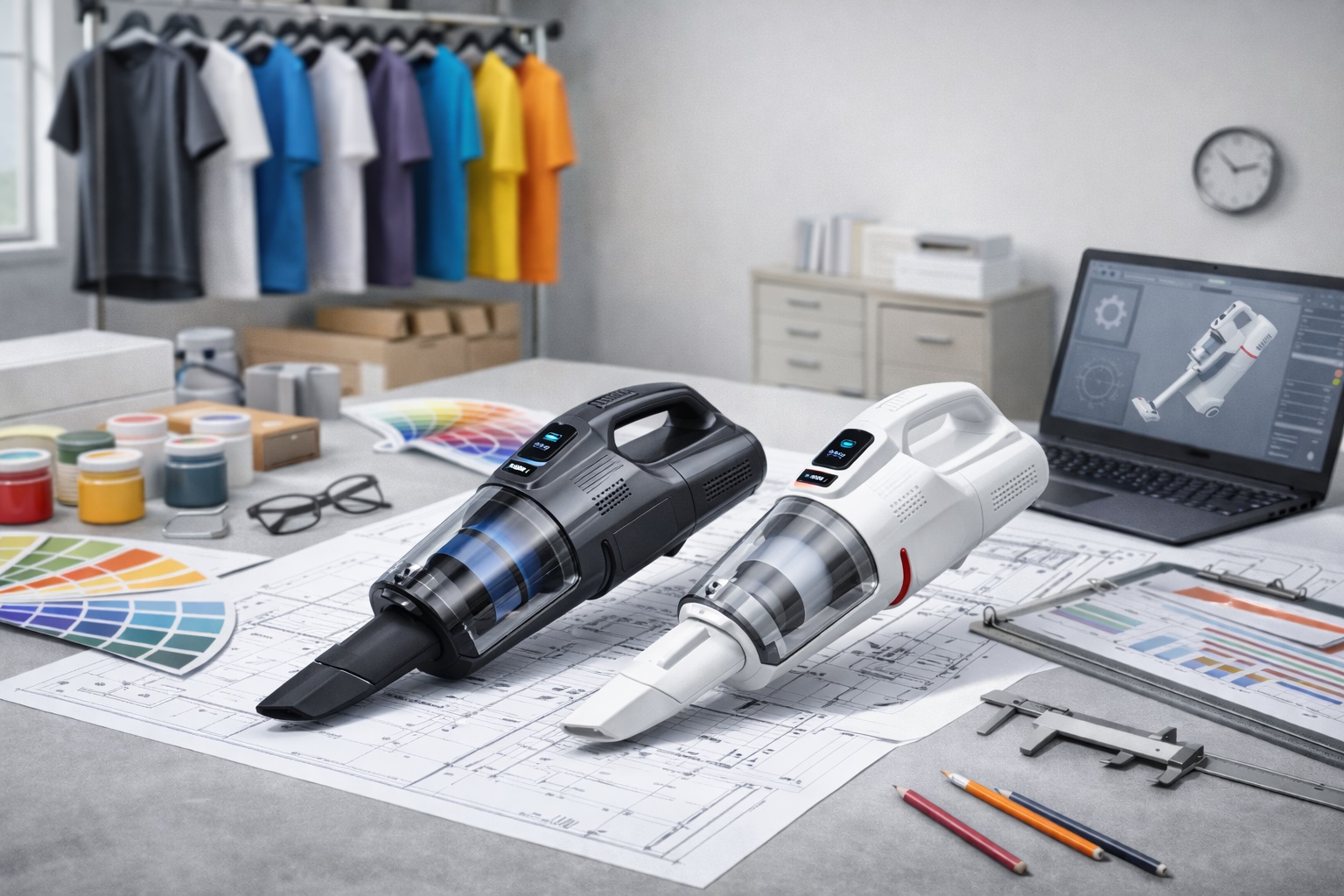
For brands and distributors looking to differentiate in competitive markets, OEM Cordless Vacuum Cleaners offer flexibility that stock models cannot. However, OEM sourcing introduces new variables—most importantly MOQ, customization depth, cost structure, and lead time.
This guide breaks down how OEM MOQ works, what customization really costs, and how buyers can plan realistic timelines when working with professional vacuum manufacturers.
1. What Does OEM Mean in Cordless Vacuum Manufacturing?
OEM (Original Equipment Manufacturer) refers to producing vacuum cleaners based on an existing factory platform, with brand-level customization rather than full product redesign.
OEM typically includes:
Logo printing (product & packaging)
Color and surface finish changes
Accessory configuration
Performance tuning (within existing structure)
Compared to ODM, OEM offers lower MOQ, faster lead time, and controlled cost—ideal for brands targeting best value vacuum segments.
2. OEM MOQ: Typical Ranges and Why They Exist
Common OEM MOQ Levels
Basic OEM (logo + box): 500–800 units
Enhanced OEM (color + accessories): 800–1,500 units
Advanced OEM (performance tuning): 1,500+ units
MOQ exists because factories must:
Purchase components in batches
Reconfigure assembly lines
Allocate engineering and QA resources
For cordless handheld vacuums and Car Vacuum Cleaner models, MOQ is often lower due to simpler structures.
3. Customization Options and Their Impact on MOQ
Not all customization affects MOQ equally.
Low MOQ Impact
Medium MOQ Impact
Custom color housing
Accessory set changes
HEPA filter upgrades
High MOQ Impact
Buyers planning OEM Cordless Vacuum Cleaners should align customization depth with realistic order volume.
4. How Customization Affects Cost Structure
OEM cost is not linear—it scales with customization.
Cost Components
For example, adding HEPA Filter Vacuum Cleaner capability may increase unit cost moderately but significantly improves appeal for:
5. OEM Lead Time: What Buyers Should Expect
Typical OEM lead time consists of:
Sample confirmation: 7–14 days
OEM tooling & prep: 10–20 days
Mass production: 25–40 days
QC & packing: 5–7 days
Total lead time usually ranges from 45–75 days, depending on MOQ and customization level.
📌 Tip: Stock color OEM projects can ship faster than wet-dry or high-suction variants.
6. Real OEM Sourcing Case Studies
Case 1: European Private Label Brand
A brand ordered 1,000 OEM units focused on quiet vacuum cleaner performance for apartments. Limited customization kept MOQ low and lead time under 60 days.
Case 2: Middle East Distributor
The distributor added custom accessories for Vacuum Cleaner for Hardwood Floors. MOQ increased slightly, but higher retail price improved margins.
Case 3: Online Brand (US)
An e-commerce brand upgraded to Fast Lightweight Vacuum Cleaner tuning. OEM cost rose 8%, but conversion rate increased significantly.
7. OEM vs ODM: MOQ and Risk Comparison
| Model | MOQ | Cost | Lead Time | Risk |
|---|
| Stock | Low | Lowest | Fastest | Low |
| OEM | Medium | Controlled | Medium | Medium |
| ODM | High | Highest | Long | High |
For most growing brands, OEM is the optimal balance between differentiation and scalability.
8. How Engineers Manage OEM Feasibility
From an engineering view, OEM success depends on:
This ensures consistent performance for Vacuum for Multi-Surface and Apartment Vacuum Cleaner use cases.
9. OEM MOQ Strategy Recommendations
New brands: Start with basic OEM (500–800 units)
Growth brands: Add accessories or HEPA upgrades
Established buyers: Move toward advanced OEM features
Strategic OEM planning minimizes risk while building brand identity 📦.
Conclusion
OEM Cordless Vacuum Cleaner sourcing is a balance of MOQ, customization, cost, and lead time. Buyers who understand these relationships can launch differentiated products faster, control budgets, and scale confidently with reliable manufacturing partners.
To explore OEM options, MOQ consultation, or project timelines, visit www.lxvacuum.com
If you are interested, please feel free to contact us.
Target Readers
OEM cordless vacuum cleaner buyers
Private-label vacuum brands
Importers and distributors
Product managers & R&D engineers
E-commerce brands seeking differentiation
50 Related Keyword Groups
Cordless Vacuum Cleaner, OEM Cordless Vacuum Cleaner, cordless handheld vacuums, High Suction Vacuum Cleaner, Portable Quiet Vacuum Cleaner, Self-Cleaning Vacuum Cleaner, Multi-Functional Durable Vacuum Cleaner, Fast Lightweight Vacuum Cleaner, Energy-Saving Efficient Powerful Vacuum Cleaner, Large-Capacity Wet Dry Vacuum Cleaner, Wet Dry Vacuum Cleaners, Li-ion Cordless Handheld Vacuum Cleaner, Car Vacuum Cleaner, quiet vacuum cleaner, wet dry vacuum, Portable Vacuum for Travel, HEPA Filter Vacuum Cleaner, Apartment Vacuum Cleaner, Wet and Dry Vacuum Cleaner, Quiet Vacuum for Night Use, Vacuum Cleaner for Pet Hair, Vacuum Cleaner for Hardwood Floors, Vacuum Cleaner for Allergies, Vacuum for Multi-Surface, best vacuum on a budget, best value hoover, good budget vacuum, best affordable vacuum, best value for money hoover, best vacuum cleaners on a budget, good budget vacuum cleaner, Lanxstar, Lanxstar vacuum, vacuums manufacturer, vacuum cleaner maker, OEM vacuum factory, wholesale vacuum cleaner, private label vacuum, budget cordless vacuum cleaner











