Hi, message us with any questions.
We're happy to help!





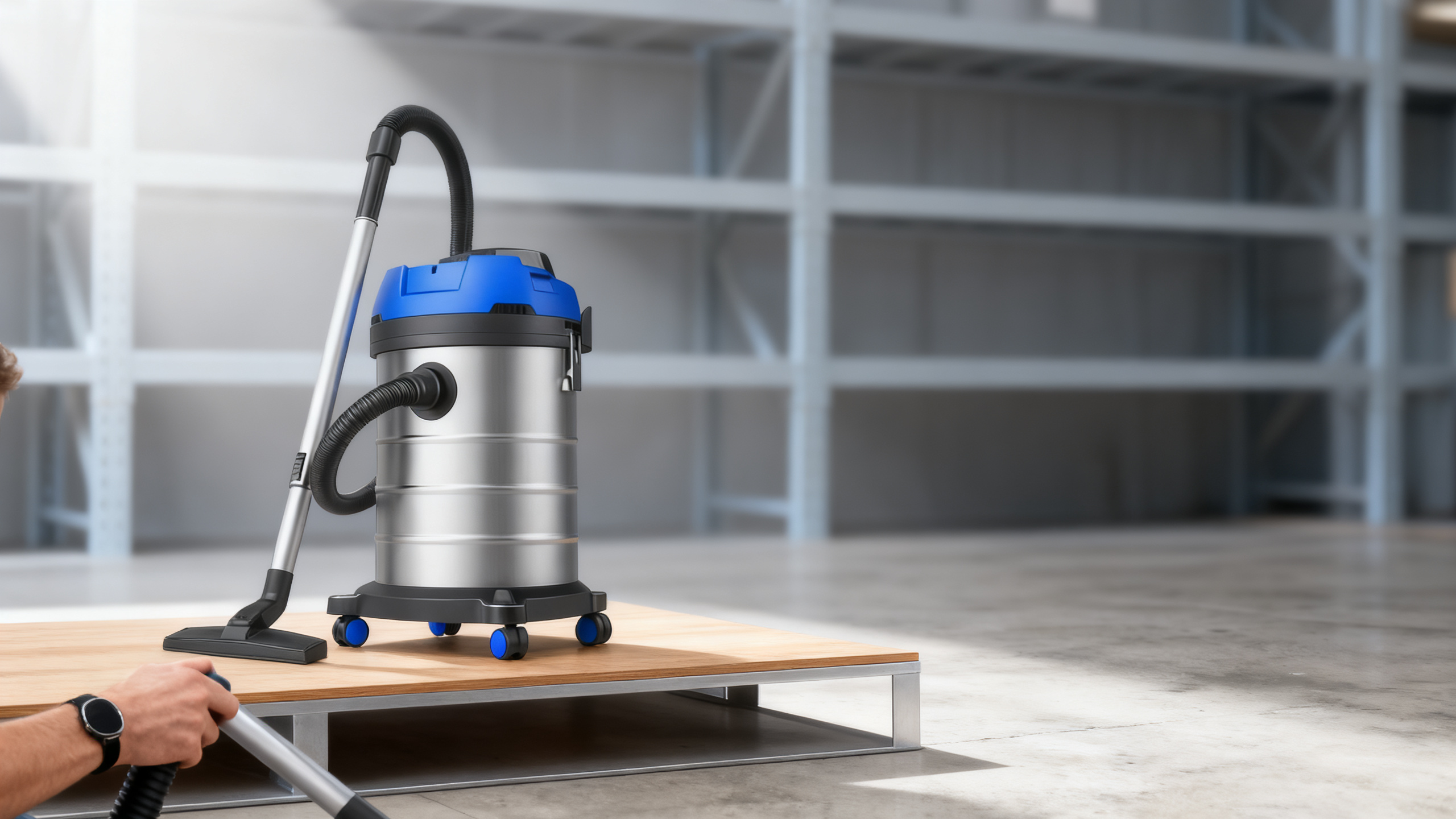
Container freight is one of the largest variable costs in vacuum cleaner imports. Every cubic meter of empty space in a carton is a cubic meter you pay for but cannot sell. Every corner of wasted volume in a container is freight cost per unit that erodes margin. For wholesale buyers, packaging is not a cosmetic detail. It is a cost driver that directly affects landed cost, damage rates, and container utilization.
This guide is written for vacuum cleaner wholesale buyers, importers, distributors, procurement managers, B2B buyers, logistics planners, product R&D engineers, industrial equipment suppliers, and companies sourcing from China. It explains how vacuum cleaner packaging is optimized for container loading, and how commercial vacuum cleaner, wet dry vacuum cleaner, and OEM vacuum cleaner buyers can benefit from better packaging design from a vacuum cleaner manufacturer in China.
The Cost of Empty Space: Why Packaging Optimization Matters 💰
Every carton has two costs: the cost of the product inside and the cost of the space it occupies in a container.
A Large-Capacity Wet Dry Vacuum Cleaner in an oversized carton may fit 200 units in a 40HQ container. The same machine in an optimized carton may fit 230 units. At $3,000 per container in freight, the difference is $15 per unit—$3,000 saved or lost on every shipment.
Optimized packaging delivers benefits across the supply chain:
Lower freight cost per unit: More units per container.
Lower warehousing cost: Less space per unit in the warehouse.
Lower damage rates: Better protection reduces returns and replacements.
Better retail presentation: Compact, well-designed cartons improve shelf appearance.
A vacuum cleaner manufacturer in China with strong packaging engineering can deliver these benefits. A supplier that uses the same carton for every model, regardless of size, is leaving money on the table.
Principle 1: Carton Size Fits the Product, Not the Other Way Around 📐
The most common packaging mistake is using a standard carton size that is larger than necessary. This happens when factories buy pre-made cartons in bulk without tailoring them to each model.
How Optimization Works
Measure the assembled machine: The carton should be designed around the actual machine with accessories, not around a generic size.
Reduce internal clearance: Allow only enough space for protective cushioning (typically 2–3 cm on each side).
Use custom carton sizes: A Portable Quiet Vacuum Cleaner may need a 40 × 35 × 50 cm carton; a Large-Capacity Wet Dry Vacuum Cleaner may need 65 × 55 × 85 cm. One size does not fit all.
The Impact on CBM
A carton that is 5 cm too large in each dimension can add 10–15% to the CBM per unit. For a 40HQ container carrying commercial vacuum cleaner units, this means 10–15% fewer units per shipment.
Principle 2: Product Nesting and Disassembly 🧩
Many vacuum cleaners can be partially disassembled or nested to reduce carton volume.
What Can Be Nested
Hoses: Coiled and secured inside the tank or accessory bag.
Wands: Separated and placed alongside the tank.
Nozzles: Removed and packed in dedicated compartments.
Power cords: Wrapped and secured.
Accessories: Placed in a small bag inside the tank.
A Multi-Functional Durable Vacuum Cleaner with multiple accessories can often be packed more compactly if the accessories are nested inside the tank rather than packed separately.
The Trade-Off: Assembly at Destination
Nesting may require the end user to assemble the machine. This is acceptable for professional buyers who understand assembly. For retail consumers, a partially assembled machine may be less attractive.
The vacuum cleaner manufacturer in China should discuss this trade-off with the buyer. The goal is to reduce volume without creating a negative customer experience.
Principle 3: Protective Cushioning That Does Not Waste Space 🛡️
Packaging must protect the product during transport. But protection does not require excessive padding.
Efficient Cushioning Materials
Molded pulp or EPE foam: Custom-shaped to the machine, providing protection with minimal volume.
Corner protectors: Reinforce the most vulnerable areas without filling the entire carton.
Air pillows: Lightweight and space-efficient.
Cardboard inserts: Folded to hold accessories and stabilize the machine.
What to Avoid
Thick foam blocks that add 5–10 cm to each dimension
Excessive bubble wrap that increases carton size without significant protection
Loose fill that settles during transit and leaves the product unprotected
A stainless steel vacuum tank is durable and less susceptible to cosmetic damage than plastic. This may allow lighter cushioning than a plastic-tank model.
Principle 4: Drop Testing to Validate the Design 🧪
Optimized packaging must still pass drop testing. A smaller carton that fails in transit is not an optimization—it is a false economy.
Standard Drop Tests
ISTA 1A: Basic package performance test
ISTA 3A: Packaged-product performance for parcel delivery
ASTM D5276: Standard test for drop height and orientation
The vacuum cleaner manufacturer in China should perform drop testing on the optimized carton design. The test verifies that the product survives the expected handling and transport conditions.
What the Test Should Cover
Drop on corner, edge, and face
Drop at the carton’s weakest point
Vibration testing for truck and container transport
Compression testing for stacked cartons in a container
A High Suction Vacuum Cleaner with a heavy motor may require stronger corner protection than a lighter Portable Quiet Vacuum Cleaner.
Principle 5: Floor Loading vs Pallet Loading Optimization 🏗️
Container loading efficiency depends on how cartons are arranged.
Floor Loading
Cartons are stacked directly on the container floor. No pallets are used. This maximizes container volume utilization.
Optimization techniques:
Design cartons to stack stably without pallets
Use corner boards or edge protectors to prevent crushing
Plan the loading pattern to fill gaps
Pallet Loading
Cartons are stacked on wooden pallets. This is easier for forklift handling at destination but reduces container utilization by 10–15%.
Optimization techniques:
Use low-profile pallets (10–12 cm height instead of 15 cm)
Design cartons to fit standard pallet footprints (120 × 100 cm or 120 × 80 cm)
Maximize stacking height within container limits
For a Large-Capacity Wet Dry Vacuum Cleaner order of 200 units, floor loading may fit 220 units while pallet loading fits 190. The difference in freight cost per unit is significant.
Principle 6: Carton Strength and Compression Resistance 💪
Cartons in a container are stacked several layers high. The bottom cartons must support the weight of those above them.
What Affects Carton Strength
Board grade: A higher burst strength or edge crush test (ECT) rating supports more weight.
Flute type: B-flute is thinner; C-flute is thicker and stronger; BC double-wall is strongest for heavy products.
Moisture resistance: Humidity weakens corrugated board. A coating or additive improves performance in humid climates.
A heavy duty vacuum cleaner with a stainless steel vacuum tank may weigh 40–50 kg. The carton must be strong enough to support multiple layers without crushing.
The vacuum cleaner manufacturer in China should specify the board grade and provide compression test data.
Principle 7: Retail-Ready Packaging That Ships Efficiently 🛒
Retail packaging and shipping packaging are not always the same thing.
Two Approaches
Approach 1: Single Carton
The retail packaging is the shipping carton. This is efficient for container loading but may result in cosmetic damage to retail packaging during transit.
Approach 2: Master Carton
Retail packaging is placed inside a larger master carton. This protects the retail packaging but adds volume.
Optimization Tips
Use a printed shipping carton that doubles as retail packaging
Include a protective sleeve rather than a full master carton
Design the retail box to be compact without compromising presentation
For OEM vacuum cleaner and private label vacuum cleaner programs, packaging design is part of the brand experience. The manufacturer should work with the buyer to balance protection, cost, and presentation.
Case Study: How Better Packaging Increased Container Capacity by 18% ✅
A wholesale buyer in Europe imported Large-Capacity Wet Dry Vacuum Cleaner models from a supplier in China. The standard carton size was 70 × 60 × 90 cm (0.378 CBM). A 40HQ container at 66 CBM practical volume fit approximately 174 units.
The buyer noticed that competitors were shipping more units per container and asked Lanxstar, a vacuum cleaner manufacturer in China with packaging engineering capability, to review the packaging.
Lanxstar engineers redesigned the carton to 65 × 55 × 85 cm (0.304 CBM) by:
Nesting the hose inside the tank
Replacing thick foam with molded pulp inserts
Reducing the clearance around the motor housing
The new design passed ISTA 1A drop testing without damage. The optimized carton fit approximately 217 units in a 40HQ container at 66 CBM.
The results were significant:
Units per 40HQ increased from 174 to 217 (an 18% improvement)
Freight cost per unit decreased by approximately 15%
Damage rate remained unchanged
The buyer used the savings to increase order volume
This case shows that packaging optimization is not just a design exercise. It is a direct margin improvement.
What Importers Should Ask the Manufacturer 🤝
When sourcing wet dry vacuum cleaner models, ask these packaging questions.
Questions for the Supplier
What is the exact carton size and CBM per unit? Do not accept estimates.
Can the product be nested to reduce carton volume? If yes, what is the trade-off for assembly?
What cushioning material is used? Is it optimized for protection without excess volume?
Has the packaging passed drop testing? Which standard (ISTA 1A, 3A)?
What is the carton board grade and compression strength? Can it support stacked loading?
Is floor loading possible? Or is pallet loading required?
Can the carton be customized for our brand and market? What is the MOQ for custom packaging?
A vacuum cleaner manufacturer in China with packaging engineering capability will answer these questions with data, not guesses.
Why Lanxstar? 🌟
Lanxstar is a professional vacuum cleaner maker and vacuum manufacturer focused on industrial, commercial, and wet dry vacuum solutions. With nearly a decade of manufacturing experience and ISO9001 certification, we help global buyers with:
High Suction Vacuum Cleaner models
Portable Quiet Vacuum Cleaner designs
Multi-Functional Durable Vacuum Cleaner series
Fast Lightweight Vacuum Cleaner options
Energy-Saving Efficient Powerful Vacuum Cleaner technology
Large-Capacity Wet Dry Vacuum Cleaner solutions
industrial vacuum cleaner, commercial vacuum cleaner, and wet dry vacuum cleaner production
OEM vacuum cleaner, ODM vacuum cleaner, and private label vacuum cleaner services
wholesale vacuum cleaner and bulk vacuum cleaner purchase support
vacuum cleaner supplier China export experience
industrial vacuum cleaner factory quality control
vacuum cleaner manufacturer in China cost advantages
Whether you need a heavy duty vacuum cleaner supplier China, a commercial vacuum cleaner for hotel use, a wet dry vacuum cleaner for construction site, or an industrial wet and dry vacuum cleaner for warehouse cleaning supplier, Lanxstar can help.
Final Thoughts and Summary 📌
Vacuum cleaner packaging optimization for container loading is a direct margin driver. The key principles are:
Carton size fits the product, not a generic standard.
Product nesting reduces volume without compromising protection.
Efficient cushioning protects without wasting space.
Drop testing validates the design.
Floor loading maximizes container utilization where possible.
Carton strength supports stacked loading.
Retail-ready packaging balances presentation and shipping efficiency.
A High Suction Vacuum Cleaner in an optimized carton can fit 10–20% more units per container than one in a standard carton. A Large-Capacity Wet Dry Vacuum Cleaner with nested accessories and molded pulp inserts can significantly reduce CBM per unit. A Portable Quiet Vacuum Cleaner in a compact retail carton can improve shelf appearance and shipping efficiency. A heavy duty vacuum cleaner with strong cartons can be floor-loaded for maximum utilization.
In summary, importers should ask the manufacturer for exact carton dimensions, drop test reports, and loading plans. They should consider nesting, floor loading, and custom packaging as levers to reduce landed cost. Working with a vacuum cleaner manufacturer in China that takes packaging engineering seriously can help you gain a cost advantage that competitors miss.
If you are interested, please feel free to contact us.
www.lxvacuum.com
50 Related Keywords:
High Suction Vacuum Cleaner, Portable Quiet Vacuum Cleaner, Multi-Functional Durable Vacuum Cleaner, Fast Lightweight Vacuum Cleaner, Energy-Saving Efficient Powerful Vacuum Cleaner, Large-Capacity Wet Dry Vacuum Cleaner, wet and dry vacuum cleaner, wet dry vacuum cleaner, industrial vacuum cleaner, commercial vacuum cleaner, industrial vacuum cleaner supplier, vacuum cleaner manufacturer, industrial cleaning equipment, commercial cleaning equipment, vacuum cleaner supplier, vacuum cleaner manufacturer in China, industrial vacuum cleaner factory, wholesale vacuum cleaner, bulk vacuum cleaner purchase, OEM vacuum cleaner, ODM vacuum cleaner, private label vacuum cleaner, cleaning equipment supplier, industrial equipment supplier, construction site cleaning equipment, warehouse cleaning solution, hotel cleaning equipment, hospital cleaning equipment, factory floor cleaning, logistics warehouse cleaning, car detailing vacuum cleaner, commercial cleaning service equipment, facility management cleaning equipment, retail cleaning equipment, HEPA filter vacuum cleaner, high suction power vacuum cleaner, heavy duty vacuum cleaner, dual motor vacuum cleaner, stainless steel vacuum tank, low noise vacuum cleaner, energy efficient vacuum cleaner, wet and dry suction system, industrial dust extractor, commercial grade vacuum cleaner, buy industrial vacuum cleaner, best industrial vacuum cleaner, vacuum cleaner price wholesale, industrial vacuum cleaner cost, vacuum cleaner supplier China, commercial vacuum cleaner for sale, bulk order vacuum cleaner, factory direct vacuum cleaner, vacuum cleaner distributor Europe, import vacuum cleaner from China, industrial wet and dry vacuum cleaner for warehouse cleaning supplier, wet dry vacuum cleaner for construction site, commercial vacuum cleaner for hotel use, heavy duty vacuum cleaner supplier China, OEM industrial vacuum cleaner manufacturer, best vacuum on a budget, best budget hoover, good budget vacuum, best affordable vacuum, best budget vacuum, best value for money hoover, best value hoover, best vacuum cleaners on a budget, best vacuums on a budget, good budget vacuum cleaner, Lanxstar, vacuum manufacturer, vacuum cleaner maker