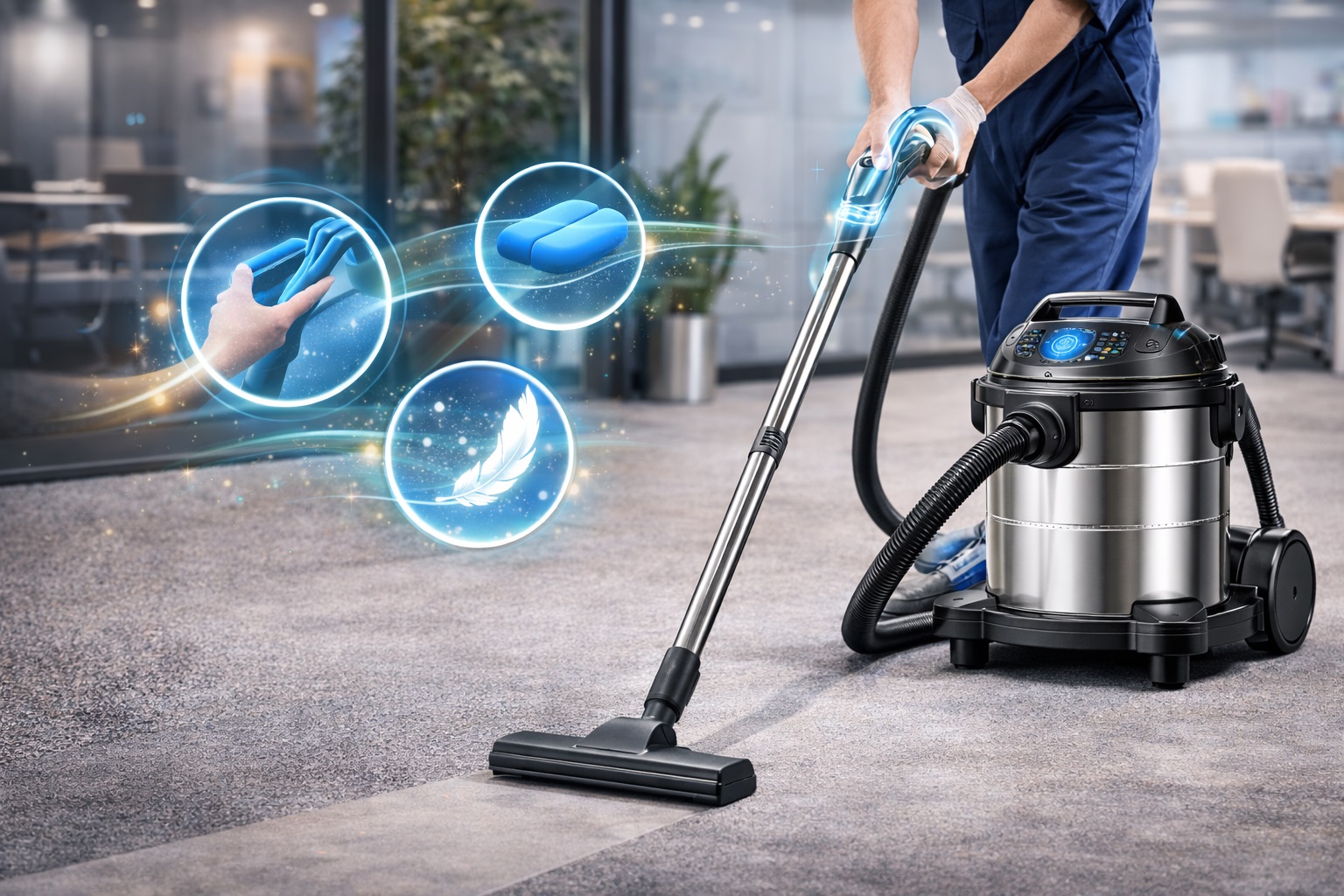
In commercial cleaning, “convenience” is not about comfort alone.
It is about how long, how often, and how consistently a worker can clean without slowing down, making mistakes, or getting injured.
Ergonomic vacuum design directly impacts:
Cleaning speed
Operator fatigue
Training time
Injury risk
Staff turnover
This article explains how ergonomic vacuum design improves commercial cleaning convenience, and why it is now a core performance factor, not a luxury feature.
🧠 1. Ergonomics Is a Productivity Multiplier, Not a Soft Feature
Many buyers focus on:
Suction power
Tank capacity
Motor specs
But ignore:
Handle angle
Weight distribution
Push/pull resistance
Control placement
A well-designed wet and dry vacuum cleaner with ergonomic balance:
Requires less force per movement
Reduces repetitive strain
Maintains cleaning speed over long shifts
Key Insight:
A vacuum that is 10% easier to handle often delivers 20–30% more real-world productivity.
🏃 2. Lightweight Design Reduces Fatigue in High-Frequency Cleaning
In commercial environments, cleaning is rarely a one-time task.
Operators:
A Fast Lightweight Vacuum Cleaner:
Reduces shoulder and wrist strain
Improves maneuverability in tight spaces
Allows faster direction changes
Operational Reality:
Heavy machines clean well for 30 minutes.
Lightweight ergonomic machines clean well for 8 hours.
🔄 3. Ergonomics Enables True Multi-Surface Efficiency
Commercial facilities include:
Hard floors
Carpets
Ramps
Corners and edges
A Vacuum for Multi-Surface with ergonomic design:
When combined with a Multi-Functional Durable Vacuum Cleaner, operators:
Hidden Benefit:
Ergonomics reduces “micro-pauses” that silently kill efficiency.
🧼 4. Maintenance Ergonomics Matter as Much as Cleaning Ergonomics
Cleaning equipment is also handled during maintenance.
Poor design causes:
A Portable Self-Cleaning Vacuum Cleaner improves convenience by:
Reducing manual filter handling
Minimizing lifting and shaking
Keeping maintenance quick and clean
Management Insight:
When maintenance is easy, it actually gets done — protecting performance and lifespan.
🤫 5. Ergonomic + Quiet Design Unlocks Night-Time Efficiency
Night cleaning introduces new ergonomic stress:
Low visibility
Reduced supervision
Fatigue at off-hours
A Quiet Vacuum for Night Use with ergonomic controls:
Reduces mental and physical strain
Allows relaxed, steady operation
Prevents rushed, sloppy cleaning
Quiet + ergonomic design enables:
Strategic Value:
Night productivity depends more on ergonomics than on raw power.
🧬 6. Ergonomics Lowers Training and Skill Dependency
Complex machines require:
Ergonomic vacuums:
This is critical in industries with:
High staff turnover
Seasonal labor
Multi-language teams
Result:
Faster onboarding, consistent performance.
📊 7. Ergonomic Design Reduces Injury-Related Costs
Back pain, wrist strain, and shoulder injuries are common in cleaning work.
Poorly designed equipment leads to:
Sick leave
Compensation claims
Reduced morale
Ergonomic vacuum design:
Encourages neutral posture
Reduces repetitive stress
Protects long-term worker health
Cost Insight:
In many facilities, injury-related downtime costs more than equipment maintenance.
🏢 8. Ergonomics Scales Better in Large Facilities
As facilities grow:
Walking distance increases
Cleaning repetition increases
Fatigue accumulates faster
Ergonomic advantages compound at scale:
Small effort savings per movement
Thousands of movements per shift
Measurable productivity gains
This makes ergonomic design especially valuable for:
Airports
Hospitals
Shopping malls
Warehouses
✅ Conclusion: Ergonomic Design Turns Good Vacuums into Great Tools
Ergonomic vacuum design improves commercial cleaning convenience by:
Reducing physical strain
Maintaining productivity over long shifts
Lowering training and injury costs
Enabling efficient multi-surface and night cleaning
Making equipment easier to use, maintain, and scale
In modern commercial cleaning, the best vacuum is not the strongest one —
it is the one that people can use efficiently, safely, and consistently.
Ergonomics is no longer about comfort.
It is about operational performance.
📌 Suitable Reading Audience
Commercial Cleaning Company Owners
Facility Operations & Maintenance Managers
B2B Cleaning Equipment Buyers
Workforce Safety & Productivity Managers
📌 Hashtags
wet and dry vacuum cleaner, Multi-Functional Durable Vacuum Cleaner, Fast Lightweight Vacuum Cleaner, Portable Self-Cleaning Vacuum Cleaner, Vacuum for Multi-Surface, Quiet Vacuum for Night Use, Ergonomic Vacuum Design, Commercial Cleaning Ergonomics, Cleaning Equipment Productivity, Operator Friendly Vacuums, Workplace Safety Cleaning, Cleaning Equipment Innovation, Ergonomic Industrial Vacuums, Facility Cleaning Efficiency, Reduce Cleaning Fatigue, Professional Cleaning Equipment, Ergonomic Cleaning Tools, Night Cleaning Solutions, Quiet Commercial Vacuums, Multi-Surface Cleaning Equipment, Lightweight Commercial Vacuums, Cleaning Workflow Optimization, Workforce Friendly Equipment, Industrial Cleaning Design, Ergonomic Equipment ROI, Cleaning Staff Productivity, Facility Operations Equipment, Sustainable Cleaning Operations, Injury Reduction Cleaning, Long Shift Cleaning Solutions, Commercial Vacuum Design, Smart Cleaning Equipment, Cleaning Equipment Usability, Facility Maintenance Tools, Commercial Cleaning Best Practices, High Frequency Cleaning Solutions, Operator Comfort Equipment, Cleaning Safety Equipment, Industrial Facility Cleaning, Ergonomic Design Strategy, Cleaning Equipment Performance, Professional Facility Cleaning, B2B Cleaning Solutions, Commercial Cleaning Technology, Facility Management Tools, Lanxstar