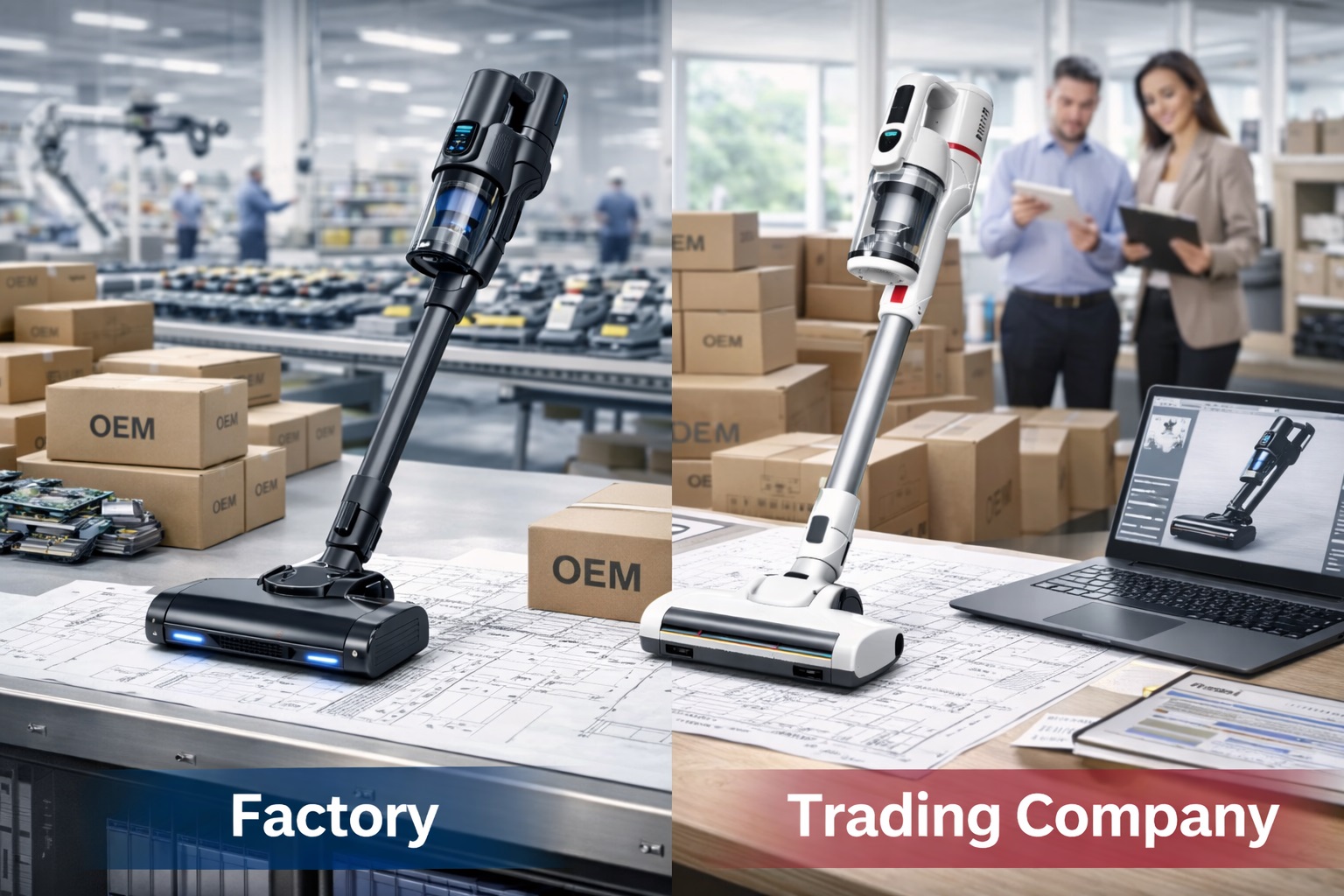
When sourcing Cordless Vacuum Cleaners from China, buyers are often faced with a critical decision: buy directly from a factory or work with a trading company. While both options exist in the supply chain, they differ significantly in MOQ, pricing structure, customization capability, and long-term scalability.
This guide provides a clear, side-by-side comparison to help buyers choose the right sourcing path based on their business stage and objectives.
1. What Is a Factory vs a Trading Company?
Factory (Manufacturer)
Owns production lines and tooling
Controls engineering, QC, and assembly
Offers OEM / ODM / private label programs
Trading Company
Acts as an intermediary
Aggregates products from multiple factories
Focuses on sales, logistics, and communication
Understanding these roles is essential before evaluating MOQ and pricing.
2. MOQ Comparison: Factory vs Trading Company
Typical MOQ Levels
| Sourcing Type | Typical MOQ | Flexibility |
|---|
| Factory Direct | 500–1,500 units | Medium |
| Trading Company | 100–500 units | High |
📌 Key takeaway:
Trading companies often advertise lower MOQ, but this usually comes with higher unit cost and limited customization.
3. Price Structure Differences
Factory Pricing
Trading Company Pricing
Higher unit cost (markup included)
Bundled logistics & service fees
Less price flexibility at scale
For buyers targeting best value vacuum positioning, factory sourcing becomes more cost-efficient as volume grows.
4. Customization & OEM Capability Comparison
| Aspect | Factory | Trading Company |
|---|
| Logo & packaging | ✅ Strong | ⚠️ Limited |
| Color customization | ✅ Yes | ⚠️ Depends |
| Performance tuning | ✅ Yes | ❌ Rare |
| Wet & dry upgrade | ✅ Yes | ❌ No |
Factories are better suited for OEM Cordless Vacuum Cleaner and Private Label strategies, while trading companies focus on ready-to-ship products.
5. Lead Time & Supply Stability
Factory Direct
Trading Company
For long-term programs such as Vacuum Cleaner for Pet Hair or Apartment Vacuum Cleaner, supply stability is critical.
6. Risk Comparison
Factory Risks
Trading Company Risks
Experienced buyers often start with trading companies, then transition to factories once demand is validated.
7. Real Sourcing Case Studies
Case 1: Startup Brand
A startup sourced 300 units through a trading company to test market response. Unit cost was higher, but risk was minimal.
Case 2: Scaling Distributor
At 1,200 units, the distributor moved to factory direct sourcing. Unit cost dropped 17%, improving margins.
Case 3: Private Label Brand
A private label brand required quiet vacuum cleaner tuning and HEPA filtration. Only factory sourcing could meet requirements.
8. Engineer’s Perspective: Why Factories Matter
From a technical standpoint, factories offer:
This is especially important for Vacuum Cleaner for Hardwood Floors and Vacuum for Multi-Surface performance tuning.
9. Which Option Should You Choose?
There is no “one-size-fits-all”—the right choice depends on your growth stage.
Conclusion
Choosing between a factory and a trading company directly affects MOQ, pricing, customization, and risk when sourcing cordless vacuum cleaners. Smart buyers align sourcing strategy with business stage—starting lean, then scaling with factories for long-term success.
To evaluate factory direct sourcing, OEM options, or MOQ strategies, visit
www.lxvacuum.com
If you are interested, please feel free to contact us.
Target Readers
Global cordless vacuum cleaner buyers
Importers comparing factory vs trading company
OEM / private label brands
Product managers & sourcing teams
Distributors scaling from test orders
50 Related Keyword Groups
Cordless Vacuum Cleaner, cordless handheld vacuums, OEM cordless vacuum cleaner, High Suction Vacuum Cleaner, Portable Quiet Vacuum Cleaner, Self-Cleaning Vacuum Cleaner, Multi-Functional Durable Vacuum Cleaner, Fast Lightweight Vacuum Cleaner, Energy-Saving Efficient Powerful Vacuum Cleaner, Large-Capacity Wet Dry Vacuum Cleaner, Wet Dry Vacuum Cleaners, Li-ion Cordless Handheld Vacuum Cleaner, Car Vacuum Cleaner, quiet vacuum cleaner, wet dry vacuum, Portable Vacuum for Travel, HEPA Filter Vacuum Cleaner, Apartment Vacuum Cleaner, Wet and Dry Vacuum Cleaner, Quiet Vacuum for Night Use, Vacuum Cleaner for Pet Hair, Vacuum Cleaner for Hardwood Floors, Vacuum Cleaner for Allergies, Vacuum for Multi-Surface, best vacuum on a budget, best value hoover, good budget vacuum, best affordable vacuum, best vacuum cleaners on a budget, good budget vacuum cleaner, Lanxstar, Lanxstar vacuum, vacuums manufacturer, vacuum cleaner maker, vacuum trading company China, OEM vacuum factory, wholesale vacuum cleaner, private label vacuum