Hi, message us with any questions.
We're happy to help!





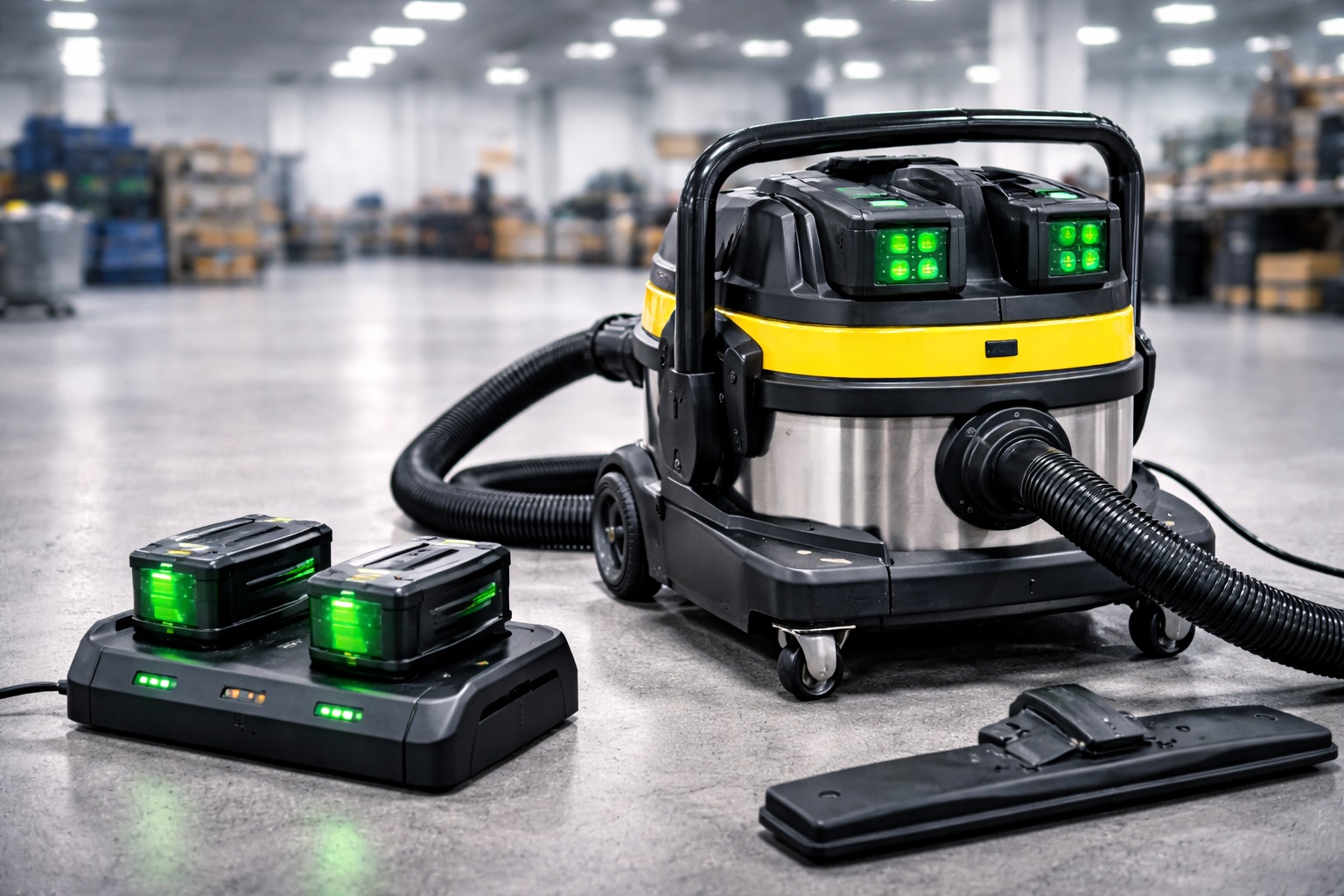
A Practical Energy-Management Guide for Professional Cleaning Operations
Cordless vacuum cleaners have transformed professional cleaning by removing cables, improving mobility, and reducing safety risks. However, in long-hour usage environments—such as commercial facilities, serviced apartments, logistics centers, and multi-shift cleaning operations—battery life becomes the primary performance bottleneck.
For facility managers, cleaning contractors, B2B buyers, and distributors in Europe, the US, and the Middle East, optimizing battery life is not about squeezing extra minutes—it is about maintaining stable performance across full shifts without downtime.
This article explains how battery life is affected by design, usage patterns, and application types—and how to select and deploy cordless vacuums that truly support long-hour operations.
🧠 Why Battery Life Fails Faster Than Expected
Many users assume battery issues are caused by “weak batteries.”
In reality, battery degradation usually results from system-level mismatches.
Common causes include:
Excessive suction demand for light tasks
Heat buildup during extended operation
Frequent deep discharge cycles
Improper battery charging routines
Using one power mode for all surfaces
Key insight:
Battery life is not just a battery problem—it is a power management problem.
🔋 Cordless Vacuum Design: Not All Are Built for Long Shifts
A Cordless Vacuum Cleaner designed for consumer use may perform well for short sessions but struggle under professional workloads.
Professional-grade systems prioritize:
Stable discharge curves
Thermal protection
Consistent power output under load
When evaluating cordless models, buyers should look beyond advertised runtime and focus on runtime stability under real cleaning conditions.
🧹 Suction Control: The Hidden Battery Killer
Constant maximum suction is the fastest way to drain batteries.
In long-hour environments:
Hard floors do not require peak power
Light debris needs airflow, not brute force
High suction should be task-specific
A Multi-Functional Durable Vacuum Cleaner with adjustable or automatic suction control can reduce unnecessary power consumption while preserving cleaning effectiveness.
💧 Wet & Dry Usage: Managing Energy Demand Correctly
A wet and dry vacuum cleaner introduces additional battery stress:
Liquid pickup increases motor load
Heavier tanks increase resistance
Improper mode use wastes energy
Optimized wet/dry systems:
Separate airflow paths
Protect motors from moisture drag
Prevent users from running dry-mode power during wet pickup
Correct wet/dry design significantly extends usable battery time.
🐾 Pet Hair & High-Resistance Debris
Pet hair behaves differently from dust:
It tangles
It resists airflow
It increases brush resistance
A Vacuum Cleaner for Pet Hair optimized for cordless use relies on:
Efficient brush geometry
Anti-tangle systems
Stable airflow rather than raw power
This reduces battery drain while maintaining pickup quality—especially in serviced apartments and hospitality spaces.
🚗 Small-Space Applications: Why Car & Apartment Use Matters
Applications like:
Vehicle interiors
Apartments
Elevators and stairwells
require frequent start-stop cycles.
A Car Vacuum Cleaner or Apartment Vacuum Cleaner optimized for cordless operation should:
Handle short bursts efficiently
Recover quickly between cycles
Avoid peak power spikes
These usage patterns directly influence battery lifespan over time.
🌡️ Thermal Management: The Silent Battery Killer
Heat is the enemy of lithium batteries.
In long-hour usage:
Motors generate sustained heat
Enclosed housings trap temperature
Hot batteries degrade faster
Professional cordless vacuums integrate:
Heat-dissipating housings
Temperature-aware power reduction
Battery protection circuits
Battery optimization without thermal control is impossible.
🔁 Charging Strategy: Usage Discipline Matters
Battery life is shortened by:
Constant deep discharge
Overcharging
Random charging schedules
Optimized operations use:
Partial discharge cycles
Rotational battery usage
Centralized charging stations
These practices extend battery lifespan and stabilize daily performance.
📉 Failure Scenario: When Battery Becomes the Bottleneck
Consider this scenario:
One cordless vacuum assigned to a long shift
Battery drains before task completion
Operator switches to backup tools
Cleaning quality drops
Result:
Productivity loss
Operator frustration
Unexpected replacement cost
Battery optimization prevents these cascading failures.
🌍 Regional Considerations
Europe
Energy efficiency and sustainability influence battery strategy
Middle East
High ambient temperatures accelerate battery degradation
Thermal protection is critical
United States
Multi-shift usage requires predictable runtime
Battery swapping systems improve uptime
Regional conditions must be considered during selection.
📊 Battery Optimization & Total Cost of Ownership
Optimized battery life delivers:
Fewer replacement batteries
Reduced downtime
Stable performance over years
Buyers who focus on lifecycle energy management often reduce battery-related costs by 30–50% over equipment lifespan.
🧭 A Practical Battery Optimization Framework
| Battery Risk | Optimization Strategy |
|---|---|
| Rapid drain | Adaptive suction control |
| Heat buildup | Thermal management design |
| Wet/dry misuse | Mode-specific power logic |
| Pet hair resistance | Efficient brush systems |
| Short battery lifespan | Proper charging discipline |
🧠 Final Insight for Professional Buyers
Long battery life is not achieved by bigger batteries alone.
It is achieved by intelligent power use, thermal control, and system-level design.
Cordless vacuums optimized for long-hour usage turn mobility into a real productivity advantage—without sacrificing reliability or lifecycle cost.
👥 Suitable Readers
Facility operations managers
Commercial cleaning contractors
B2B vacuum cleaner buyers
Equipment distributors
Product development engineers
🔖 Hashtags
wet and dry vacuum cleaner, Multi-Functional Durable Vacuum Cleaner, Car Vacuum Cleaner, Cordless Vacuum Cleaner, Vacuum Cleaner for Pet Hair, Apartment Vacuum Cleaner, cordless vacuum battery life, battery optimization strategies, professional cordless vacuum, long hour cleaning equipment, vacuum power management, battery powered cleaning tools, commercial cordless vacuum, cleaning equipment energy efficiency, lithium battery management, cleaning operations optimization, vacuum runtime stability, battery degradation prevention, cleaning equipment TCO, B2B cleaning solutions, pet hair cordless vacuum, apartment cleaning tools, vehicle interior cleaning equipment, lightweight cordless vacuum, smart power control, vacuum thermal management, professional cleaning technology, facility maintenance tools, sustainable cleaning equipment, commercial janitorial tools, energy efficient vacuum systems, European cleaning market, Middle East cleaning equipment, US commercial cleaning, vacuum battery replacement cost, cordless vacuum system design, cleaning industry innovation, equipment lifecycle management, battery charging strategy, modular battery systems, professional vacuum solutions, cordless cleaning productivity, cleaning operations reliability, Lanxstar



