Hi, message us with any questions.
We're happy to help!





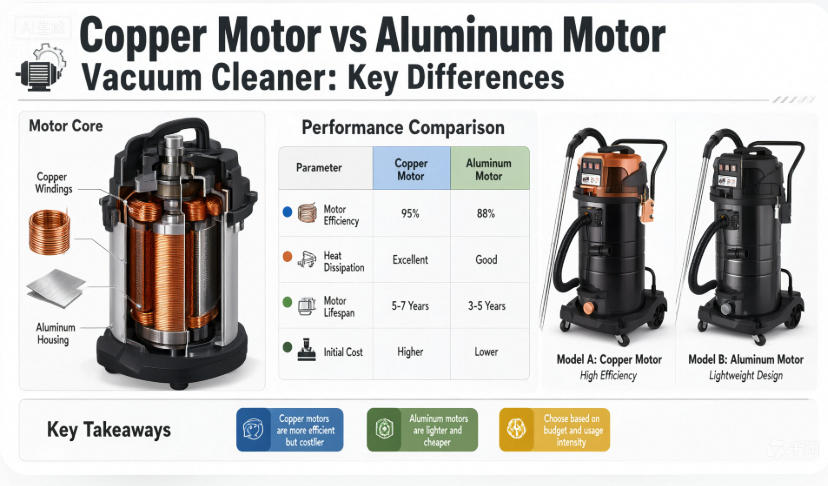
One of the most important but least discussed decisions in vacuum cleaner sourcing is the winding material inside the motor. Copper and aluminum are the two main choices. The difference affects performance, heat, lifespan, noise, energy efficiency, and total cost of ownership. For B2B buyers, understanding this difference is essential for making smart purchasing decisions.
This guide is written for B2B vacuum cleaner buyers, brand owners, procurement managers, product R&D engineers, global wholesalers, distributors, industrial equipment suppliers, and commercial cleaning contractors. It explains the key differences between copper motor vacuum cleaner and aluminum motor vacuum cleaner designs, how these differences affect commercial vacuum cleaner performance, and how to work with a vacuum cleaner manufacturer in China on OEM vacuum cleaner and private label vacuum cleaner projects.
What Is a Copper Motor vs Aluminum Motor? 🔌
In a vacuum cleaner, the motor uses winding wire to create the magnetic field that drives the fan. The winding wire can be made of copper or aluminum. Both are conductive metals, but they have very different physical properties.
Copper motor: The winding wire is made of copper. Copper has high conductivity, good heat resistance, and a high melting point .
Aluminum motor: The winding wire is made of aluminum. Aluminum is lighter and cheaper than copper, but it has higher electrical resistance and lower heat tolerance .
The choice of winding material is a cost-performance trade-off. Buyers need to understand what they are trading.
Key Difference 1: Electrical Conductivity and Efficiency ⚡
Copper has significantly higher electrical conductivity than aluminum. This is the most fundamental difference between the two materials.
At 20°C, the conductivity of copper is approximately 5.96 × 10⁷ S/m, while aluminum is approximately 3.77 × 10⁷ S/m . This means copper conducts electricity more efficiently. For the same cross-sectional area, aluminum has higher resistance and produces more heat during operation.
In a vacuum cleaner motor, higher resistance means more energy is lost as heat instead of being converted into suction power. A copper motor vacuum cleaner is generally more energy-efficient than an aluminum motor equivalent. For buyers sourcing Energy-Saving Efficient Powerful Vacuum Cleaner models, copper windings are the safer choice.
To achieve similar performance with aluminum, manufacturers often need to use thicker wire or a larger stator. This increases motor size and weight . A Fast Lightweight Vacuum Cleaner design may still use aluminum for weight savings, but the trade-off in efficiency must be accepted.
Key Difference 2: Heat Resistance and Melting Point 🔥
Heat is the enemy of motor life. Copper and aluminum behave very differently under heat.
Copper has a high melting point and excellent heat resistance. It can withstand higher operating temperatures without degrading. This is why copper motors are known for high temperature resistance and long single-operation time .
Aluminum has a lower melting point and poorer heat tolerance. Under sustained high-load operation, aluminum windings are more likely to overheat, and the motor can burn out . For heavy duty vacuum cleaner applications that run for extended periods, this is a serious risk.
For Large-Capacity Wet Dry Vacuum Cleaner models used in continuous commercial cleaning, copper motors are strongly preferred. Aluminum motors may be acceptable for light-duty or intermittent use, but they are not suitable for demanding industrial environments.
Key Difference 3: Lifespan and Durability 🛠️
The heat issue directly affects motor lifespan.
Copper motors generally have longer service life because they handle heat better and experience less thermal stress . The winding insulation lasts longer, and the risk of burnout is lower.
Aluminum motors have shorter lifespan for several reasons:
Higher resistance causes more heat, accelerating insulation degradation
Aluminum is more difficult to weld or connect reliably to copper power lines, creating weak points that can fail
Thermal cycling can cause the winding to degrade faster
For commercial grade vacuum cleaner applications where reliability matters, copper windings reduce warranty claims and field failures. For a good budget vacuum targeting occasional household use, aluminum may be acceptable, but buyers should understand the lifespan trade-off.
Key Difference 4: Noise Level 🔇
Noise is a key requirement for many commercial applications. Copper and aluminum motors can produce different noise levels.
Motor noise comes from several sources: electromagnetic vibration, mechanical vibration, and airflow. The winding material affects electromagnetic noise because aluminum has higher resistance and different magnetic properties.
Industry testing suggests that a vacuum cleaner with a pure copper winding motor may operate at around 75 dB, while an aluminum winding motor can be approximately 7 dB louder . On the logarithmic dB scale, 7 dB is a noticeable difference. For low noise vacuum cleaner requirements in hotels, hospitals, or offices, this difference matters.
A Portable Quiet Vacuum Cleaner designed for noise-sensitive environments should use copper windings, combined with sound insulation and optimized airflow, to meet strict dB targets.
Key Difference 5: Cost and Price 💰
Aluminum is significantly cheaper than copper. This is the primary reason some manufacturers use aluminum windings.
Copper is a more expensive metal, and its price is volatile. Aluminum is abundant and lower cost . For budget-focused products, aluminum motors can reduce the unit price. This is why some best budget vacuum or best affordable vacuum models use aluminum motors.
However, the purchase price is not the total cost. Aluminum motors may have higher field failure rates, shorter lifespan, and more warranty claims. For vacuum cleaner price wholesale calculations, buyers should include warranty reserve, replacement cost, and brand reputation impact. A slightly higher unit cost for a copper motor can be cheaper in the long run.
Key Difference 6: Weight and Portability 🚀
Aluminum is lighter than copper. An aluminum motor can reduce the overall weight of the vacuum cleaner, which may improve portability.
For a Fast Lightweight Vacuum Cleaner designed for quick cleaning tasks, aluminum windings can contribute to weight savings. However, the weight difference is usually small compared to the tank, housing, and battery. For most commercial applications, weight is less important than durability and performance.
A Multi-Functional Durable Vacuum Cleaner should prioritize motor reliability over minor weight savings. Copper is the better choice for durability-focused designs.
Key Difference 7: Identification and Quality Control 🔍
How can B2B buyers tell whether a motor is copper or aluminum? Visual inspection is difficult because the winding is inside the motor housing. However, there are some indicators:
Wire diameter: Aluminum wire generally needs to be thicker than copper wire to achieve the same current-carrying capacity. If the motor is designed with larger wire slots and thicker windings, it may be aluminum .
Motor size: To compensate for aluminum’s higher resistance, manufacturers may need a larger stator and thicker wire. A motor that is larger than expected for its power rating may use aluminum .
Supplier documentation: The most reliable method is to require motor specifications from the supplier, including winding material, wire gauge, and insulation class. A professional industrial vacuum cleaner supplier should provide this information.
Sample testing: Buyers should test samples under sustained load and measure temperature rise. Aluminum motors will typically run hotter than copper motors under the same conditions.
The Hidden Costs of Aluminum Motors ⚠️
B2B buyers often focus on unit price. But aluminum motors carry hidden costs:
Warranty claims: Motor burnout is a common failure mode. Aluminum motors are more susceptible to heat damage, increasing warranty claim rates.
Brand damage: A vacuum cleaner that fails early damages customer trust. For commercial cleaning equipment brands, reliability is part of the value proposition.
Certification risk: Some markets have strict safety requirements for motor temperature rise. Aluminum motors may struggle to meet these limits under continuous load.
Replacement cost: If the motor fails, the entire vacuum cleaner may be out of service. For facility management cleaning equipment, downtime is expensive.
When Aluminum Motors May Be Acceptable ✅
Aluminum motors are not always a bad choice. They can be acceptable in certain scenarios:
Light-duty household use with short operating times
Budget products where price is the primary purchase driver
Applications where weight is critical and the duty cycle is low
Markets where the product is sold at a very low price point and customers accept shorter lifespan
For a best vacuum on a budget or good budget vacuum cleaner targeting occasional use, aluminum may be a reasonable trade-off. But for commercial vacuum cleaner, wet dry vacuum cleaner, and industrial vacuum cleaner applications, copper is strongly recommended.
Case Study: How a Distributor Avoided Warranty Losses with Copper Motors ✅
A distributor in Southeast Asia sourced commercial vacuum cleaner models from a low-cost supplier. The supplier used aluminum motors to keep prices competitive. The distributor sold the units to hotels, offices, and cleaning contractors.
Within six months, warranty claims began to rise. Motors were burning out under sustained use. Hotel housekeeping teams reported that the vacuums became too hot to touch after 30 minutes of operation. Some units failed completely.
The distributor contacted Lanxstar, a vacuum cleaner manufacturer in China, for a solution. Lanxstar analyzed the failed motors and confirmed that the aluminum windings were overheating under commercial duty cycles. Lanxstar recommended replacing the motors with copper winding versions, combined with better thermal protection and a stainless steel vacuum tank for improved heat dissipation.
The results were significant:
Warranty claims dropped by more than 50%
Customer complaints about motor failure stopped
The distributor was able to position the product as a commercial grade vacuum cleaner
Repeat orders increased because customers trusted the product
This case shows why the winding material matters. It also shows why B2B buyers should work with a vacuum cleaner manufacturer in China that understands motor engineering and does not cut corners on critical components.
OEM, ODM, and Private Label Motor Options 🏷️
For brand owners and distributors, motor specification is a key part of product positioning.
OEM vacuum cleaner: An OEM partner can specify copper or aluminum windings based on your target market and price point.
ODM vacuum cleaner: An ODM partner can design the motor and cooling system from scratch, optimizing for performance, noise, and lifespan.
Private label vacuum cleaner: A private label program allows distributors to offer copper motor models under their own brand, with consistent quality and documentation.
When you import vacuum cleaner from China, ask your supplier directly: “Is the motor copper or aluminum?” A reliable vacuum cleaner manufacturer in China will answer clearly and provide specifications.
Wholesale and Bulk Purchase Tips 💰
For wholesalers and distributors, consider:
vacuum cleaner price wholesale and industrial vacuum cleaner cost
factory direct vacuum cleaner pricing
bulk vacuum cleaner purchase terms
Spare parts and warranty policy
commercial vacuum cleaner for sale support materials
For budget-focused markets, you may choose aluminum motors for entry-level products. For premium markets, copper motors support best value hoover, best value for money hoover, and commercial grade vacuum cleaner positioning.
Final Thoughts and Summary 📌
The difference between a copper motor vacuum cleaner and an aluminum motor vacuum cleaner is not just a technical detail. It affects efficiency, heat resistance, lifespan, noise, and total cost of ownership.
Copper offers better conductivity, higher heat tolerance, longer lifespan, and lower noise. Aluminum offers lower cost and lighter weight but sacrifices durability and efficiency.
For commercial vacuum cleaner, wet dry vacuum cleaner, and industrial vacuum cleaner applications, copper is the safer choice. For light-duty budget products, aluminum may be acceptable with clear disclosure and appropriate warranty terms.
In summary, B2B buyers should ask about winding material, compare total cost of ownership, and work with a professional vacuum cleaner manufacturer in China that provides transparent motor specifications. The best industrial vacuum cleaner is not the one with the lowest unit price. It is the one that keeps working year after year.
If you are interested, please feel free to contact us.
www.lxvacuum.com
50 Related Keywords:
High Suction Vacuum Cleaner, Portable Quiet Vacuum Cleaner, Multi-Functional Durable Vacuum Cleaner, Fast Lightweight Vacuum Cleaner, Energy-Saving Efficient Powerful Vacuum Cleaner, Large-Capacity Wet Dry Vacuum Cleaner, wet and dry vacuum cleaner, wet dry vacuum cleaner, industrial vacuum cleaner, commercial vacuum cleaner, industrial vacuum cleaner supplier, vacuum cleaner manufacturer, industrial cleaning equipment, commercial cleaning equipment, vacuum cleaner supplier, vacuum cleaner manufacturer in China, industrial vacuum cleaner factory, wholesale vacuum cleaner, bulk vacuum cleaner purchase, OEM vacuum cleaner, ODM vacuum cleaner, private label vacuum cleaner, cleaning equipment supplier, industrial equipment supplier, construction site cleaning equipment, warehouse cleaning solution, hotel cleaning equipment, hospital cleaning equipment, factory floor cleaning, logistics warehouse cleaning, car detailing vacuum cleaner, commercial cleaning service equipment, facility management cleaning equipment, retail cleaning equipment, HEPA filter vacuum cleaner, high suction power vacuum cleaner, heavy duty vacuum cleaner, dual motor vacuum cleaner, stainless steel vacuum tank, low noise vacuum cleaner, energy efficient vacuum cleaner, wet and dry suction system, industrial dust extractor, commercial grade vacuum cleaner, buy industrial vacuum cleaner, best industrial vacuum cleaner, vacuum cleaner price wholesale, industrial vacuum cleaner cost, vacuum cleaner supplier China, commercial vacuum cleaner for sale, bulk order vacuum cleaner, factory direct vacuum cleaner, vacuum cleaner distributor Europe, import vacuum cleaner from China, industrial wet and dry vacuum cleaner for warehouse cleaning supplier, wet dry vacuum cleaner for construction site, commercial vacuum cleaner for hotel use, heavy duty vacuum cleaner supplier China, OEM industrial vacuum cleaner manufacturer, best vacuum on a budget, best budget hoover, good budget vacuum, best affordable vacuum, best budget vacuum, best value for money hoover, best value hoover, best vacuum cleaners on a budget, best vacuums on a budget, good budget vacuum cleaner, Lanxstar, vacuum manufacturer, vacuum cleaner maker