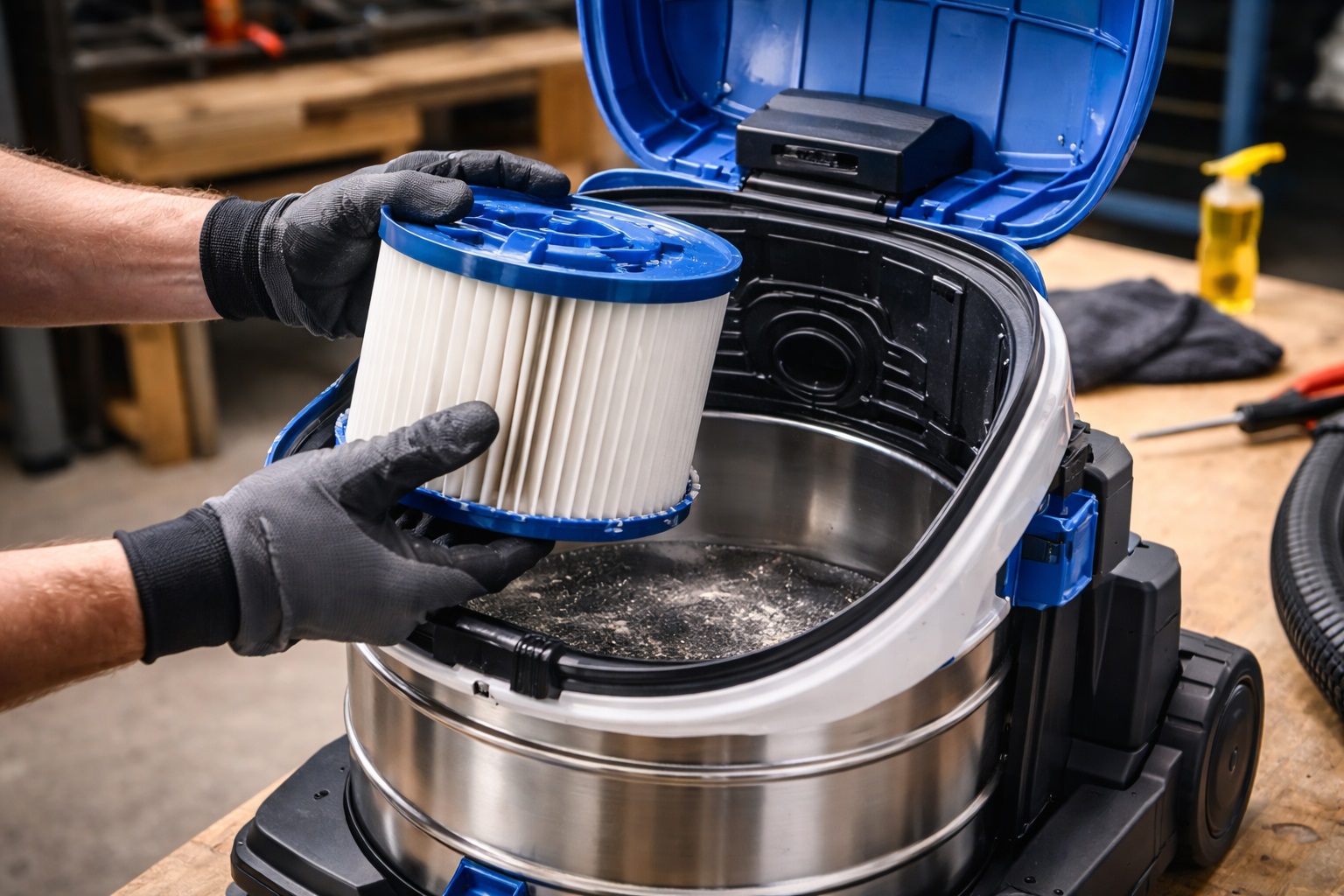
A barrel vacuum is not just a cleaning tool — in commercial environments, it is a productivity asset.
Whether used as a wet and dry vacuum cleaner in mixed-use facilities or deployed as a Multi-Functional Durable Vacuum Cleaner in industrial environments, proper maintenance directly determines:
Service lifespan
Suction stability
Energy efficiency
Operational safety
Long-term ROI
Poor maintenance can reduce service life by 30–50%.
This guide outlines essential maintenance strategies to extend equipment lifespan and reduce total cost of ownership.
🔧 ① Establish a Preventive Maintenance Schedule
Most vacuum failures are not sudden — they are gradual.
A structured maintenance cycle should include:
Daily (High-Use Facilities)
Weekly
Monthly
Inspect motor airflow
Check sealing rings
Tighten loose screws
Preventive care significantly reduces downtime.
🛢️ ② Keep the Tank & Interior Dry After Wet Use
When operating as a wet and dry vacuum cleaner, moisture management is critical.
After wet cleaning:
Empty liquid immediately
Wipe interior dry
Leave lid open for air drying
Failure to dry internal components can cause:
Odor buildup
Mold growth
Corrosion
Electrical risk
Moisture control extends structural durability.
💨 ③ Protect Motor Performance & Suction Stability
The motor is the core of any Energy-Saving Efficient Powerful Vacuum Cleaner.
To maintain stable suction:
Avoid running with clogged filters
Do not exceed recommended continuous runtime
Allow cooling intervals during heavy-duty cycles
Overheating shortens motor lifespan and reduces energy efficiency.
Clean airflow = stable suction = longer service life.
🔇 ④ Maintain Noise Control Components
If your system operates as a Quiet Vacuum Cleaner, airflow balance and insulation must be preserved.
Key checks:
Dust accumulation increases resistance and raises noise levels over time.
Regular cleaning keeps operation smooth and quiet.
🧪 ⑤ Filter Maintenance & Allergy Control
For facilities requiring high hygiene standards — especially when used as a Vacuum Cleaner for Allergies — filter condition is critical.
Best practices:
Replace HEPA filters as recommended
Avoid over-washing disposable filters
Ensure proper sealing during reinstallation
Compromised filtration reduces dust capture efficiency and may release fine particles back into the air.
Healthy filters protect both performance and indoor air quality.
🏢 ⑥ Multi-Surface Attachment Care
A Vacuum for Multi-Surface use requires frequent attachment inspection.
Check for:
Worn brushes reduce cleaning efficiency and strain the motor.
Replacing low-cost attachments prevents high-cost repairs.
🔋 ⑦ Battery & Electrical System Care (Cordless Units)
For battery-powered models:
Avoid full discharge cycles frequently
Store at moderate temperature
Use original chargers only
Lithium batteries degrade faster under extreme heat — especially in Middle Eastern climates.
Proper charging habits extend battery life by up to 20–30%.
📊 ⑧ Total Cost of Ownership (TCO) Model
Ignoring maintenance increases long-term cost.
Example comparison:
Well-maintained unit:
3-year lifespan
Minimal repair cost
Poorly maintained unit:
If replacement cost = €450
Extending lifespan by 1 year saves significant capital expenditure across multiple units.
Preventive maintenance protects investment.
🌍 Europe vs Middle East Maintenance Considerations
Europe
Frequent filter cleaning is essential.
Middle East
More frequent motor cooling inspection and seal checks recommended.
🔄 ⑨ Common Maintenance Mistakes to Avoid
❌ Overfilling tank
❌ Ignoring minor airflow reduction
❌ Running continuously without cooling
❌ Using incorrect replacement filters
❌ Storing equipment in damp areas
Small mistakes compound into major repair costs.
🔮 ⑩ Future-Ready Maintenance Strategy
As vacuum systems become more advanced, expect:
Smart clog detection alerts
Motor temperature monitoring
Maintenance reminder systems
Modular filter replacement
Adopting structured maintenance practices today ensures compatibility with future intelligent systems.
❓ FAQ
Q1: How often should filters be replaced?
Depends on usage intensity. Commercial settings may require quarterly replacement.
Q2: Does frequent wet use reduce lifespan?
Not if the tank is properly dried after each use.
Q3: Why does suction decrease over time?
Often due to clogged filters, airflow obstruction, or motor overheating.
Q4: Is professional servicing necessary?
Annual inspection is recommended for high-frequency commercial operations.
✅ Conclusion
Extending the service life of your barrel vacuum requires:
Whether operating as a wet and dry vacuum cleaner, a Multi-Functional Durable Vacuum Cleaner, or an Energy-Saving Efficient Powerful Vacuum Cleaner, consistent maintenance protects suction performance, reduces downtime, and maximizes long-term ROI.
A well-maintained vacuum is not just cleaner — it is more profitable.
📌 Suitable Readers
Commercial cleaning contractors
Facility managers
Property maintenance teams
Cleaning equipment distributors
Hospitality operators
📌 Hashtags
Lanxstar, wet and dry vacuum cleaner, Multi-Functional Durable Vacuum Cleaner, Energy-Saving Efficient Powerful Vacuum Cleaner, Quiet Vacuum Cleaner, Vacuum Cleaner for Allergies, Vacuum for Multi-Surface, commercial vacuum maintenance guide, industrial barrel vacuum care, professional cleaning equipment servicing, HEPA filter maintenance tips, battery care vacuum cleaner, durable cleaning machine, B2B vacuum distributor, Europe cleaning equipment supplier, Middle East facility maintenance tools, preventive maintenance strategy, high efficiency motor technology, commercial sanitation equipment, facility management cleaning tools