Hi, message us with any questions.
We're happy to help!





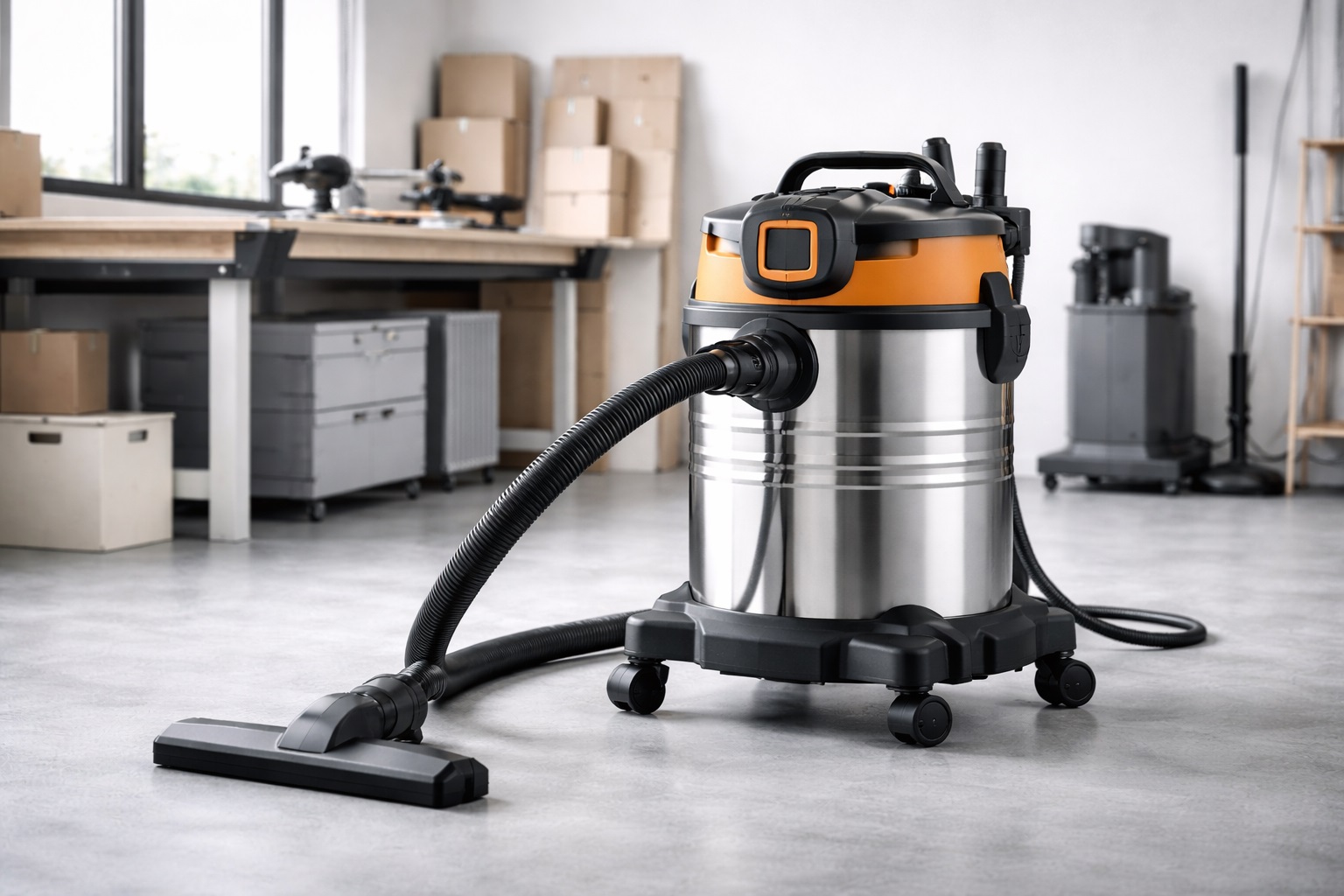
(For European & Middle Eastern Vacuum Cleaner Distributors & Industry Professionals)
🚀 When Simplicity Outperformed Complexity
In an industry often obsessed with digital features, smart sensors, and cosmetic redesigns, the barrel-style wet and dry vacuum cleaner emerged as a surprising long-term winner.
It didn’t rely on screens.
It didn’t promise AI mapping.
It didn’t chase aesthetic trends.
Instead, it optimized structure.
And that structural logic turned the barrel platform into one of the most stable foundations in both commercial and residential vacuum markets.
True innovation is not always about adding more.
Sometimes it is about removing weaknesses.
🏗 The Structural Weakness of Traditional Designs
Before barrel systems gained global recognition, upright and compact vacuums dominated.
However, they faced persistent engineering limitations:
Limited debris capacity
Higher airflow resistance
Motor overheating risk
Reduced durability under heavy-duty use
Filter clogging under wet conditions
The barrel platform solved these problems by separating:
Motor head
Debris tank
Airflow path
This separation reduced internal turbulence and improved cooling efficiency — creating a multi-functional durable vacuum cleaner capable of industrial and residential deployment.
📊 Structural Comparison: Barrel vs Upright vs Robotic Systems
| Factor | Barrel System | Upright Vacuum | Robotic Vacuum |
|---|---|---|---|
| Durability | High | Medium | Low–Medium |
| Wet Capability | Yes | Limited | No |
| Energy Efficiency | Optimizable | Moderate | Variable |
| Repair Complexity | Low | Medium | High |
| Lifecycle Length | Long | Medium | Shorter |
| Commercial Suitability | Strong | Limited | Minimal |
This structural resilience explains why barrel-style wet and dry vacuum cleaners remain dominant in workshops, warehouses, facility management, and increasingly pet-friendly homes.
⚙️ Airflow Dominance: The Real Definition of High Suction
The industry often markets wattage as power.
But a true high suction vacuum cleaner depends on:
Airflow volume (CFM)
Sealed suction pressure (kPa)
Air Watts balance
Internal air channel smoothness
Thermal management
Barrel systems naturally reduce airflow resistance due to:
Straight-line suction paths
Cylindrical tank geometry
Minimal internal bends
This design sustains negative pressure even under heavy debris load.
That is why barrel vacuums often outperform higher-watt upright models in real-world conditions.
🔋 Energy Efficiency: Quantifying the Advantage
The rise of EU energy standards forced manufacturers to rethink power consumption.
Modern barrel systems evolved into an energy-saving efficient powerful vacuum cleaner platform.
Instead of increasing wattage, manufacturers improved:
Impeller blade angle
Motor copper winding efficiency
Airflow channel optimization
Heat dissipation architecture
Energy Cost Saving Example
Assume:
Old model: 1800W
Optimized barrel model: 1200W
Usage: 2 hours/day
Electricity cost: €0.25/kWh
Annual saving per unit:
0.6kW × 2h × 365 × €0.25
≈ €109.5 per year
For 10 commercial units:
≈ €1,095 annual energy savings
Energy optimization is no longer marketing — it is measurable cost control.
🧪 HEPA Integration: From Industrial Tool to Health Device
The integration of HEPA filter vacuum cleaner systems marked a major turning point.
Originally built for construction and workshops, barrel vacuums entered:
Hospitals
Schools
Office buildings
Apartment complexes
However, HEPA efficiency depends on:
Sealed airflow system
Multi-stage filtration
Proper gasket integrity
Controlled exhaust design
Without sealing, HEPA becomes branding.
With sealing, it becomes compliance.
🐾 Pet Ownership & the Residential Expansion
Pet ownership growth across Europe changed residential vacuum expectations.
A reliable vacuum cleaner for pet hair must deliver:
Stable suction under fiber load
Anti-clogging brush systems
Allergen capture through HEPA
Consistent airflow under shedding conditions
Barrel systems adapted by:
Adding pet-specific nozzles
Improving airflow stability
Integrating sealed filtration modules
This allowed industrial DNA to move into premium household segments.
🧠 The Barrel Innovation Framework
To understand why this platform endured, consider the following model:
The Barrel Innovation Framework
1️⃣ Structural Simplicity
2️⃣ Airflow Dominance
3️⃣ Energy Optimization
4️⃣ Modular Upgrade Capability
5️⃣ Compliance Adaptability
Each layer strengthens the next.
Together, they create a platform that scales across:
Tank capacities (20L–70L)
HEPA upgrades
Energy-saving motor versions
Pet-specific attachments
Voltage adaptations (50Hz / 60Hz)
Innovation here is architectural, not decorative.
💰 Distributor Advantage: Stability Over Trend
Compared to fast-moving smart devices:
Lower firmware risk
Lower RMA exposure
Longer product lifecycle
Easier spare parts ecosystem
Better OEM adaptability
A well-positioned multi-functional durable vacuum cleaner generates:
Initial equipment sales
Filter replacement revenue
Accessory upgrades
Motor replacements
Predictability builds margin stability.
🔮 The Future of Barrel Vacuum Engineering
Future development will likely focus on:
Dual-motor industrial variants
Improved airflow simulation modeling
Enhanced allergen filtration systems
Lower-noise energy-optimized motors
Hybrid wet-dry + pet-performance platforms
But the foundational idea remains:
Simplicity engineered correctly outperforms complexity engineered poorly.
The barrel vacuum did not succeed because it looked innovative.
It succeeded because it solved structural weaknesses competitors ignored.
📌 Suitable Readers
European Vacuum Distributors
Middle Eastern Cleaning Equipment Importers
Facility Management Procurement Teams
Industrial Equipment Buyers
Vacuum Industry Entrepreneurs
📌 Hashtags
wet and dry vacuum cleaner, multi-functional durable vacuum cleaner, energy-saving efficient powerful vacuum cleaner, high suction vacuum cleaner, HEPA filter vacuum cleaner, vacuum cleaner for pet hair, industrial vacuum system, commercial cleaning equipment, stainless steel barrel vacuum, heavy duty vacuum cleaner, construction site vacuum, warehouse cleaning machine, GCC cleaning equipment supplier, European vacuum distributor, OEM vacuum cleaner manufacturer, ODM vacuum factory, B2B vacuum sourcing, professional suction equipment, facility management vacuum, hotel cleaning vacuum machine, workshop vacuum cleaner, car wash vacuum system, dust extraction vacuum cleaner, energy efficient vacuum motor, cyclone filtration vacuum system, dual motor industrial vacuum, 30L vacuum cleaner, 60L industrial vacuum machine, portable wet dry vacuum, sealed HEPA system vacuum, anti static hose vacuum cleaner, high airflow vacuum equipment, durable tank vacuum cleaner, polypropylene barrel vacuum, low noise industrial vacuum cleaner, sand resistant vacuum system, commercial suction equipment, cleaning equipment wholesaler Europe, vacuum cleaner spare parts supply, filter replacement vacuum system, motor upgrade vacuum cleaner, heavy duty suction equipment, apartment cleaning vacuum solution, renovation debris vacuum cleaner, Middle East vacuum market demand, Europe cleaning equipment industry, facility cleaning vacuum system, industrial maintenance vacuum cleaner, pet hair removal vacuum, Lanxstar