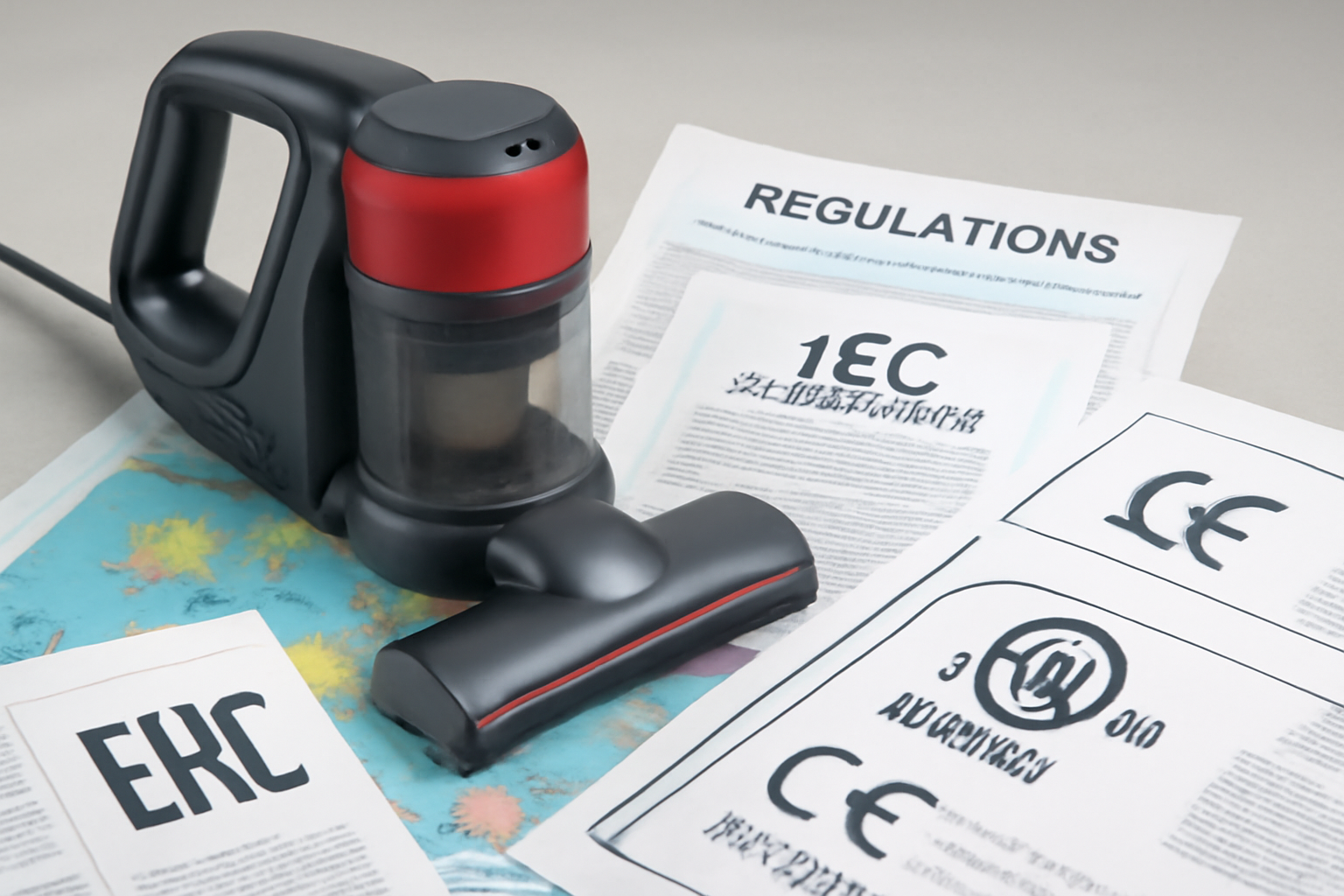
For vacuum cleaner exporters, navigating international certifications and compliance standards isn’t just a box-checking exercise—it’s a critical factor in market entry and long-term success. From electrical safety to environmental regulations, meeting global standards is often the difference between seamless expansion and costly setbacks.
1. Understanding the Global Certification Landscape
Each region has its own certification frameworks that manufacturers must comply with. In the U.S., exporters must meet UL and FCC standards; in Europe, CE and RoHS are mandatory. In many Asian and Middle Eastern markets, region-specific marks such as PSE (Japan), KC (Korea), and SASO (Saudi Arabia) apply. Misunderstanding or underestimating these requirements can result in rejected shipments, fines, or permanent bans from online platforms.
A great resource for tracking these changes is the International Trade Administration, which regularly updates guidance for U.S. exporters on certification compliance by country.
2. Documenting and Testing the Right Way
Regulatory bodies often demand rigorous documentation: test reports, declarations of conformity, technical files, and in some cases, product labeling in local languages. These must align with the latest testing protocols. For instance, exporting a vacuum cleaner with multi-function features to the EU would require EMC testing, energy efficiency labeling, and material safety compliance.
Working with global certification labs—such as SGS or Intertek—helps ensure that your vacuum cleaner is tested under the right standard in the right market context. These institutions can also assist with pre-certification audits and gap assessments.
3. Aligning Product Features with Regulation
A growing number of countries are setting performance and sustainability thresholds. Exporters must not only comply with base electrical standards but also demonstrate that the product is energy-efficient and environmentally safe. One way to meet these requirements is by developing vacuum cleaners that align with future-forward performance indicators.
Imagine an export-ready model designed to deliver high suction for powerful cleaning, crafted in a portable build for convenience, and engineered to operate quietly in both residential and commercial settings. It includes a self-cleaning feature for hygiene, functions across multiple surfaces, and is built with durable, long-lasting components. The machine operates at high speed without sacrificing control, is lightweight for global shipping efficiency, energy-saving by design, and offers optimized airflow for greater efficiency. It is robust, capable, and comes equipped with a large-capacity tank suitable for both wet and dry usage. In short, it is a high-suction and portable, yet quiet and self-cleaning, multi-functional and durable, fast-operating and lightweight, energy-saving and efficient, powerful with large-capacity wet and dry vacuum cleaner.
Certifications and regulations shouldn’t be viewed as hurdles—they are opportunities to prove your product’s quality on a global stage. With careful planning and the right partners, exporters can navigate compliance with confidence and position their brand as a trusted name in international markets. For more global insights and solutions, visit www.lxvacuum.com.